Helen Buckingham’s Wafer

church bells versus
the ice cream van
a wafer each way

© Helen Buckingham (UK)
(Presence, 54, 2016)

The image at first reading draws an amused smile, thinking of this van whose call is contrasted by church bells and which at the bottom presents its ice creams in wafers similar to the host. But, a reflection immediately arises. The ice cream van is so earthly, a bearer of carnal pleasure, compared to the bells that for centuries have been calling for moments of spirituality. It is, therefore, to be thought that the van is practically reduced to silence. It makes one think of the Middle Ages, of the centuries in which every frivolous pleasure was branded as a mirror of evil… and, in the present moment, to the heavy hand that every religion continues to have, openly or more subtly, towards its believers. This poem leaves a lot of food for thought, that delves deep into reality, and keeps a sense of lightness, which is the merit of a successful haiku.

Margherita Petriccione (Italy)

As I perceive this, there is an element of conflict between divine duty and human desires. The haijin is trying to keep both in balance but keeps humor alive. There are irony and humor in this and I feel this haiku has the Japanese aesthetic of karumi.

Pragya Vishnoi (India)

I can see both the materialistic and spiritual sides of life in this beautiful haiku.

Church bells are a call for prayer to gather the blessings of life and also indicate the awakening of the inner self by focusing on spiritual energy. This aspect takes us closer to the self that we usually ignore due to different activities of life. The bells repeatedly toll to remind us to take a break from worldly chaos and the fast pace of life. On the other hand, we always rush to complete our daily activities and to-do lists so that we can find ways to stay in competition or do work well.

The ice cream van indicates our cravings that build up from different flavours and tastes of life which pull us towards them. But, they melt down fast like ice cream and we strive for the next flavor or taste of life. This endless cycle goes on, where we share mixed feelings and collect precious memories as well.

The word ‘versus’ in the first line shows that we are oscillating between two ends, one that leads us deep inside–a sort of spiritual journey. The other one is worldly desires that pull us daily to enjoy the bounties and blessings of life that surround us. In both ways, there is a wafer that may come as blessings, happiness, joys, or self-fulfillment only if we keep a balance between both ends, which can bring harmony in our lives and give us real satisfaction in life. I love the simplicity and choice of words in this haiku that metaphorically hide the image of the entirety of life and give us a lesson about enjoying every aspect of life by keeping balance.

Hifsa Ashraf (Pakistan)

A lot is going on here. While an ice cream van can represent the season of summer as a kigo, to me this reads more of a senryu than a haiku.

I like the clash between the sound of church bells and the notorious melody an ice cream van makes at the same time.

I can picture people outside the church being tempted by a passing ice cream truck perhaps because of the outdoor heat while struggling to make it to church on time because that’s the purpose of church bells, which is to gather people of faith together, while an ice cream van gathers people for profit.

The struggle between what’s holy and the worldly is strong in this senryu. What makes it strong to me is the power of God over something trivial as ice cream or vice versa if you’re an atheist.

Then, the poet adds on the last line “a wafer each way” which makes me, the reader, wonder if it is a communion wafer or an ice cream wafer? Perhaps a person who’s taking a communion wafer is thinking of ice cream at the same time or it could be the other way around.

This poem is a great example of ‘show, don’t tell’ through sensory images. Mixing the images lets the reader visualize or interpret what is happening when two things happen at once.

Fractled (USA)

I enjoy the comedic nature of this haiku/senryu. “a wafer each way” instantly makes me chuckle. However, there is a deeper layer behind the comedy. The temptation of eating ice cream, something earthly, is summoned by the ice cream van’s music, while the church bells bring out a sense of faith and duty in us. This mix causes a person to choose between what is most important to him or her. In a way, life is about making choices, and those choices determine who we are.

I like the sound of “van” and “versus,” “wafer” and “way,” “church” and “cream.” It brings out the playful sense in which this poem was written. The lack of punctuation and the pacing of the poem also suggest that it leans more towards a senryu.

An enjoyably deep senryu.

Nicholas Klacsanzky (USA)

Did you enjoy this poem and the commentary? Let us know in the comments.
OLYMPUS DIGITAL CAMERA
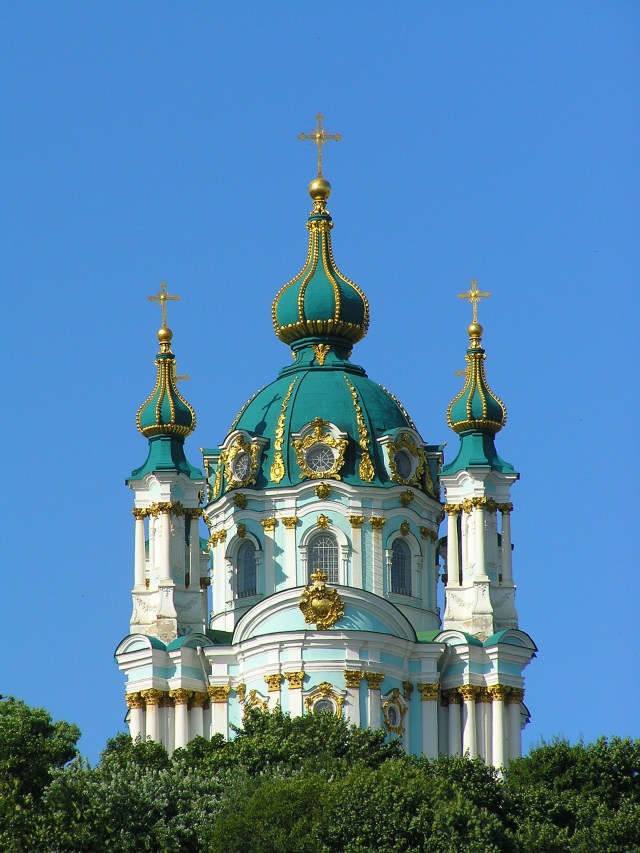
– Saint Andrey’s Church in Kyiv, Ukraine
Carl Mayfield’s Puddle

the puddle
brimming with sky
alone at dusk

© Carl Mayfield
(published in Modern Haiku 43.3 Autumn 2012 and High Desert Cameos by Carl Mayfield)

The opening line of this haiku shows the stark part of life that one faces after rainy days. The puddle reflects the deep reality of life that brings loneliness after those rainy days, mirroring the personal deeds or mistakes that take a person to the stage where they feel alone and helpless.

I love the way the poet used juxtaposition to connect both Earth and sky. The sky could be dreams, wishes, longing, and even hope that keeps on coming to the person who has lost everything and he or she relies on them. The sky also shows openness and meditative thoughts that give clarity to the person by brimming or supporting his or her reflection in the puddle. It may also give a sense of realization that a person has when alone at dusk. The dusk comes with various colourful shades of life that may be positive or negative. A person who relies on their fate can finally get a nature-giving helping hand, especially at dusk when all feelings and thoughts converged in certain beliefs and prayers.

The earth and sky are well connected in this haiku by a sky that provides a platform where a person can revisit his or her thoughts and analyze them at dusk, when there is complete silence all around that provides an ideal time to think over about what’s next in life after losing everything.

Hifsa Ashraf (Pakistan)

This haiku is quite interesting. The images captured my mind. Whether it’s a late sun shower or a cloud-filled sky, the poet, in my opinion, left enough space for me to resonate with.

The last line further adds more interpretations of what or who is alone. Is it the puddle or someone observing it? Such openings for the reader to think about and envision to me makes a wonderful haiku.

Note* The word “dusk” is considered a micro kigo which is a moment within 24 hours.

Fractled (USA)

The small containing the vast. The vast reduced to the small. The power of focus and contentment in being solitary. I think these are the main themes of this haiku.

The last line, however, is a mystery. We don’t know if the line is referring to the puddle or the author, or perhaps a person in view. This uncertainty only adds strength to the poem.

The structure is also interesting. It can be read as one part or it having a break after line two. If it is read in one go, you can even say the last line is talking about the sky being alone at dusk. So, a seemingly simple haiku can derive many interpretations based on its format and pacing.

The sound makes this haiku balanced sonically. The “l” and “d” sounds give it a good mix of soft and hard sounds.

My only qualm with the haiku is that though it is highly effective and meditative, it is not so unique. However, with its original format, I think it makes up for this.

Nicholas Klacsanzky (USA)

Did you enjoy this poem and commentary? Please let us know in the comments.

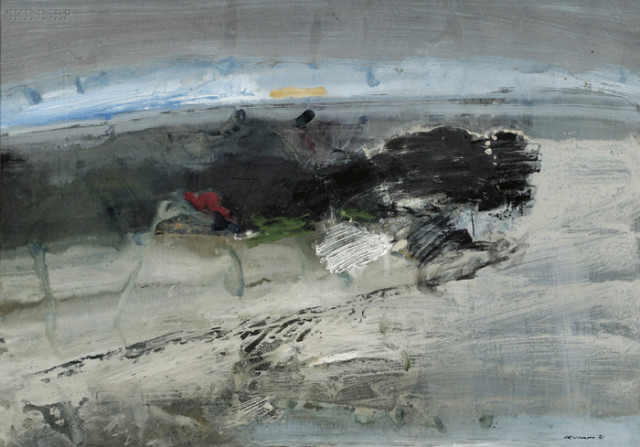
arthur-okamura-japaneseamerican-1932-2009-ocean-borderings

– Ocean Borderings by Arthur Okamura (1932-2009)

Susan King’s Riverside Rock

resting
the deep down cool
of a riverside rock

© Susan King (UK)

(Previously published in Lacewings, 2010)

A poem that, despite the modern form in which it is presented, recalls classic haiku in its atmosphere and content … The first that comes to mind is a famous haiku by Issa:

“our house”
already in these words,
freshness

In King’s haiku, as in Issa’s, freshness and rest interpenetrate, meaning freshness reveals what suffocates the soul even more than the body. Here, the freshness is at its best: the coolness of the rock made even icier by the waters of the river and is accentuated by the fluid sounds of words.

But a rock on a river also awakens in me the image of someone motionless, meditating on the shore, wrapped in the freshness of nature, purified and new in his or her mind … It is really “resting” read as a verbal form that strengthens me in this opinion.

The last image involves me to the point that, immersed in reading, I think of nothing else. I feel a great freshness inside me and an even greater lightness. Chapeau!

Margherita Petriccione (Italy)

This haiku has a good use of visual space but to me the use of sound through vowels (“i” and “o”) reads well out loud which is an important technique in haiku and poetry in general.

The word “cool” is a seasonal word in a Japanese saijiki that refers to summer.

While there seems to be an emphasis on “riverside rock” because of the adjectives “deep down,” it can also read as a noun “the deep.” This makes this haiku quite interesting depending on how a reader reads it.

While there are many breaks in this haiku, it can be also be read as a phrase in one breath. It’s more apparent as a monoku:

resting the deep down cool of a riverside rock

…as opposed to a concrete fragment on line one followed by a phrase that is typically used in haiku, which commonly starts with a noun and not a gerund.

But in three lines as the reader, “resting” does intrigue me for an opening line in combination with the following two lines (phrase), which forces me to wonder and conjure my own images of what’s resting. While some might see this as a shashei (sketch of life) haiku, it also isn’t because of the thinking room that does not state the obvious—but that’s up for the reader to decide on this well-crafted haiku.

Fractled (USA)

This haiku gives a continuity of deep thoughts about a person who is in search of eternal peace. The starting line ‘resting’ reveals both physical and mental states of a person who really wants to get some rest. It is not simply rest that she is referring to, though. It is the state of mind of seeking for serenity and calmness.

“riverside rock” is beautifully used in this profound poem, where it reflects the metaphysical side of the elements of nature. The riverside rock remains wet and cool all the time because the flowing water of the river constantly strikes it and keeps it cold. It seems the poet has kept her head on the riverside rock, which gives her an intuition about the inner peace she felt through the first touch of the riverside rock.

Metaphorically, our head is more like a riverside rock that needs a constant flow of thoughts like river water, which keeps us calm, positive, and peaceful. It is all about absorbing those thoughts to the core so that we can experience the serenity of deeply rooted positive energy and actually feel relaxed.

Hifsa Ashraf (Pakistan)

I think starting with just “resting” allows us as readers to relax. That kind of pause is necessary in our lives.

The second line soothes even further with “deep down cool.” King conveys with sound how cool the rock is. I also enjoy how we can read it as the rock resting or the cool itself resting. Coolness chilling out multiplies the effect of serenity, which is a hallmark of haiku.

The focus and simplicity of this haiku are admirable. It soothes us and brings us into a semi-mystic state by reading it. A lovely composition by King that employs that right pace, wording, and sound to bring us into meditation.

Nicholas Klacsanzky (USA)

Did you enjoy this haiku and the commentary? Let us know in the comments below.

img004.jpg

– Art by Godai Katsunaga