
riverlight
the sewing pins
of rainfall
– Alan Summers (UK)
Modern Haiku volume 48.3 Autumn 2017
Commenting on a master’s haiku is always a gamble, but fundamentally … fortuna adiuvat audaces. At first, I wondered what the light of the river was: the brightness of the river’s surface or the lights on its shore … then I realized that it didn’t really matter and that I didn’t have to rationalize too much. The image that reaches me is immediate: dark, a light that reflects on the river and on falling raindrops. The raindrops, if illuminated by an intense light in the dark, can highlight and hypnotically catalyze the eye. Enlightenment that reveals what would otherwise escape us. And here, they are clearly evident: these thin needles that sew the river with the sky, the darkness with darkness, in a single landscape.
This haiku, masterfully expressed in a few words, has enchanted someone like me who loves brevity very much. I also enjoy its harmonious fluidity, which cleverly breaks into a stark tone only in the second line. It harmonizes well with an Italian who is accustomed to the harmonious sounds of their own language. Chapeau.
– Margherita Petriccione (Italy)
This is a very visual haiku where I can immediately see a scene of a night of rain ripples but one might ask how can there be light at night if it’s raining? To answer that, another immediate scene came to my mind, which was an urban or suburban area lit by city lights around the river. Manhattan or the other side Brooklyn is a perfect atmosphere for this haiku. This haiku also conjures images of rain needles during the day too.
Another question to ask is why would someone be in the rain to view such a sight? Perhaps an unexpected downpour occurred while someone was by the river or was inside a boat/ferry to capture this moment. There’s a lot going on in this seven-word haiku.
Although this haiku can be seen as a shasei “sketch of life” poem, one can note the juxtaposition between the fragment (riverlight) and the phrase (rain) and the space the reader has to fill in to see the ripples without it being told. Ex. If this haiku was written as:
riverlight
the sewing pins
of rainfall ripples
That to me would be too telling and boring and would definitely classify as shasei.
Another interesting thing about this haiku is that riverlight on the spellchecker sees it as a typo. I’m not sure if it was intended or not and I could not find a direct definition of the word but found that’s it’s a name of a property in London. Perhaps leaving the word not in caps made it personal to the author yet open to the reader. Either way, it doesn’t hurt the essence of this haiku, which to me is quite masterfully written.
– Fractled (USA)
Riverlight, with its great mystery, is used as the starting note of this beautiful orchestral haiku, where the subtlety of life lies in the light that makes no difference to the flowing water but to the falling rain. It’s a deep expression of having everything but still nothing in life. The riverlight may be soft, subtle, mysterious, and vague for the rhythmic movement of water but it has a great impact on the things that are intangible.
Sewing pins not only help in setting clothes but also fixing mending issues by providing adherence. The analogy of sewing pins with rainfall makes this haiku poignant and profound. Again, the riverlight gives a great colour to the rain but metaphorically doesn’t change the vagueness and purposeless life of it.
In life, we may experience a lot of things that look different when uncovered or unveiled by rational thinking. We may find them piercing our life and wish to not face them or encounter them again. Glimpses of adversity in life may be painful but it brings ease with them.
The synthesis of sight, touch, and feel in this haiku makes it more profound and mystical in nature, where the light turns rain into painful experiences or trials of life that eventually lead to eternal peace.
– Hifsa Ashraf (Pakistan)
One of the great qualities of Alan’s work is that it is always unique and often imaginative/abstract. However, this imagination is grounded in the perception of reality. “riverlight” is a good example of this. The invented word in the first line and the image of rainfall being like sewing pins can be easily understood. In some instances, rain does appear to be sharp and could be mistaken for sewing pins.
Though sewing pins can be seen as something sharp, they can also be perceived as something that mends the broken. This may be why “riverlight” is used: the rain has merged the river and sunlight/moonlight. Also, Alan might be saying that riverlight is akin to the magic of rain appearing as sewing pins.
In terms of sound, the “i” jumps out in almost every word in this haiku. They are in the shape of sharp rain and even have a sonic comparison to them. I also like the format, with the second line setting up a surprise in the third line.
Overall, I believe this poem is unique, fascinating, and economically written.
– Nicholas Klacsanzky (USA)
Did you enjoy the haiku and commentary? If so, please leave us a comment.
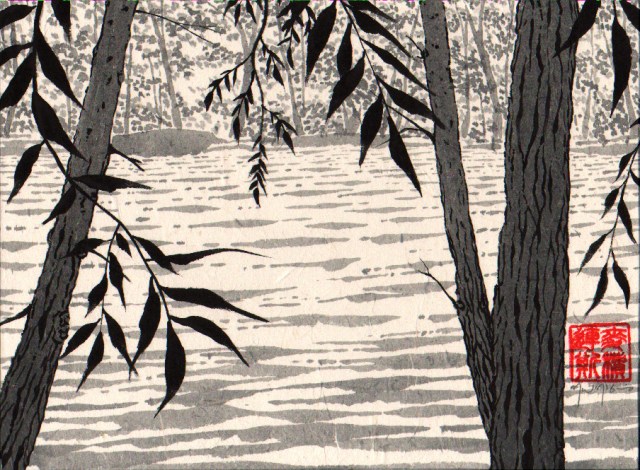
– Sumi-e painting by Mark W. McGinnis
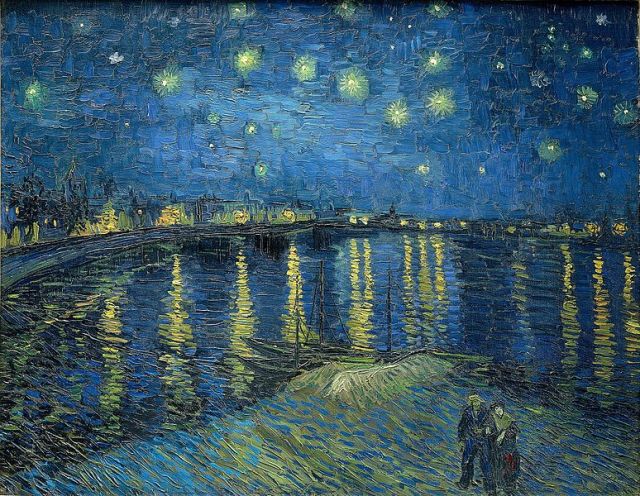 – Painting by Vincent van Gogh
 Haiku Commentary