H. F. Noyes’ Morning Stroll

morning stroll–
unshared thoughts float off
with the withered leaves

(The Heron’s Nest, Volume II, Number 10: October, 2000 – Heron´s Nest Award)

© H. F. Noyes (1918 – 2010) (USA)

I have a soft spot for the word “stroll.” It seems perfect for haiku and the leisurely way we write in this genre. Morning strolls are usually done on the weekend, when we have rested well and are relaxed.

However, with “unshared thoughts,” we get a look into the psychological condition of the poet. It implies, in a way, that the poet has thoughts he would either not want to share, or deems not important enough to communicate. Or, it could be that the poet simply did not share them, without any preconceived notion.

When I read “float off,” I resonated with it, in that I often have something similar happen. A thought comes, and soon appears to drift away. Thoughts sometimes are like satellite signals, beeping in and out of existence.

This state where thoughts are more loose can be entered when viewing nature. Seeing nature in its splendor and grandeur can often still our minds. In this instance, the poet connects his thoughts with the withering leaves that are also floating away. “withered leaves” refers to autumn, and this link may imply that the poet believes his thoughts are as useful or important as autumn leaves. The beauty of autumn is not captured here, but rather its deterioration. Additionally, maybe he is inferring that unless and until we share our thoughts, they are as substantial as withered leaves.

In terms of its technical aspects, the punctuation, sound, and layout can be considered. I think the ellipsis is fine as a way to make the reader pause and imagine a morning stroll, but it seems an ellipsis would have been more suitable to fit the mood and action of floating.  When looking at the sound of the haiku, we can notice the usage of “o” sounds to slow down our reading, reflecting the sense of a stroll. The “r”s also keep the pace of the poem leisurely. Speaking of the layout, we have a typical structure for English-language haiku, with a short first line, a longer second line, and a third line.

I like how casual the first line is, and how it is contrasted by the evocative last two lines. A striking haiku in its simplicity and imagery.

Nicholas Klacsanzky (Ukraine)

This haiku is either about yearning for certain dreams, or things that bother one the most. The opening line indicates that the person seeks solitude that this autumn morning provides fully. But, certain unshared thoughts still annoy in a way, as there is no one to share them with. It shows the introverted personality of a person who tries to live in solitude, and still enjoys it the most.

Withered leaves in this context symbolises death/ irrelevant thoughts that are still unshared and a mystery. I can also see an element of meditation here, as a morning stroll and withered leaves indicate the deep silence of autumn, departure, solitude, and hibernation. So, the person finds it the best ambiance for pondering deeply and filtering those unshared thoughts—eventually, finding those thoughts more like withered leaves: irrational. Mindfulness is the key here, where the poet cleverly related his ongoing thoughts with the season and finally achieved his goal: inner peace and serenity.

Hifsa Ashraf (Pakistan)

Did you enjoy the poem and commentary? If so, leave us a comment below. 
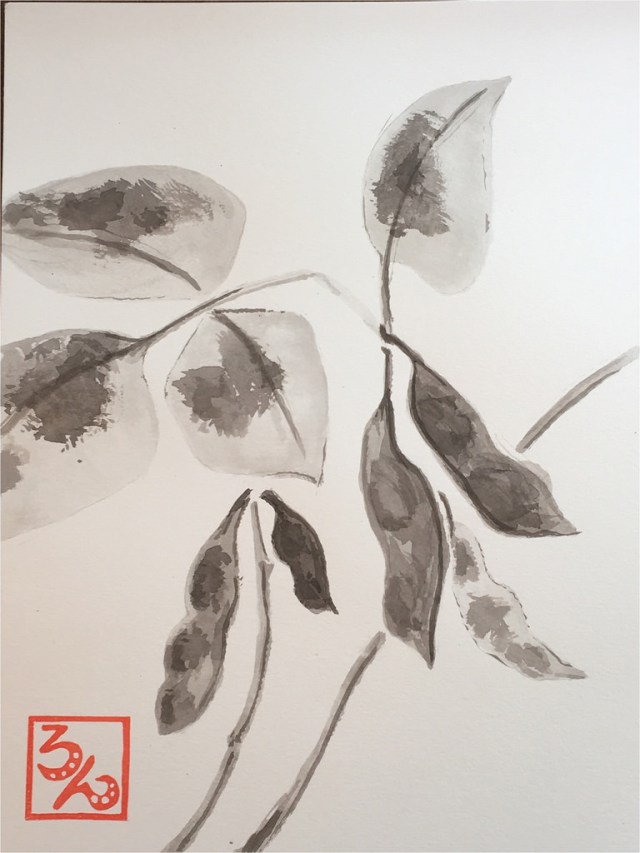
35064618046_6fd40e8fd2_b

– Ron Frazier

Stefano d’Andrea’s Word

golden grapes —
if only each word
were so sweet

Ephemerae, volume 1, 2018

© Stefano d’Andrea (Italy)

The protagonist in this haiku probably refers to the type of sweet, small tomato known as “golden grapes.” They are loved as snacks in the summer and spring. The poet is from Italy, and I can imagine these in salads, and various other dishes.

Possibly, while eating one of these delicious tomatoes, the poet had a yearning for our words to be just as sweet. Maybe, recently he was engaged in an argument with friends or loved ones, or he saw the banter of politics in the news. Either way, it is a contemplation on the almost-perfection of nature, with each golden grape being consistently pleasing to the taste in the right season. In a way, it recalls a sense of innocence, when we see the world in a more simple and magical way. It could also be an introspection for us to think about what we can change in our behavior, especially in our current political climate.

Getting into the technical stuff like punctuation, layout, and sound, I like the pause given with the em dash in the first line. It gives reader’s time to imagine the golden grapes. In terms of the layout, we have a standard English-language format of a short first line, a longer second line, and a short last line. The pacing of the lines are natural and it reads easily. When looking at the sounds, one cannot skip over the multiple usage of “o.” It is reflective of the shape of the golden grapes. The haiku becomes musical with the repetition of “g” in the first line, and “s” in the third line.

A charming haiku that makes us introspect about human behavior and its relation to nature.

Nicholas Klacsanzky (Ukraine)

Grapes are golden when it’s the beginning of autumn, after the fructose in them has increased at the height of the summer sun’s exposure.

When the poet says “if only each word were so sweet,” it suggests that maybe somebody has talked in a not-so-kind way to him… There is a sort of subtle sorrow, in which the sadness of a farewell can be perceived… golden grapes, golden times, golden words… Gold has always dealt with the divine, and indeed a divine dimension can be experienced through a sweet dialogue, maybe with a missed love… a regret? A loss? A grief?

Mead, the most ancient alcoholic drink men started to produce, or the nectar of the Gods, is also made from a golden and sweet substance: honey. It was cherished by the Egyptians and ancient Aegean Sea cultures, and something divine is findable in that attribute of grapes too. So, grapes are golden when ready for harvest, ready for making first the must, then to become wine. “In vino veritas” is a Latin phrase that means “in wine there’s the truth.” The poet, an Italian, is probably fond of this extraordinary drink, and maybe he is a sommelier and vine grower. In the haiku, he seems to recall wine and its properties… Maybe words should be always full of truth and sweetness before being pronounced… And probably words should be always chosen after having reached a gentle state of mind before being written or told, especially in a poetic path such as the writer’s.

Anyways, words have a very deep and magical power, and we should prefer silence, which is also golden if words cannot be as golden as Stefano’s grapes in his poem….

A haiku that leads the reader from the sensual dimension (visual, taste) to the comprehension and acceptance of human imperfections through the divine beauty of nature….

Well done,  d’Andrea!

Lucia Fontana (Italy)

Did you like this haiku and commentary? If so, please leave us a comment.

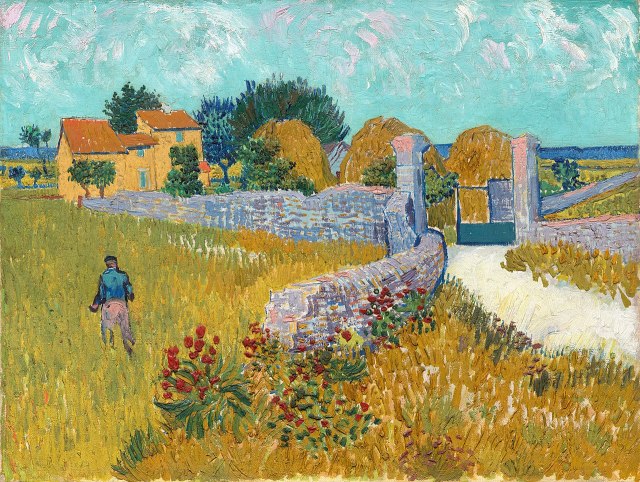
1280px-Farmhouse_in_Provence,_1888,_Vincent_van_Gogh,_NGA

– Vincent van Gogh

H. Gene Murtha’s Dawn

dawn
caught in a dew drop —
the empty swing

(The Heron’s Nest vol. 5 #2, 2005)

© H. Gene Murtha (1955 – 2015) (USA)

Every year, the H. Gene Murtha Senryu Contest is held by Michael Rehling (Failed Haiku journal) and Steve Hodge (Prune Juice journal). It was initiated to honor the influential American poet and naturalist, who was a tanka editor of the journal Notes from the Gean, a haiku contest judge, and included in the landmark collection Haiku in English: The First Hundred Years. Read more about Gene at The Living Haiku Anthology and from his collection of selected poems, Biding Time.

Commentary from Michael Rehling and Steve Hodge

Dawn is a time of potential and hope for most of us. Waking up we have a chance to look forward. But the poet has the image of an empty swing in his eye and his mind. Sometimes a dewdrop is just a dewdrop but you can’t fit a swing set into a dewdrop. Although you can if the dewdrop is not really a dewdrop but a tear you are looking through. Gene struggled with ‘loss’ his whole life. He lost a child to a stillbirth and it haunted him. Here, I believe, is the poet looking out at a new day not with hope and anticipation but with a crushing vacant view of the lost potential of a missing child. We all prepare for the birth of a child so the empty swing is not out of the ordinary and glimpsing it created the ‘dewdrop’ in his eye.

I knew Gene and he could be irascible and course, but he never once failed to be able to recover himself and get in touch with his better angels in the end. In this poem he returns from bitter grief to capture a moment of unique tenderness and put it into this fine poem. That, for those of you did not know Gene, is why his poems still touch us so deeply. I am writing this through a dewdrop right this moment…

Michael Rehling (USA)

I remember the first time I read this poem. I was struck by the beautiful image that the first two lines brought to my mind; light from a warm golden dawn sparkling in a clear crystalline drop of dew. I remember getting a chill when I read the third line. The empty chair has been a common metaphor for a recently deceased loved one in English language folk songs from Europe and the U.S. for centuries. As sad as I’ve always found the empty chair to be in those songs, the empty swing suggests something far more heartbreaking; the death of a child. I only knew Gene through online encounters with him and wasn’t aware of the details of his personal life. It wasn’t until I read the following poem by him that I understood the ‘the empty swing.’

spring mist —
a mallard paddles
through our stillborn’s ashes

‘The empty swing’ is an extraordinary poem; a beautiful image juxtaposed against tragic loss. I mentioned to Gene how deeply this poem moved me when we were later in an online conversation. I had the feeling that the experience which inspired the poem was something he didn’t care to discuss. Who could blame him? Never having lost a child, I can’t begin to imagine what it must be like. But ‘the empty swing’ is a beautiful tribute to the child he lost and a beautiful gift to the world of haiku.

Steve Hodge (USA)

Commentary from Our Community

There is something very sad about this haiku. It resonates with something in me, a deep loneliness rooted in the past, in childhood — indicated by the swing. I think it is a deeply sad memory, the whole light of the new day — imagined future perhaps — encapsulated in this one dewdrop, on or near the empty swing. Perhaps there were previous happy times spent on the swing with someone dear, expectations of a happy future that disappeared like that drop of dew? It just makes me want to cry.

Martha Magenta (UK)

This is quite a deep haiku that reflects elements of sadness, stillness, loneliness, and flashbacks. The opening line, ‘dawn’, gives a sense of hope, renewal, energy, and awakening. In this case, it awakens childhood memories, and loneliness as well.
Morning dew drops symbolise here the tears of grief, sadness, and mishaps that have happened in the past of someone’s life. I can also see the misery of that dawn (day) whose image/reflection is encapsulated in a tiny dew drop, which means certain long-lasting memories that haunts every morning, maybe as a result of nightmares of traumatic events.

There is a catch in the last line, as I was thinking about a particular type of swing— maybe a tyre swing in this case where one can see a lot of dew drops settle down in the tyre. But, the stillness of empty swings shows no life, no activity, and no wind to give a chance for the dew drops to stay longer than usual. Besides the structure of swing, this part also shows lingering memories that are not oscillating anymore—maybe a kind of fixation.

Overall, the haiku reflects traumatic events in one’s childhood that haunts an individual every morning, waking to sadness, grief, and stillness.

The letter ‘w’ is prominent in the three lines, which reflects the wavelength of echoes or flashbacks of childhood.

Hifsa Ashraf (Pakistan)

I feel this poem has a mixture of sadness and hope. The first two lines seem like a revelation of the immensity of the universe, beauty, the interconnectedness between small and large, and more. The last line, however, changes our attitude towards this poem. The first part explores a sense a fullness, and the second part describes a scene of emptiness. To me, I feel the poet is saying in indirect terms: “This is how life is: vast and yet vacant.” With the haiku ending on the note of emptiness, I believe Gene is stressing this element of life over fullness. This poem is a fine example of how a poet can convey deep emotions in a few words through implication.

Besides the words themselves, the sound, punctuation, and layout create a sense of loss. The repetition of “d” sounds bring about an atmosphere of seriousness. The accents of “t” and “w” sounds make the poem more stark, in my opinion. With the use of the ellipsis, the contemplative tone is added upon. I feel, as well, that having “dawn” stand on its own in the first line provides a sense of gravity.

A poem written with precision, understatement, and feeling, we cannot help but connect to what the poet experienced.

Nicholas Klacsanzky (Ukraine)

Did you enjoy this haiku and commentary? Let us know in the comments section.

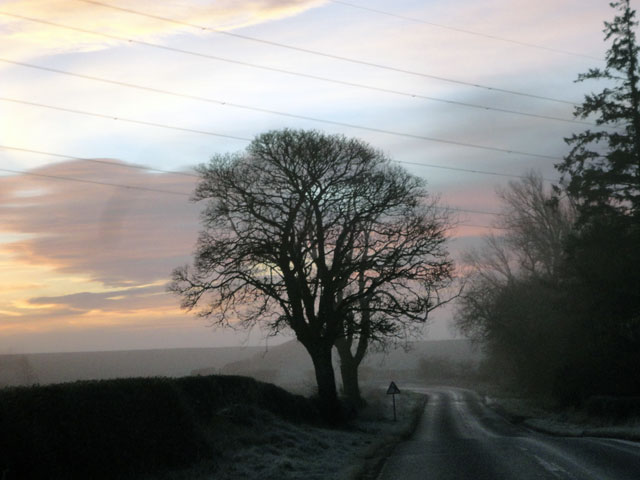
Fog-at-dawn