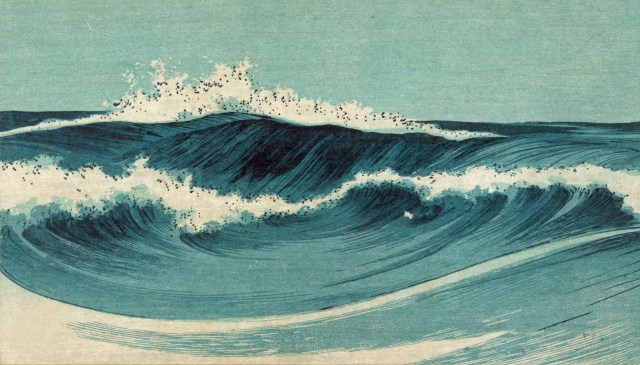
Rachel Sutcliffe’s Hollow Winds

hollow winds
my thoughts turn
to firewood

© Rachel Sutcliffe (UK)

Usually, metaphors are not common in haiku, but I enjoy them the most, especially if they are well composed. This haiku reminds me of the phenomenon of action and reaction. Hollow winds reflect the cruelty, rudeness, and impoliteness that is against nature, but not against our nature. We have a lot of delusions, misconceptions, illusions, and assumptions that finally become demons without having any real existence. Paranoid thoughts take us to a level where we not only destroy ourselves, but also those around us. So, these hollow winds make us more like a slave to follow our destructive thinking more than constructive ones.

I can see a kind of submission of the self to those hollow winds—and when this happens, thoughts may turn to firewood: dry, fragile, broken, weak, and easily become ashes. So, two extremes are connected with thoughts here. The thought of nothingness that leads to nothing but nothingness :) Hollowness on one end, and ashes on the other end.

I can also see a lack of rational and critical thinking that acts like a sift to filter these thoughts. Additionally, I sense an expression of the lack of mindfulness that helps us to stay in the current moment and understand our thoughts in a better way. I can also see a negligence of emotional intelligence that helps us manage our emotions in the best way.

The letter ‘o’ in this haiku is quite significant, as it represents the vicious cycle of thoughts that continuously keep us engaged in the same pattern of life that is not real. The ‘o’ also represent the rhythm of ‘hoo’ (Sufism) that is much needed here to release the negative energies for the attainment of inner peace.

Hifsa Ashraf (Pakistan)

“Hollow winds” is an exceptional image and also a troublesome one. I think of the wind as a lathe that hollows out wood. A lathe turns a chunk of wood into something—a useful object like a bowl or into a piece of art. Certainly firewood is useful. One also thinks of “turning” wood on a lathe. In this haiku, the wind turns the thoughts to firewood, and hence the coming cold. The wind hollows out the warmth to bring on the cold of fall. “Hollow” suggests “howl,” and howling winds suggest fall’s chill. The word “hollow” makes all the difference in this poem.

Jim Krotzman (USA)

I quite agree that when we say “hollow winds,” we equate that with the “howling and bitter cold” kind of wind. The author then proceeded with thoughts of firewood, which to me is a natural association to the bitter cold of wind, because firewood creates fire that in turn creates heat to neutralize the effects of the former.

The moment also brings to mind the feeling of coldness brought about by being alone, and perhaps by being lonely, although the idea of aloneness could be construed in a different light. Here, the author tries to “feel comfortable” despite the odds of her physical world.

Willie Bongcaron (Philippines)

I guess everybody knows about da Vinci’s Vitruvian Man. Leonardo wanted to show how a human being can be harmoniously unscripted into two perfect figures: the cycle of the sky, which represents divine perfection, as well as the square, which symbolizes the earth.

This poem evokes in my mind the cycle of the sky (winds), the human being (thoughts) and earth (firewood). Through the fire that purifies all the material and immaterial processes on Earth, the metamorphosis ends with ashes, again in the wind—so in the sky. This is a never ending enso (a Zen term for “circle”).

I imagine the author’s thoughts burning as a wood fire, in a sacred cleansing flame: ideas can be good or bad, creating issues. Anyway, these ideas can control a person.

But thoughts can heal and warm our impermanent passage on Earth… The author seems to find a healing source in thoughts as a kind of spiritual nourishment, as also Wilfred Bion wrote, thoughts console in grief and give hope… they are a balm for each wound, something only humans can enjoy, since only creatures with grey matter in their brain can….. (a paraphrase)

In this ku, I can perceive two dimensions: one horizontal at the beginning with the first line, then after the turn at the second line, a vertical one, picturing the fire, whose flames go to the sky.

It seems the ku invites us definitely to make the most important life change: to be reborn from a flat, material life, to a spiritual one.

Very well done Rachel. My deepest congratulations for a ku I’d like to have written myself…!

Lucia Fontana (Italy)

What drew me to this haiku was the atmosphere it invoked and also the surprise in the third line. “hollow winds” and the purifying effect of fire have a subtle correlation in that they both present emptiness in different forms. Though the third line can be taken as the poet thinking of firewood, it could also imply that her thoughts have transformed into something like firewood: ready to be burned and let go. Maybe the poet felt that only through surrendering her thoughts, she could be relieved of a certain anguish. A haiku that captures a mood strongly and astonishes the reader in the last line.

Nicholas Klacsanzky (Ukraine)

Did you enjoy this haiku and commentary? Let us know in the comment section.
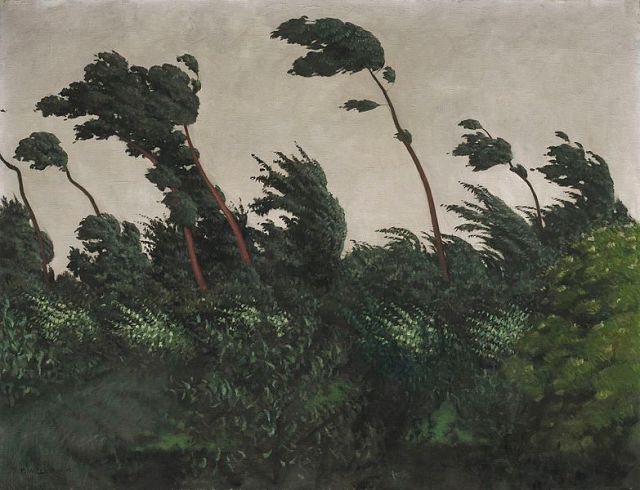
The_Wind_A10464

(Painting by Félix Édouard Vallotton, 1865 – 1925)
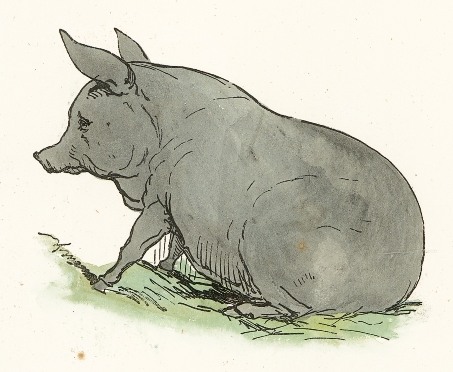
Marlene Mountain’s Pig

pig and i spring rain

(Published in Frogpond, 2:3-4, 1979)

© Marlene Mountain (1939 – 2018) (USA)

Pigs and rain both symbolize abundance, power, and strength. So, I can see a very close connection between the first word (pig) and the last word (rain). Another element that comes to my mind is the food chain. Rain helps to nourish plants and bring fertility to crops. Pig meat is used as food, so it shows the interdependence of different elements of nature that gain strength only if the cycle is not disrupted. Spring symbolizes the abundance of blessings, whether it is in the form of food or rain, that makes a person happy.

Besides that, I can see a friendly relationship between animals, nature, and human beings—key elements of nature. Spring here also indicates harmony and a balanced relationship among all nature’s agents.

Spiritually, I can see a balance between physical (pig) and spiritual (rain) needs.
In addition, I can see the dominance of ‘i’ in this haiku that indicates the individual identity of these three: pig, i, and rain.

Hifsa Ashraf (Pakistan)

“The transparent, childlike directness of this haiku and the poet’s complete immersion in sensory awareness put it in the category of “much harder to do than it looks”. I look to this poem often when I feel my own poetry is becoming too weighted down with words and thought.”

(From Favourite Haiku on the New Zealand Poetry Society‘s website)

Melissa Allen (USA)

“I think it was de Tocqueville who, after seeing how many roving bands of semi-domesticated pigs ran unattended in the city streets of America in the 18th century, remarked that they were a perfect expression of America’s come-one come-all, democratic spirit. This poem by Marlene Mountain reminded me of him because by using the non-capitalized personal pronoun “i” she puts herself on a plane with the “pig”, and is as free as a pig is to enjoy the rain which falls democratically on all alike. There is something uninhibited in the pig’s appreciation of rain that the poet may well share, even if she does not bask, Moonbeam McSwine-like, in the mud. It is the poet’s joy to participate in the fructifying seasonal rebirth brought on by the change of weather, and take pleasure in the simple companionship of this uncomplicated animal. Reading it is like breaking through barriers to a free place.”

(From re:Virals 109 on The Haiku Foundation blog)

Garry Eaton (Canada)

“American poet, Marlene Mountain, has been experimenting with single line or ‘monostich’ haiku since the late 1960s and this is one of her most anthologised.

From a formal aspect there’s a seasonal reference, what’s known as a kigo in the Japanese classical tradition, with spring rain. There’s a natural caesura, or breath pause, after pig and i: an invitation to consider its juxtaposition with spring rain. From a semantic point of view: pig and i is a more formal choice than ‘me and the pig’. And pig rather than ‘the pig’ creates a kind of archetypal pig, something more than a specific farmyard oink.

Use of the lower case personal pronoun is quite common in contemporary EL haiku: the argument for it is often the dilution of personal ego – but there’s too much of a whiff of Zen in that for me. And it’s an argument that feels contradictory too: a lower case i seems to draw even more attention to itself than the standard upper case, which we’re so familiar with we hardly notice it (as long as it’s not overused). But here I’m actually in favour of the lower case for the parallel it appears to draw between the pig and the narrator, both as equals in the spring rain, on the balanced see-saw-like single line.

pig and i – spring rain

But … is the prettiness/tentativeness of spring rain making me see the pig, probably the least pretty of animals, (and the haiku) through rose-tinted spectacles? Someone else would have to analyse and argue for that case.”

(From haiku: a poetry of absence or an absence of poetry? on the An Open Field blog)

Lynne Rees (UK)

Did you enjoy this haiku and commentary? Let us know in the comments.

Gray_Pig_Drawing

Elliot Nicely’s Small Worries

these small worries . . .
wave upon wave,
the ocean
collapsing
beneath itself

(Presence, #58, 2017)

© Elliot Nicely (USA)

A very well-crafted tanka that shows a relationship between our feelings and ocean waves. The opening line “small worries” takes us to our daily activities, where we constantly pass through a lot, and which lets our mind and heart oscillate between logic and feelings.

The ocean here symbolizes the deep feelings and thoughts that are sometimes unfathomable, and we can’t deal with them well. Waves upon waves may be our cognitive process that keeps on filtering our thoughts to find out some solutions based on logic. I can also see an element of ego here where a person’s worries can be related to his/her egoistic approach towards life. Waves upon waves in terms of the heart could be saying that feelings are blindfolded, and we can’t see that logic and thought dominates compassion, kindness, etc. In both cases, the worries or problems are not dealt with effectively, which may lead to destructive thoughts, poor relationships, and in the long run, poor mental and physical health.

Hifsa Ashraf (Pakistan)

Yes, small worries are but waves in our lives—they come and they go. In a moment, there are worries to think about and that give color to our mundane life. And then in the next moment, these are all gone and we’re back to our own silent and secure existence.

Willie Bongcaron (Philippines)

I like that this tanka points to the fact that we often get so wrapped up in the daily grind, that we often forget that our troubles are usually pretty minor. The ocean in the poem is a kind of reminder that each moment is new, and an issue of just the moment before can be washed away.

The word “collapsing” works well not only as an image, but also in its power. We commonly see ourselves as a linear story of a person. But in fact, we are always changing, and in each moment, we can choose to be a new individual.

Let’s talk about the punctuation a bit. The ellipsis reflects the continuous motion of the waves, and the comma allows the reader to pause a bit to imagine the waves. Also, take notice of the economy of language: no line is longer than three words, but each of them is strong and creates a stark image.

Sound is also important in this tanka. In my mind, the “s” and “o” sounds create the most prominent effects. The “s” letters seem to be making the “sss” of incoming waves, and the “o” letters appear to be mimicking the “ooo” of receding waves.

This tanka is written in a convincingly straightforward manner, but the last line surprises and allows us to introspect about how daily strifes are not so essential in the larger picture.

Nicholas Klacsanzky (Ukraine)

Did you enjoy this tanka and the commentary? Leave us a comment if you did.

japanese-waves-painting

© Dawn Hudson