I believe this photo-haiku brings out the humility of animals and the no-mind state that spirituality expounds on.
In the first line, we get the pleasant image of spring rain, which is a sign of nourishment and kindness, you could say.
The second line presents a mystery. Who is drinking out of the gutter? And from such a pretty scene as a “spring rainfall” we get the contrast of a gutter.
In the last line, we learn that a goldcrest, a lovely, small bird, is drinking out of the gutter. I think it is called a goldcrest because of its royal appearance of a gold streak on its head and wings.
This royal bird is drinking from a gutter, and just accepts life as it is. It doesn’t have thoughts like, “I am above drinking out of a gutter–I am a magnificent bird.” It just drinks because it is thirsty and the water happened to be there. The use of “a goldcrest” instead of “the goldcrest” further shows the humility of the bird. The freshness of the spring rain is compared to the fresh mind or beginner’s mind of the bird.
The isness of this haiku is much in line with Zen philosophy. In Zen, there is a philosophy that having awareness without thought is a state of meditation. If you have thoughts, you are not truly meditating. You are adding your own shades to reality when you have thoughts. Reality, as it is, is something different than what we think or feel about it. It just is, and this haiku, in my mind, champions this philosophy.
The sound of the haiku is quite nice with “r” going through “spring” “rainfall” “drinking” “gutter” and “goldcrest.” The “r” sounds, coincidentally, like rain.
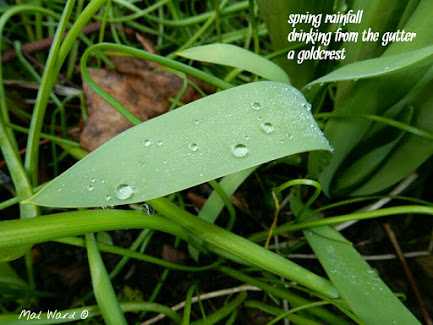
The photo shows the beauty of the spring rain and the lettering adds further to the mood of the haiku.
A fine photo-haiku that just is.
– Nicholas Klacsanzky (Ukraine)

