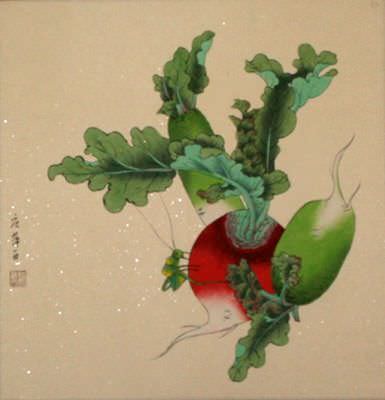
radish harvest—
a child’s tug of war
with the earth
— Saumya Bansal (India)
(Grand prize winner at the 25th International Kusamakura Haiku Competition, 2020)
This haiku speaks to me in several ways.
The child specifically struggling in a tug-of-war with the radish tells me the child may not be physically strong enough yet and could be very young. In fact, it could be the very first time the child has tugged on a plant before. The tug-of-war could also mean the soil conditions are not ideal. According to my research on https://www.gardeningknowhow.com, it states: “…a good way to tell if the radishes are ready to be harvested is to simply pull one from the soil. If the soil is particularly crusted or hard, use a garden fork or trowel to gently lift the root from the soil.” With this in mind, perhaps the tug-of-war has more to do with dry soil. In that interpretation, climate change could be a part of this haiku, contributing to drought. The tug-of-war could also mean the radishes are not ready to be pulled, yet the child still pulls simply out of curiosity, not knowing if it’s ripe yet. In that sense, I feel this haiku speaks to the importance of patience and timing. The word “harvest” tells me there is an abundance of radishes here, so it seems this child is growing up on a farm.
This haiku, however, goes beyond just pulling radishes and expands to include the child’s long-term relationship with Mother Earth and food. It sparks an important discussion about what we teach our children about food and how we care for each other and the Earth sustainably. On the note of parenting, I wonder where the child’s mother and father are in this haiku? Did the child wander out alone to pull radishes? Is this child lost? Did he/she run away from home for unknown reasons? Is the mother and/or father nearby watching over the child? There is some mystery here.
There is another connection regarding the nutritional value of radishes that will become an integral part of this child’s life. According to my research on:
https://www.healthline.com/health/food-nutrition/the-benefits-of-radishes#5-health-benefits-of-radishes: “…radishes have been used as a folk remedy for centuries. They are used in Ayurveda and Traditional Chinese Medicine to treat many conditions such as fever, sore throat, bile disorders, and inflammation.” Radishes have a wide range of other health benefits as well. They have anti-cancer properties, help prevent cell aging through antioxidants such as Vitamin C, are high in fiber and help with our digestive system, and have antifungal properties. Another site states: “Radishes are rich in antioxidants and minerals like calcium and potassium. Together, these nutrients help lower high blood pressure and reduce your risks for heart disease.”
(source: https://www.webmd.com/diet/health-benefits-radish)
We know sustainable farming methods were well-developed in indigenous communities for thousands of years. They took only what they needed and harvested crops not only to feed themselves but also future generations. I appreciate their strong communities. In this modern age, I think we can learn a lot from indigenous people and their care and reverence for the Earth.
In short, it’s clear to me this child (at a very young age) is developing a deep physical and psychological connection with radishes (and presumably other crops) that will last for the rest of his or her lifetime. It has become an integral part of the roots of the child’s upbringing. This haiku sparks an important conversation about how we relate to food and sustainably care for each other and Mother Earth.
— Jacob Salzer (USA)
Radishes are cultivated and harvested normally from October to November—the time when the season is transforming and summer is replaced with autumn. This is also the time for focusing within as our inner energies are at their peak. Since a radish is a root, it can be easily related to one’s deep-rooted feelings and emotions. A child is usually curious about their surroundings and being impatient, they need to reach a conclusion very quickly regardless of whether it will fulfill a purpose or not. The relationship between a child’s curiosity, impatience, and fighting (tug of war) may also point towards needs that are not being fulfilled due to various reasons. The earth metaphorically may be the circumstances that are given to that child, and their survival instinct pushing them to fight for their primary needs. As it is the season of transformation, the child maybe has developed or learned how to fight for their primary needs.
Overall, this poignant haiku reflects how in the early stages of childhood, life teaches us how to become aware of our primary needs and how they can sometimes even go against nature.
— Hifsa Ashraf (Pakistan)
Jacob and Hifsa amply explored this haiku already. However, I can lend a bit more observation.
Radish harvesting could be a kigo for several seasons, depending on the type of radish and the place. For instance, daikon radishes are often pulled out before winter truly sets in. Radishes can be harvested as little as three weeks from their planting, though. So, pinpointing the kigo for this haiku can be difficult.
The em dash in the first line works well to set the mood and to separate the two parts of the haiku. Also, the pacing and the length of the lines match approximately with the rhythm of traditional Japanese haiku, with a short first line, a longer second line, and a longer third line to make the “go-shichi-go” rhythm.
The usage of the article “a” for the child shows that the poet wanted to put more focus on “the earth.” It perhaps speaks to the grandiosity of the earth in comparison to the child.
In terms of sound, I notice that “i” and “r” feature strongly. I feel a sense of starkness from the “i” sounds and a feeling of being grounded by the “r” sounds. Anyway, they both add to the musicality of the poem.
This is a haiku that can mean many things to different people. It’s not easy to achieve that universality when writing haiku.
— Nicholas Klacsanzky (USA)