moonbow . . .
in a grain of wheat
a farmer’s song
© Sandip Chauhan (USA)
2nd Place, 2014 International Matsuo Basho Award for Haiku Poetry
This haiku starts with subtle feelings. The writer takes us to the world where serenity tickles all the elements of nature. Watching a moonbow itself brings delightful feelings with the deepest effects. The arc of the moonbow reflects the mesmerizing impact of beautiful things around us that bring blessings in our lives. It also is a kind of celebration and/or reward for the hard work one has done in the field.
In a farmer’s life, the only thing that can bring true blessings and happiness is a golden crop that manifests his or her wishes to fulfill his or her desires. A grain of wheat symbolizes prosperity and wealth, where every grain is full of life. No one else can understand this better than a farmer who has given his or her days and nights to bring golden grains to their final stage, when they are called a treasure of life. The farmer’s song on the harvest day indicates that harmony and genuineness of things that complement each other. The moonbow in the sky, the grains in the field, the song a farmer sings as a whole, displaying a perfect picture of the ideal harvest day.
– Hifsa Ashraf (Pakistan)
A moonbow is reminiscent of the moonlight on a sickle when, in my country, the wheat is harvested in the light of the full moon so as not to face the June sun. During the night, from the valleys behind the last houses of the village, come the songs of the peasants. In the morning, someone gives us an ear of wheat to wish us luck and that calloused hand slips a little grain and shows it to us with satisfaction.
I found everything in this beautiful haiku. I found the sowing, the harvest, the hope, and also the fear of a farmer who lives a life tied to the seasons and the whims of time. I found our life connected to the seasons and the harmony of a world that follows the cyclic repetition of natural events—a world intimately linked to zoka. A large-scale haiku, in which it is possible to dive in-depth and that transmits calm and serenity with a few simple words.
– Margherita Petriccione (Italy)
To me, this reads as a hokku because, in the fragment, there’s a beautiful image followed by a phrase that speaks to me about the sense of time, perhaps fleeting, followed by the ma (thinking space) which are known techniques used for this style of poetry that predates haiku.
I couldn’t find “moonbow” as a kigo reference but this rainbow phenomena happens with moonlight instead of the sun and often appears near waterfalls on a near-to-full moon. So, in a sense, it could be considered a micro kigo which is associated with certain parts during the day e.g. dawn, mid-noon, sunset, etc. But in this case, it’s monthly via the phase of the moon.
What also interested me about this poem is the lack of juxtaposition between the fragment or phrase or in the fragment itself, which further solidifies my thoughts that this is a hokku where there’s “no trickery” in terms of zoka. That is another aspect to this style of writing which Basho is known for. I think his “old pond” hokku did not have juxtaposition either but instead utilized a great use of space and sense switching which led to many scholarly debates.
One can easily argue that this is a haiku as well from a Shiki point of view, who also didn’t use any tricks. Then again, she didn’t use much or any space in much of her work as well.
The phrase is open to interpretation. Perhaps it’s the end of a bountiful harvest or the opposite. It could be a song of jubilation or a somber one with or without the view of a moonbow. Whether this is a haiku or a hokku, the author wrote something very interesting with a beautiful opening line and an intriguing phrase to dive in and ponder on.
– Fractled (USA)
I think this haiku is reflective of William Blake’s poem “Auguries of Innocence.” Here is a famous excerpt:
To see a World in a Grain of Sand
And a Heaven in a Wild Flower,
Hold Infinity in the palm of your hand
And Eternity in an hour.
However, Chauhan’s haiku provides a less direct approach and aesthetic, which is common in finely written haiku. She is comparing the subtle, magical, and mystical event of a moonbow with a farmer’s song in a grain of wheat. One might ask how it is possible for a song to be in a grain of wheat. It does seem a bit fanciful but really it isn’t. The vibration of the farmer’s voice can easily physically enter into the wheat. But I think we don’t want a science lesson, so it is better to talk about what this image implies.
Not only does it reflect an interconnection between humanity and nature but also the cause and effect relationship there is between all things. This haiku can call attention to our actions, whether they are positive or negative. In the case of this poem, the (assumed) joy of the farmer is transferred to the grain of wheat and vibrates with positive energy, so to say. A moonbow, with its subtle stream of colors, is also representative of a synthesis of things.
Overall, the mood is cheerful and mystic. The last line surprises the reader and this astonishment brings a sense of wonder. This is a common goal for many haiku poets: to induce wonder in our readers.
Lastly, it works great technically. The ellipsis in the first line allows the reader to pause to imagine the wonderful sight of a moonbow. In terms of sound, the “o”s work fantastically to create a sense of the length of the moonbow and the song of the farmer. Also, the three “r”s give it a twang that is reminiscent of the language of a farmer.
A delightful haiku that is at once spiritual, joyful, and a celebration of the ordinary.
– Nicholas Klacsanzky (USA)
If you enjoyed this haiku and commentary, please let us know in the comments.
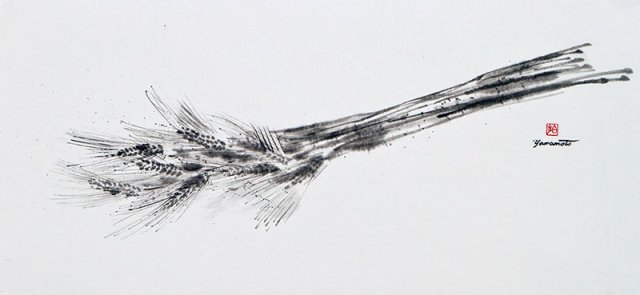
– Art by © Hiroshi Yamamoto