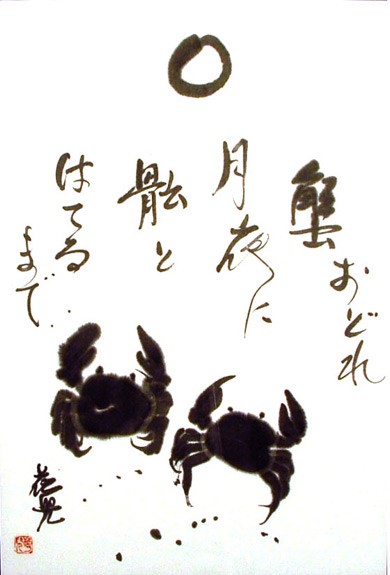
dance crabs
under the full moon
until you become a skeleton
© Kaji Aso (1936-2006) (Japan)
Before discussing this haiga (art plus poetry), I will supply some biographical information about the artist and poet.
Kaji Aso was born in Tokyo, Japan in 1936. He received an BFA in Painting and MFA in Printmaking at the Tokyo University of Art. But he was not only an artist; he was also a teacher, singer, adventurer, poet, and philosopher. All those who speak of Kaji Aso use the words “renaissance man” to capture his many accomplishments and his boundless spirit.
In 1972, he founded the Kaji Aso Studio Institute for the Arts in Boston, MA. Here he brought together Japanese and western culture: visual art, music, poetry, philosophy, theater, and good food. He also designed and built the first Japanese teahouse in Boston, where he presided as tea master. For thirty-three years, Kaji Aso was also a professor at the School of the Museum of Fine Arts, Boston. His art is part of the permanent collections of many museums around the world, including the Museum of Fine Arts, Boston; the National Museum of Modern Art, Tokyo; the Museum of Modern Art, NY; National Museum of Czechoslovakia; the State Pushkin Museum, Moscow and Padua Museum of Fine Arts, Italy. Thirteen of his works are registered as Japanese National Properties.
As a talented tenor, Kaji Aso performed opera and Italian and Japanese songs. He ran in thirty-six Boston Marathons and led kayak expeditions down some of the longest rivers in the world including the Mississippi, the Nile, and the Volga.
Although haiku was just one of his many special gifts, Kaji Aso very often expressed the wisdom of his beliefs in haiku and did a lot of haiku illustrations. He organized and took an active part in many seminars and lectures about Japanese art, haiku, sumi painting and calligraphy. With countless awards and publications attributed to him, he can be rightly called a legend. [Adapted from The Living Haiku Anthology]
Commentary
In the art, we can notice the moon at the top, with the haiku written in an accented way to take in the haiku slowly. The crabs below the haiku are shown dancing by the dots below them. This type of painting is not exacting, but rather an approach is taken to capture the spirit of what is seen. This relates to wabi-sabi, allowing imperfections to be and seeing the beauty in them. Sumi art is more of a sketch of life, rather than an exact showcasing of it.
Though the art seems simple, we can get a poignant feeling from it. I perceive joy and austerity in the blots and lines of the ink. It gives off vibrations of spirituality, but also a pure simplicity that makes one joyful when viewing it.
The feeling the art exudes compliments the mood of the haiku. Though the art does not show the crabs as skeletons, it shows their dancing and allows us to feel the mysticism of the haiku more.
In terms of the haiku, each line is striking and wakes one up to the moment. Though the haiku can be taken literally, I believe it has a spiritual mood.
Crabs are a reference to different seasons, but most commonly, they reference summer. It would make sense that they would be dancing if it is summer.
The full moon has so much symbolism in Japan that it is hard to define it in a few short lines. But the full moon can mean complete enlightenment, the absolute truth, and even specific mystical beings. In the context of this haiku, I feel the full moon is in a sense luring the crabs into a mystical experience, and that the poet suggests the crabs to give up the attachment of their bodies. The poet recognizes the crabs as seekers of truth when they dance under the full moon, and is instructing the crabs as he would students of Zen or other forms of spiritual practices. There is no sense of division of the human and natural world in the mind of the poet.
We get a contrast of the full moon and the skeleton. This juxtaposition, though it seems obvious after a few readings, does not seem apparent quickly. This is because the starkness of the moment described is so strong, that the reader does not consider the aesthetic of it at first.
A masterful haiga by an enormously talented artist and poet.
– Nicholas Klacsanzky (Ukraine)

