
Martha Magenta’s Last Goodbye

last_goodbye

Words and image by Martha Magenta (UK)

This tanka is packed with emotion and is centered around a stark image.

Last goodbyes are something almost anyone can identify with and the emotions it brings. Sometimes, we never forget these moments, and they linger in our memories each day.

The abruptness of the rain filling the footprints, before the ocean tide could, is poignant. It magnifies the sadness the poet feels and represents a lack of mercy.

But on the other hand , you can see it as a blessing. Looking at the footprints of a loved one who has left can be agonizing and the rain filling the footprints up so quickly show the spontaneous compassion of nature.

So, we have a sad and compassionate view of this tanka, simultaneously.

The language is simple, to the point, and well-paced. It is hard to imagine adding or taking out a word. That is a sign of a strong tanka. Plus, the tanka hits the correct emotional chord and tone that touches readers. If a tanka sounds metallic, it is hard to say that it is a tanka.

The sound of the tanka is important as well. The “o” sound is represented in “our” “goodbye” “on” “how” “your” and “footprints.” This gives the sense of length of yearning–the sense of time being too long. Another thing to note is the alliteration of “footprints filled” which adds emphasis.

The art associated with the tanka (I think it is a photo with painted-over rain) is moody and adds to the atmosphere that the tanka creates.

– Nicholas Klacsanzky (Ukraine)
Marilyn Ward’s Rainfall

2016 - 1

I believe this photo-haiku brings out the humility of animals and the no-mind state that spirituality expounds on.

In the first line, we get the pleasant image of spring rain, which is a sign of nourishment and kindness, you could say.

The second line presents a mystery. Who is drinking out of the gutter? And from such a pretty scene as a “spring rainfall” we get the contrast of a gutter.

In the last line, we learn that a goldcrest, a lovely, small bird, is drinking out of the gutter. I think it is called a goldcrest because of its royal appearance of a gold streak on its head and wings.

This royal bird is drinking from a gutter, and just accepts life as it is. It doesn’t have thoughts like, “I am above drinking out of a gutter–I am a magnificent bird.” It just drinks because it is thirsty and the water happened to be there. The use of “a goldcrest” instead of “the goldcrest” further shows the humility of the bird. The freshness of the spring rain is compared to the fresh mind or beginner’s mind of the bird.

The isness of this haiku is much in line with Zen philosophy. In Zen, there is a philosophy that having awareness without thought is a state of meditation. If you have thoughts, you are not truly meditating. You are adding your own shades to reality when you have thoughts. Reality, as it is, is something different than what we think or feel about it. It just is, and this haiku, in my mind, champions this philosophy.

The sound of the haiku is quite nice with “r” going through “spring” “rainfall” “drinking” “gutter” and “goldcrest.” The “r” sounds, coincidentally, like rain.

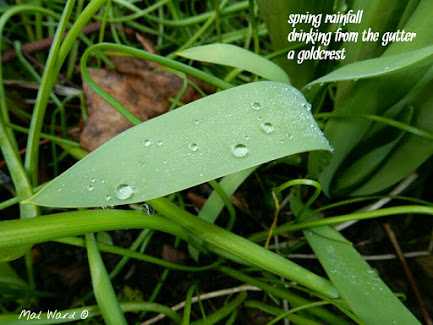
The photo shows the beauty of the spring rain and the lettering adds further to the mood of the haiku.

A fine photo-haiku that just is.

– Nicholas Klacsanzky (Ukraine)

Laughing Waters’ Thanks

life ended 
thanks for playing
god

© Laughing Waters (Italy)

This senryu accomplishes a contrast of two opposing moods in the same piece. That is difficult even for the most experienced writers.

1. Our mortality and briefness in this world conveys a serious finality. We are finite and god/God is there with the poet. Perhaps god is just “looking” on as the scene unfolds.

2. Then, there is humor in that it is also god/God giving the poet a memo on her life and referring to it as a role (playing) or even a game–especially a game.

This removes the finality a little since “god” might have another role/game up “his/her” sleeve. We don’t really know and that unknown aspect adds poignancy to the “memo.” It leaves the reader wondering what is meant, possibly after the memo has been received.

This one actually gets away with personifying “god,” if it is, indeed, a memo.

In haiku, we avoid personification of the natural world so it can remain part of the natural world. Clouds, for example, wouldn’t be “crying” but they could sure be used in an image set against another image of a person weeping, crying, lamenting, etc.

– Edwin Lomere (USA)