Yumino Aoiro’s Wisteria

12+-+1


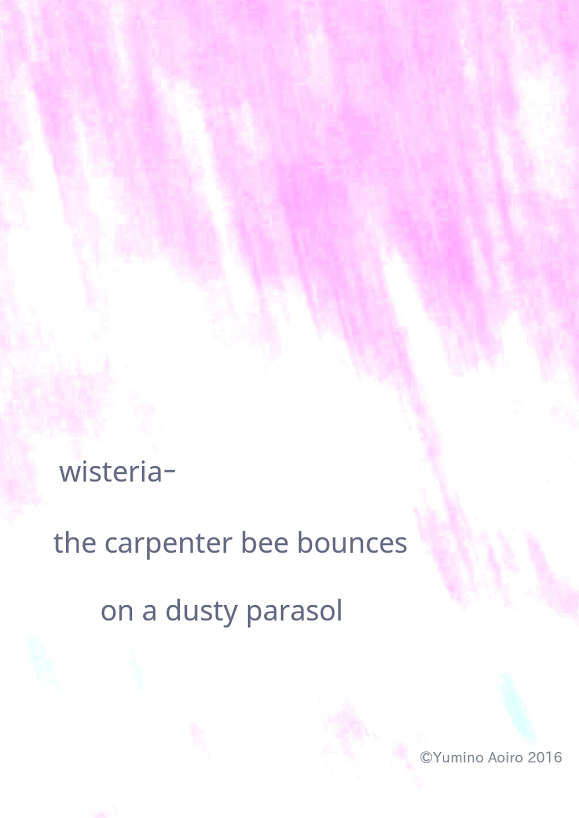
Firstly, I would like to note that this is a shahai, or a haiku accompanied by an image, or within an image. Yumino made an abstract representation of wisteria with the image, to my mind. But getting to the haiku itself, I like how each word is needed and works well. The first line begins simply with “wisteria-” which is a beautiful plant that blooms in late spring. So, the kigo, or seasonal reference points to it being about late spring. In late spring, animals are in a busy mood. And here comes the second line:

“the carpenter bee bounces”

And carpenter bees are certainly busy dudes in late spring. A bee bouncing is quite an interesting image. A nice alliteration is made with “bee bouncing.”

Bounces on what? “on a dusty parasol.” Why is the parasol dusty? Could be that the parasol has been left behind for some time, or that the dust is actually pollen (maybe wisteria pollen).

Yumino skillfully does not tell us, but shows how the pollen or dust lifts into the air from the bounce of the bee on the parasol, and how it is quite like the shape of wisteria blossoms. So, this haiku is a comparison haiku: it compares how wisteria pollen or dust looks in mid air when bounced off a parasol by a bee with how the wisteria blossom is shaped and hangs.

So, maybe Yumino is implying that wisteria blossom and pollen is one and the same. Whatever philosophical implications this means to you, you can introspect on it.

Note:

Check out how the third line is indented, giving us the space to imagine the bounce.

Also, take note of how Yumino used articles. “the” was used for the bee to give it is more importance, and “a” was used for the parasol to not steal the show from the bee.

– Nicholas Klacsanzky (Ukraine)
Edwin Lomere’s Sunrise

2robins1

Words and image © Edwin Lomere (USA)

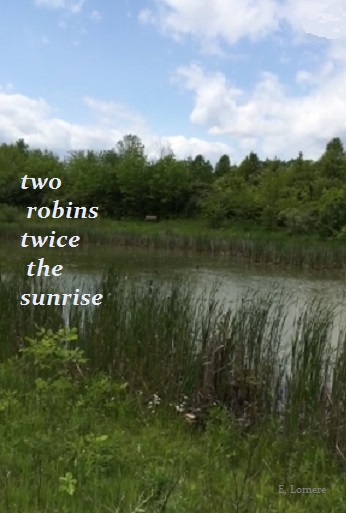
It is so simple, only one word per line, but it is pregnant with meaning and implication. The photo is taken after sunrise, and appears to be the aftermath of the sunrise. The photo shows two sides of a river or pond, which coincides with “two robins.” As with most shahai, or photo haiku, the photo does not directly reflect the haiku, but adds to it or creates more implications.

The red breast of the robin compliments the red of the sunrise. Also, the song of robin is at once majestic and cheerful, like a sunrise. But with the two robins, the haiku could be implying the sunrise has not happened yet, but the sunrise has been represented twice in the robin’s look and song.

Another reading of it is “two robins twice/the sunrise” which is saying that the sunrise is like seeing or hearing two robins twice. It brings in an aesthetic of fullness that is dear to haiku.

I think this is a spring haiku, not only from the view of the photo, but from the cheerful atmosphere created by the poet.

The sound of the haiku is quite pleasant, with the “o” sound running through “robins” and “two,” and “two” and “twice” having a play with the “t” sound. The “i” sound is in “twice” “robin” and “sunrise, all of which gives a musical quality to the haiku–maybe imitating the song of the robin.

I think the poet slowing the poem down to one word per line makes us not only appreciate each word more, but saves us from having it like:

two robins
twice
the sunrise

…which would afford us less chances to read it differently.

– Nicholas Klacsanzky (Ukraine)

Lucky Triana’s Hat

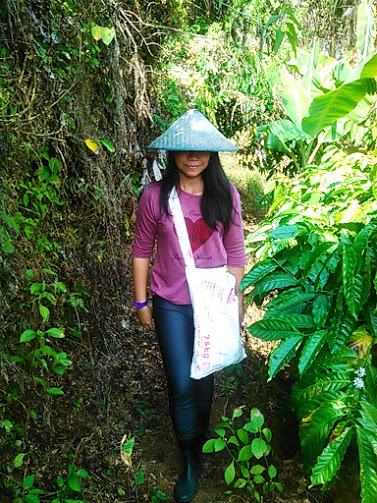
a triangle hat
i search
my third side

16+-1

words and image
© Lucky Triana (Indonesia)

A witty and introspective haiku.

Wordplay in haiku has a long tradition, and when it was the hokku as a part of renga (a long linked poem), it used much more wordplay. So, you could say this haiku tapped into an ancient tradition.

We have a literal interpretation, but the metaphorical one is more interesting to me. Usually, people say they have two sides, but what about a third side? I think the haiku reminds people about who they are beyond the flesh. People often forget their spiritual, metaphysical sides, getting lost in material life.

It’s wonderful when a haiku can draw us towards our true selves.

– Nicholas Klacsanzky