Antonietta Losito’s Dandelion

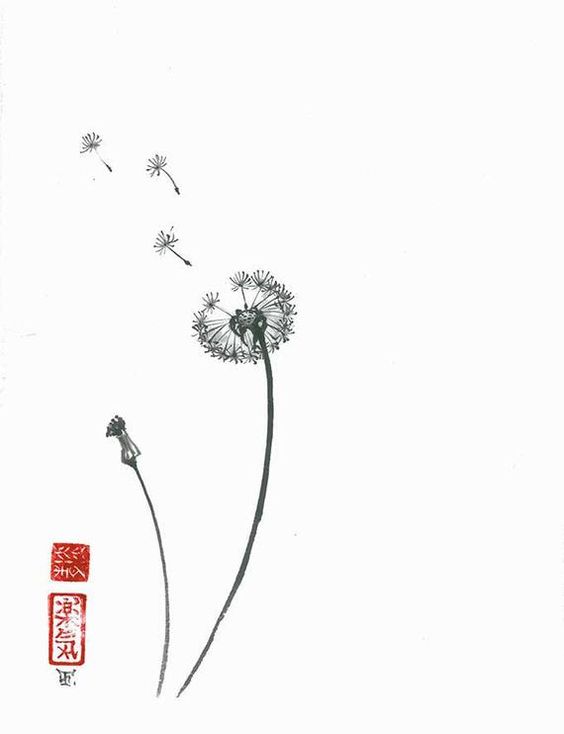
dandelion—
I’m the breeze
that moves it

Antonietta Losito (Italy)
(published in The Heron’s Nest March 2020)

Dandelions symbolize the hope, wishful thinking, delicacy, fragility, and movement in life that we all need. Nothing is static in this world, and this particular haiku is a simple but precise explanation of that. The breeze is our way to deal with life and its various aspects, especially the ones that are delicate and demanding. It also reflects the meditative thoughts where one can let go of things like dandelions release their fluff.

Moving onto the third line, it is fantastically used by the poet. It shows the flow of life the way we see it, not the way it is. I loved the simplicity of this haiku that made it easy to connect with deep meanings of life. It’s a perfect combination of thoughts and actions that are glued by hope, delicacy, and the fragility of life.

Hifsa Ashraf (Pakistan)

This haiku gives me the impression that the poet is close to the dandelion, to the point where her breathing becomes its own wind current. At first, I saw the dandelion petals moving. But when I read “dandelion,” I also think of dandelion seeds. In this poem, I saw the poet making a wish and blowing away the dandelion seeds. Thus, I saw the poet’s breath carrying the hidden words of her wish. In turn, her wish and breath have spread the seeds for new dandelions to grow. So, there is a feeling of the poet giving new life and continuity.

To deeply add to this effect, the Spirit of the poet has literally become her own breath in “I’m the breeze.” Thus, this haiku seems to communicate that what is invisible is more important than what meets the eye. It also seems to signify how the Spirit of a person affects the physical world and how we see it. But I think there is much more than a cause-and-effect movement in this poem. I feel an unspeakable oneness as the poet’s invisible breath and Spirit has become one with the dandelion. To that end, this haiku could even signify it is the last breath the poet takes in their lifetime and that even as the poet passes away, her Spirit lives on in nature. I feel her personal breath and Spirit (the individual soul or in Sanskrit, Jiva) has become the wind itself, which is universal and a symbol for the Universal Spirit (Shiva).

In addition, in these times of climate change and uncertainty, this poem reminds us of the significant impacts we have on Mother Earth. If a single human breath can move a dandelion or blow away dandelion seeds, how much of a greater impact do we have collectively on Mother Earth in so many ways. I sincerely hope this haiku will inspire us to take better care of the Earth and each other.

I feel this haiku expresses a union between the human Spirit and the Spirit of the Earth, between the individual soul and the universal Spirit. Ultimately, I feel it inspires respect and compassion. A powerful, transformative haiku.   

Jacob Salzer (USA)

I also echo what Hifsa and Jacob said: there are many interpretations and meanings for the word “breeze” here. I think that speaks to the strength of this haiku. Commonly, the power of a haiku can be gauged by its layers of resonance and its impact through these layers.

In terms of the sound, I feel the letter “e” is most significant in the haiku. You can sense the motion of the dandelion seeds through the reading of the “e”s. Looking at the structure, the haiku is set in a standard English-language haiku format of a short first line with punctuation, a longer second line, and a short last line. Finally, the season this haiku references seems to be spring and that reflects well in the narrator being the breeze.

A well-written haiku that seems simple on the surface but offers a spiritual meaning.

Nicholas Klacsanzky (USA)

Irina Te

George Klacsanzky’s glasses

my glasses missing
I see impressionistic
paintings all day

George Klacsanzky (1956-2003)  (USA/Hungary)

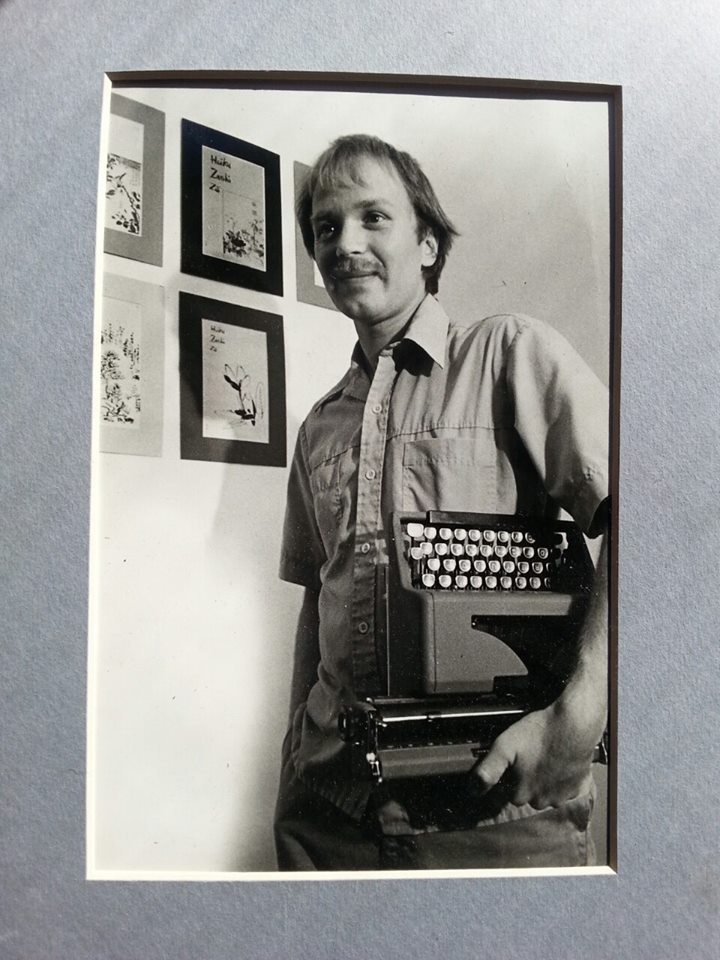
George Klacsanzky with his typewriter and issues of his journal “Haiku Zasshi Zo”

I appreciate George’s insight into sight itself. How many of us take vision for granted? The saying “Beauty is in the eye of the beholder” comes to mind when reading this haiku. I also like his sense of humor in “my glasses missing.” It seems some people have become numb to modern-day conveniences and items we use daily. But when a useful item goes missing, like glasses, then it seems we regain an appreciation for it and no longer take it for granted. In this way, George’s haiku could point to experiencing life without conveniences but also gently reminds us to not take things for granted. A beautiful haiku.

Jacob Salzer (USA)

First of all, it is a great honour for me to write commentary on this brilliant haiku of George Klacsanzky. He is truly a great and inspirational haiku poet.

The opening line gives an impression of a person’s view of the world without any artificial sight. It reflects the genuine connection of a person with nature or their surroundings where they enjoy nature or any imagery without any barrier (glasses) by using their insight or perception. I love the use of the word ‘impressionistic’ which conveys a strong image of what the person is viewing. It may also be a vivid memory that a person is cherishing or reminiscing about. There can be various interpretations of ‘paintings all day’. A person may be seeking solace in nature, their surroundings, a memory, or they are enjoying the deep elements of an image with the help of insight’s lens through daydreaming.

Hifsa Ashraf (Pakistan)

My father, George Klacsanzky, wore thick glasses. I think if he took them off or lost them, he would be seeing the world as if it was an impressionistic painting. But I think besides the humor in this haiku, I believe my father was expressing the fact that our experience as human beings is based on our subjective sensorial perception. Though our sense organs are tangible, the results they produce are variable and depend on each individual’s facilities. In a way, it seems my father was pointing to the illusion of our so-called reality.

I enjoy how the second line has enjambment. It is a witty line break that sets up a surprise in the last line. In terms of sound, it appears that the letter “s” takes the cake. From this string of “s” sounds, I can hear a paintbrush against a canvas. The letter “l” is also employed well, which gives the reading a more weighted feeling, in my opinion.

Another haiku by my father that on the face seems to be only comical but has deep philosophical undertones.

Nicholas Klacsanzky (USA)

Elliot Nicely’s comb

hospice care
the way she quietly combs
sunlight
into his hair
with her fingers

Elliot Nicely (USA)
(previously published in Eucalypt #25)

This tanka gives me a real sense of peace and acceptance, specifically in: “she quietly combs sunlight into his hair.” I feel a gentleness in the verb “combs,” which reminds me of slow-rolling ocean waves, or a soft breeze in a field of grass. It also brings me a sentiment that the person lived a fulfilling life, regardless of their age. I first envisioned the man is in hospice and his wife is combing his hair, though I like how the tanka leaves this open for interpretation. It could very well be the woman who is in hospice and she’s combing the hair of her husband, her son, or someone else she’s close to. Hospice relates to a person who is physically ill and has 6 months or less to live. Love and compassion don’t always require words and can be expressed through silence, in gentle, wordless action. I feel this tanka expresses one of those moments. A beautiful poem. 

Jacob Salzer (USA)

The opening line of this tanka takes us to hospice care as an expression of a place that everyone knows. The tanka precisely describes the story of a woman who may be a nurse, a mother, a spouse, or a grandmother. In each case, she is caring and may be missing her motherhood memories in the past. The scene describes a carefree moment where she may be sitting in the sunlight with a child/boy/man and enjoying combing his hair with her fingers. It also shows the personal touch of a person with someone who is close to her and where there are no materialistic things needed to enjoy mundane activities.

This also demonstrates how both persons are pondering about life, maybe reminiscing their past. I can see the furrows in the hair resultant from combing with fingers, which depicts how fruitful life becomes when someone sows the seeds of love, care, and sincerity. I loved the imagery of this tanka, which portrays the story of life in hospice care—full of memories, love, compassion, kindness, and personal touch.

Hifsa Ashraf (Pakistan)

This is a moment of quiet yet powerful symbolic actions—whether intended or not. The person being cared for is ill or dying, and sunlight, the power of the sun, is being combed into the patient’s hair. In a way, it is giving life to a person on the edge of death. It could also be a sign of someone who has lived their life fully and is now returning to the realm of the natural world.

The sense of sound in this tanka is wonderful as well. The soft “o”s in hospice, combs, and into, and stark “i”s in hospice, quietly, sunlight, into, his, hair, with, and fingers make for a sonorous feel that adds emotion to the poem. The tanka is sparse in words, but each word seems carefully selected and paced. It’s a tanka with depth that can be clearly seen.

Nicholas Klacsanzky (USA)

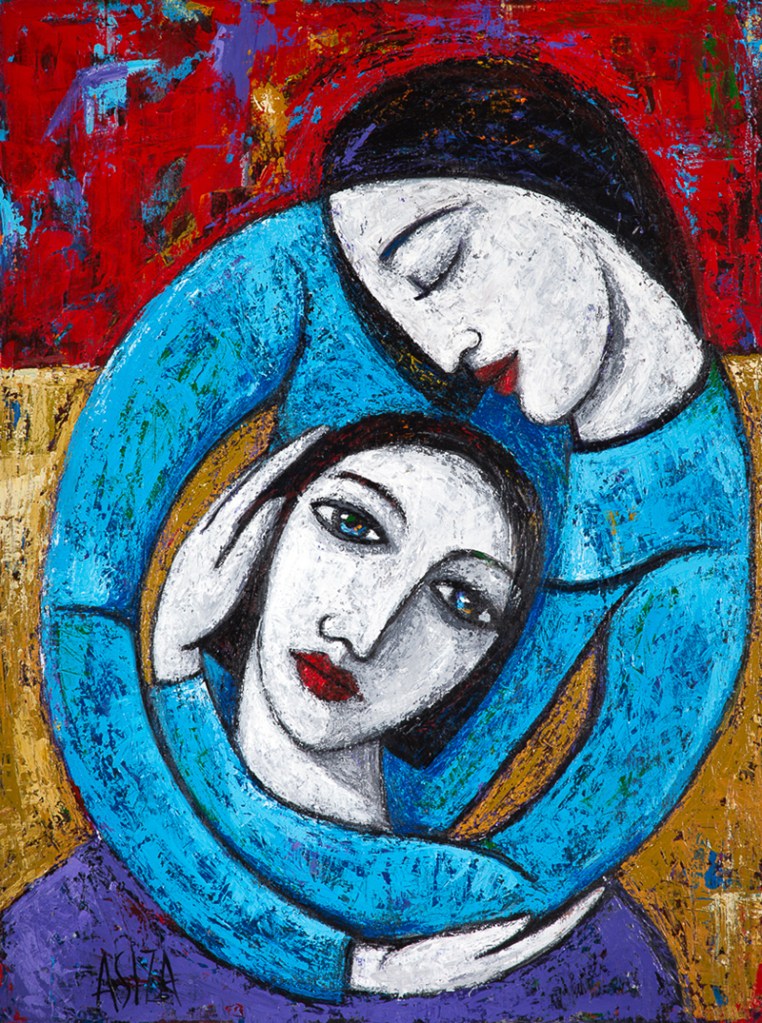
“Endearment” by Asiza.