Blithe Spirit 26.1
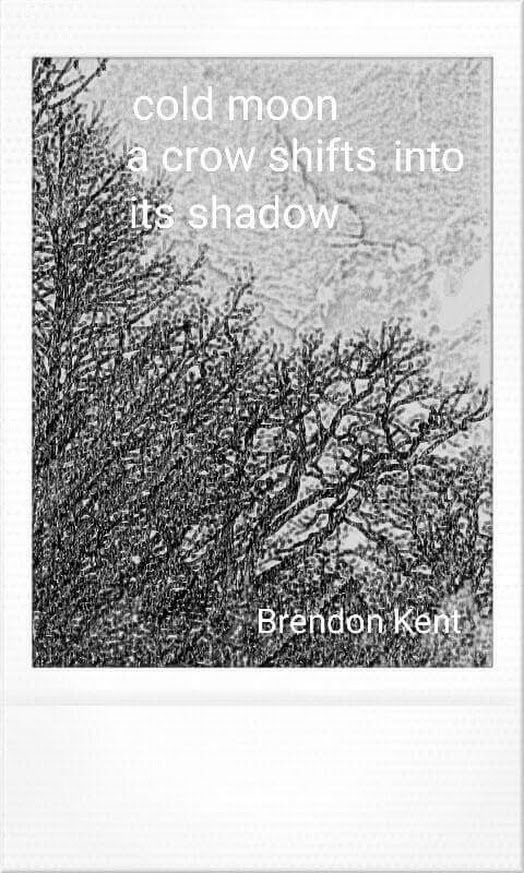
shahai/haiga (c) 2016 Brendon Kent (UK)
I enjoy many things about this shahai, or haiku accompanied by an image: its imagery, its sound, its use of articles, and its surprising third line. It has an austere and spiritual quality to it. “cold moon” is a winter kigo, or seasonal reference. The moon can mean many things to people: enlightenment, romanticism, a comprehension of knowledge, and so on. “cold moon” could mean a retreat from enlightenment or self-hood, or from one’s emotions.
The word “shifts” works great, as it shows minimal movement, but it also implies transformation.
There is also a nice strain of sound, with “cold” “crow” and “shifts” and “shadow.” I think the “c” sound makes the harsh atmosphere more prominent, and the “s” sound imitates the sound of the crow shifting.
I was surprised when Brendon used “a crow” instead of “the crow,” but it was appropriate to use “a” to give the shadow prominence. The usage of articles can be tricky and can even add new dimensions to haiku, and Brendon used articles masterfully.
The last line comes as a great surprise to the reader. The crow being black and it going into its shadow leaves a strong image. I think the crow escaping the moonlight is a metaphor for leaving the spiritual reality and retreating back into one’s comfortable life, instead of facing the reality that has been exposed to you.
The photo that the haiku is attached to conveys the austere mood strongly and provides us with extra imagery to imagine.
A great shahai, Brendon!
– Nicholas Klacsanzky (Ukraine)

 Haiku Commentary