
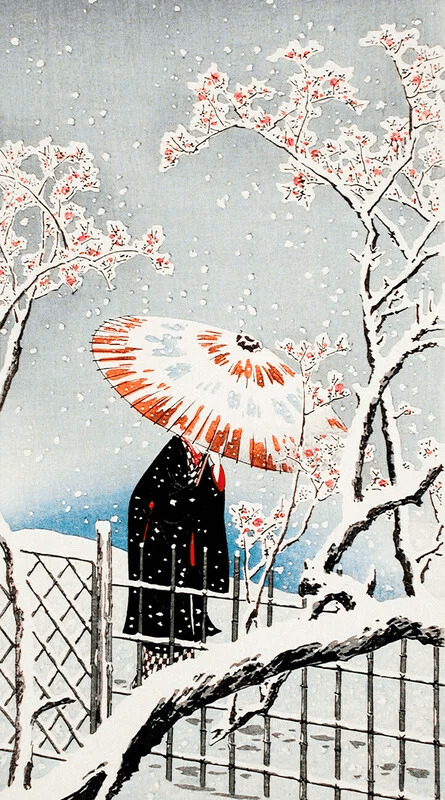
all her feelings for him coming back first snow
— Quamrul Hassan (USA)
published in the Wales Haiku Journal, Winter ’25/26 edition
Commentary by Jacob D. Salzer:
An interesting haiku about a past relationship that has not fully faded away. The many qualities of snow really come alive in this one-line haiku (monoku) in relation to the complexity of a past relationship, partly because the poet has used very few words. Perhaps the poet met a previous partner in late spring or early winter as the first snow was falling. Perhaps the man in this poem is relatively quiet and soft-spoken with a kind heart. Perhaps there is also something that was suppressed or hidden beneath the layers of snow in the man’s and/or woman’s mind.
Snow is soft, quiet, and often magical, yet it can also carry connotations of melancholy, distance, danger, and emotional coldness. In places that experience all four seasons, the snow comes and goes, and then melts away. However, even when the snow melts, the scent of snow remains in our memory, just as the memories of this man seem to remain in the woman’s heart and mind, even if it’s only traces of him. It seems the woman in this poem could be feeling a combination of feelings all at once. Whether the breakup was last year or several years ago, it seems it was complex and not an easy decision.
In addition, the common phrase, “falling in love,” could be implied in this monoku as the first snow is falling. Why did this couple go their separate ways? How often do couples reunite? What brings people together? What tears people apart? The cycles of the seasons create a complex dynamic in this poem, as the memory of this man returns. In the end, how long will our memories remain in a personal and collective sphere? Does the snow itself also carry memories as it melts into rivers and streams? This is a powerful monoku that juxtaposes human relationships with the many qualities of snow.
her goodbye
too soft to hear
autumn rain
— Tom Bierovic (USA)
published in The Heron’s Nest, Volume XXVII, Number 1: March 2026
Commentary by Hifsa Ashraf:
The haiku begins with the pronoun ‘her’, which immediately personalizes the experience. The phrase ‘her goodbye’ carries a particular emotional weight. Had the poet written simply goodbye, the effect would have been more general, but the addition of her suggests someone who has a special place in someone’s life. It conveys a sense of disbelief, as though the speaker cannot quite accept that this particular person is leaving.
The line ‘too soft to hear ‘is especially striking because goodbyes are often associated with sadness, bitterness, or rage. However, in this haiku, the goodbye is soft, suggesting tenderness. Perhaps the separation has been discussed and mutually accepted, making the departure gentler, though no less painful. The repetition of the long o sound in too and to subtly deepens the emotional intensity of the moment.
The word ‘hear’ is equally important. It may imply that the speaker does not fully register the goodbye, either because it is spoken so softly or because the reality of the parting is too difficult to accept. There is something intriguing here; who heard it? The intended person, or perhaps others who witnessed the scene?
The ending image, ‘autumn rain’, beautifully anchors the poem. Autumn is normally associated with decline, endings, and melancholy, while rain often evokes quiet sorrow and introspection. The seasonal image deepens the emotional resonance of the farewell, allowing readers to connect their experiences of loss and separation to the poem.
What I particularly appreciate is the mystery of this haiku. The word ‘her’ remains open-ended. She could be a beloved, a family member, or a friend. Likewise, the goodbye may signify a breakup, a departure, an illness, or even death. This openness invites readers to enter the poem with their own memories and emotions, giving the haiku a universal and enduring quality.
remaining snow —
my eulogy rests
in the closet
— Martina Matijević (Croatia)
Commentary by Nicholas Klacsanzky:
The poem opens with a seasonal reference (kigo) that indicates late winter, when the snow has refused to melt. The em dash (cut marker or kireji) at the end of the first line allows readers to pause and consider the image presented. The run of “n” sounds in this line also brings a sense of heaviness.
The second line, “my eulogy rests,” creates a turn in the haiku. However, the word “remaining” relates well to “rests.” It makes a connection between the snow and the eulogy. As a written tribute to someone who has passed, it is intriguing that the poet’s eulogy is already composed—either by the poet herself or by someone else. The word “rests” also personifies the eulogy, or the piece of paper it is written on. It gives the eulogy a life of its own. There is a mix of soft and hard sounds in this line, with “o” and “r” continued from the first line. These letters reflect the mixture of emotion someone might have when writing a eulogy.
“in the closet” as a third line brings the haiku back to the mundane from the flight of the previous line. The expression “in the closet” has many connotations and interpretations. A closet is often a repository of postponed things, our winter coats, our old lives, the objects we can’t quite throw away and can’t quite use. Having one’s eulogy in the closet could mean you were close to death once and have now recovered. Furthermore, it could be interpreted as the eulogy being less important than previously thought from the poet’s perspective. Perhaps the poet feels that words cannot adequately describe a life. Finally, “in the closet” can mean keeping a key aspect of your identity, such as sexual orientation or gender identity, a secret from others. It stems from the phrase “skeleton in the closet,” highlighting a time when hiding your true self was seen as a shameful secret. Leaving these mysteries in the haiku provides space (ma) for the reader to find meaning that is their own.
There are a lot of soft sounds in the last line, with “o,” “l,” and ‘i.” But the “t” at the end subtly closes the matter and makes us feel that perhaps the eulogy will remain in the closet for some time more.
The resonance from “remaining snow” deepens after reading the whole haiku. Both the snow and the eulogy belong to a colder season, a season of dying, and yet both persist.
In form, the haiku hits the sweet spot with only eight words. The diction is simple, though poetic enough to have flavor. Each word is needed and adds to the sentiments and scene. This haiku is a grand, layered association between nature and human mortality.
Painting by Hiroaki Takahashi

