
the first hole of a shakuhachi dawn
— Elliot Diamond (USA)
Modern Haiku 55.2, 2024
Commentary from Nicholas Klacsanzky:
This haiku succeeds in seamlessly layering sound and imagery to create a spiritual atmosphere. It juxtaposes the shakuhachi—an ancient Japanese bamboo flute—with the unfolding of dawn. The “first hole” can be read both literally, as the finger-hole that allows the first note to emerge, and metaphorically, as an aperture through which the first light of day enters the world. It also could be a symbol of a threshold between silence and sound, darkness and light. The shakuhachi’s connection with Zen practice further shades the image with spiritual awakening: dawn not only as a time of day, but also as a symbol of enlightenment.
The haiku, being one line, creates a representation of the shakuhachi. It could have been written as three lines, such as “dawn/the first hole/of a shakuhachi.” However, I feel the haiku is more organic and interesting as one line.
The diction is minimal, yet the resonance is wide: the reader can hear the first note, feel the cool breeze of dawn, and perhaps see the bamboo hollowed into an instrument. In addition, the phrasing enjoyably blurs instrument and environment. What we’re left with is not just an instrument or a sunrise but a moment of initiation, where time seems to exhale through the flute.
Though there is no kigo or seasonal reference, the time is evident. There is also no kireji or marker for a break, though there can be a natural pause after “shakuhachi.”
Finally, the sound of the haiku works well with the letter “h” being the most prominent. The breathiness of the letter “h” in “hole and “shakuhachi” illustrates blowing into a flute.
Despite the minimalist aesthetic of this haiku, the poet leaves a lot for the reader to ponder and feel through inner vision.
summer solstice
the busker plays
a tune from home
— Neena Singh (India)
2nd Prize, Japan Fair Haiku Contest 2025
Commentary from Hifsa Ashraf:
The haiku’s imagery, anchored by the summer solstice kigo, evokes solitude and introspection through a busker’s tune played from home. The solstice’s long daylight amplifies the sense of isolation, yet the music serves as a cathartic bridge to an unseen audience, blending self-fulfillment with a subtle yearning for connection. The summer solstice, with its prolonged daylight, casts a spotlight on the busker’s solitary performance, evoking and highlighting both isolation and self-awareness. I see the poem as a catharsis and self-awareness where an artist thoroughly enjoys their talent without having an audience or the audience is unseen.
The haiku conveys the busker’s enjoyment of solitude, longing, or melancholy in the deepest way. The poem balances solitude and loneliness, suggesting the busker finds fulfillment in their music while possibly yearning for the connection typically found in public performance. If rooted in a Japanese context, the busker’s solitary tune might reflect a Zen-inspired embrace of the present moment, deepening the poem’s meditative quality. In any case, it is irrelevant to the person who may be in a meditative state of selflessness or enjoying being alone, only with what they enjoy the most. It also makes me wonder: does the poem suggest the busker imagines an audience, or is the music itself a bridge to an abstract sense of connection?
A “tune from home” could imply the busker is playing from within their home, possibly for an unseen audience. However, buskers traditionally perform in public spaces for passersby, so the shift to a private setting might be a deliberate contrast in the poem, symbolizing introspection or a lack of external validation.
Looking at the technical details, the lack of punctuation and the rhythmic ‘m’ sounds mirror the tune’s fluidity, creating a meditative tone that resonates with both the busker’s inner world and the listener’s sense of belonging.
the branches
of my family tree
together
— Jennifer Gurney (USA)
Cold Moon Journal, 6/19/25
Commentary from Jacob D. Salzer:
I appreciate how this haiku offers at least a few different interpretations. After the first read, I saw many lives joined through her family heritage. This seems to be a relatively simple metaphor, but it can act as a portal into the details of many family members and their stories. After reading a second time, I saw the branches as fallen and now physically gathered together. This leads to an interesting metaphorical interpretation that perhaps the souls of her family ancestors could be together in a different dimension. After a third reading, I saw the poet viewing a historical family album and/or a historical document/book about her ancestors.
As a creative writing exercise, I recently wrote a letter to my first great-grandfather, who settled in the U.S. I tried my best to transport myself back in time and asked many questions about his life. In addition, my father shared historical records of our ancestors. This has deepened my understanding of our family tree and makes me realize how much has changed in a relatively short amount of time. All this being said, I appreciate how this haiku encourages us to study our genealogy and history to see what we can learn about our ancestors and ourselves.
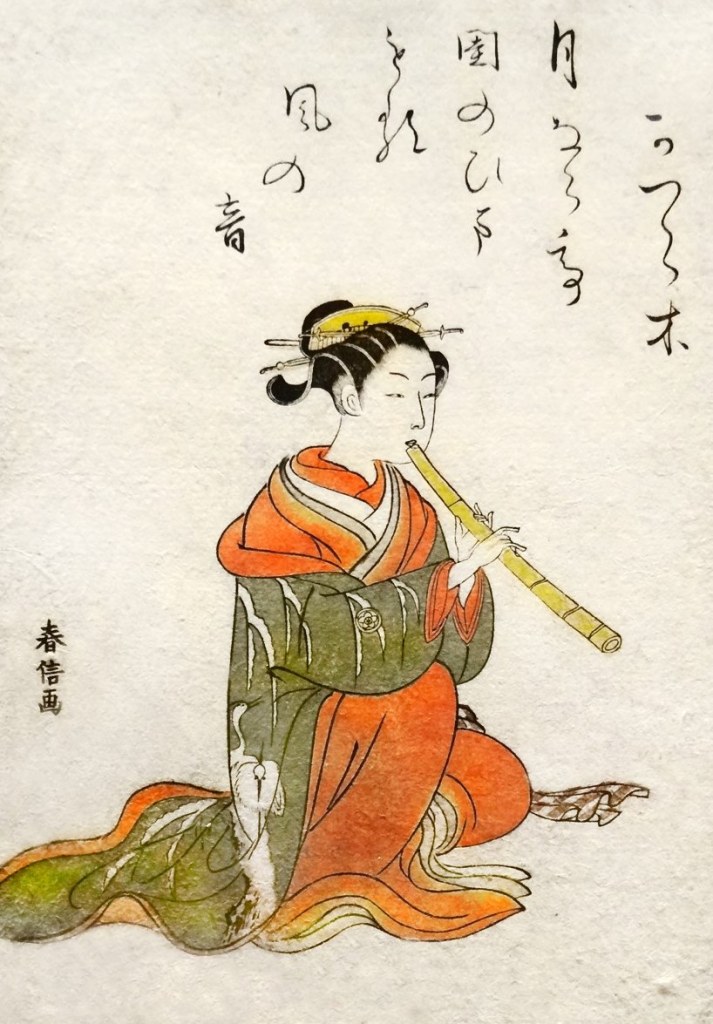
Suzuki Harunobu (circa 1725-1770). Courtesan playing Shakuhachi. Page from: Ehon Seiro Bijin Awase (Picture Book of comparative beauties of teahouses).
 Haiku Commentary
It is lovely to read the different nuances of these and to read them all together.
LikeLiked by 2 people
Dear Nicholas, Jacob & Hifsa- honored to be featured in Haiku Commentary. Grateful to Hifsa for the insightful and beautiful comments. Congratulations to Elliot & Jennifer – loved reading the haiku and the expert comments.
LikeLiked by 2 people
Pingback: Haiku Commentary – Whispers of the Soul
one thing I learned about haiku is that it should never be a regular sentence. There is no cut or break in this monoku. Thoughts?
LikeLike
It becomes quite complicated when examining the history. In Japan, haiku is typically written as a single line, and the kireji is sometimes placed at the end of the poem. So, sometimes they are written as one phrase or thought. However, in the monoku mentioned, there is an intuitive cut before “dawn.” It could be seen as one phrase or two. The haiku in the post, if read as one phrase, is not a complete sentence as well.
LikeLike