Haiku and senryu by Lucas Weissenborn, Vaishnavi Pusapati, and Neena Singh

corporate avenue –
even the trees
follow in line


Lucas Weissenborn (Norway)
first published in Failed Haiku, Volume 10, Issue 111, August 2025

Commentary by Jacob D. Salzer:

This haiku/senryu essentially shows the consequences and limitations of corporations and a corporate mindset, which is hierarchical, with the CEO at the top of the pyramid. The CEO’s vision and values trickle down, affecting the entire corporation and all employees. The CEO and senior management usually make far more money than the rest of the employees, sometimes to an extreme extent. The straight line mentality of “business as usual” seems to have inherent limitations and psychological consequences.

The last line reminds me of a conveyor belt: the same thing is done every day, much like a machine, and the employees within certain corporations may start to feel like gears in the machine. As a result, this poem indirectly shows the beauty and importance of creativity, as it avoids the straight-lined mentality. Even the trees in this poem that were planted along the avenue may appear to be artificial, given that they were planted in a perfect straight line. Also, the word “follow” in the last line reminds me of the corporate and military culture to follow orders. In the U.S., the best-paying jobs are often found in corporations. Some corporations have made more significant contributions to humanity, while others feed materialism and a consumer-based society. Non-profit organizations, such as The Nature Conservancy, have tried working with corporations to inform them that environmental stewardship is critical, not only for the planet, but for their own business as well. I don’t know how successful they have been with this endeavor, but I think The Nature Conservancy is worthy of praise and recognition for its sincere efforts.

While some people may regard this poem as a senryu, with the focus on the corporation (and because it was published in Failed Haiku), others may see this as a haiku, capturing part of modern culture. Regardless, this is an important poem that provides a window into the world of corporations and their limitations. May more corporations see the bigger picture to take better care of the Earth, people, employees, and other species.

mist over the pond –
last year’s reeds
still whisper


Vaishnavi Pusapati (India)

Commentary by Nicholas Klacsanzky:

Living in the Pacific Northwest, I’m very familiar with mist. It gives a spiritual, mysterious mood. Sometimes it is a welcome sight, and other times, you wish you could drive more clearly. Anyway, the first line presents a classical haiku scene with a dash to allow readers to pause before considering the second half. Thinking about mist in India, the primary season for it would be winter, specifically from late November to February. Having this haiku placed in winter resonates with the stark imagery in the last two lines.

I enjoy the surprise from the second line to the third. I expected the last line to be something like “still standing.” But “still whisper” resonates much more and leaves white space for the reader to fill in. The reeds could be staying around in a dry form, with the wind making music while moving through them. Also, the reeds could now be in a different form, as all decomposed matter transfers to other beings. The whispering of last year’s reeds could be part of the flora and fauna in the area or beyond.

The pacing of the lines is a little different than usual, with a longer first line and decreasing line lengths from there on. The first line could simply be “misty pond,” but the image of the mist suspended over the pond creates a more substantial effect in comparison to the whispering of last year’s reeds.

It appears to me that the most prominent letter in this haiku is “r.” It gives a weight to the reading and mood of the poem. Also, each word is chosen well and is compact, with only nine words in the haiku. It’s a haiku that effectively captures the mood of the scene and allows our imagination to see how a passed-on being still breathes through new life.

childhood home
I reach for a hand
no longer there


Neena Singh (India)
published in THF Volunteer Haiku Anthology—Kick the Clouds, 2025

Commentary by Hifsa Ashraf:

Childhood homes, family havelis, and ancestral spaces are among my most cherished themes in haiku. I spent my school summer vacations in our family haveli in the rural side of Punjab, where I experienced nature in its purest form. Those moments remain deeply embedded in my memory and continue to be a part of my poetry.

This haiku captures the innocence of a time when relationships were simple, honest, and pure. The opening line, ‘childhood home’, invites the reader to pause and absorb its emotional weight and strength. In the subcontinent, such homes are often vibrant, shared spaces where extended families live together under one roof. They are rich with relationships, daily rituals, and collective memory. Here, the poet evokes not just a physical place, but a nurturing environment that shapes one’s social and emotional values.

The second line, ‘I reach for a hand,’ introduces an intimate and personal gesture. It suggests the presence of a loved one, perhaps a grandparent, an aunt/uncle, or a cousin, etc. The act of reaching conveys both connection and longing. It feels like a vivid recollection of childhood, where true family bonds once existed. At the same time, it hints at absence and an emotional void.

The final line, ‘no longer there’, brings a subtle shift. A gentle sense of yūgen reflects a deep, unspoken awareness of life’s transience. Maybe time has changed the landscape of the home; the people who once lived there are gone, whether through distance or death. What remains is an emptiness that contrasts beautifully with the warmth of memory. Yet, in recalling these moments, the poet brings them to life.

Having no punctuation invites the reader to linger in the space, to experience the gaps where memory fades, and absence quietly endures.
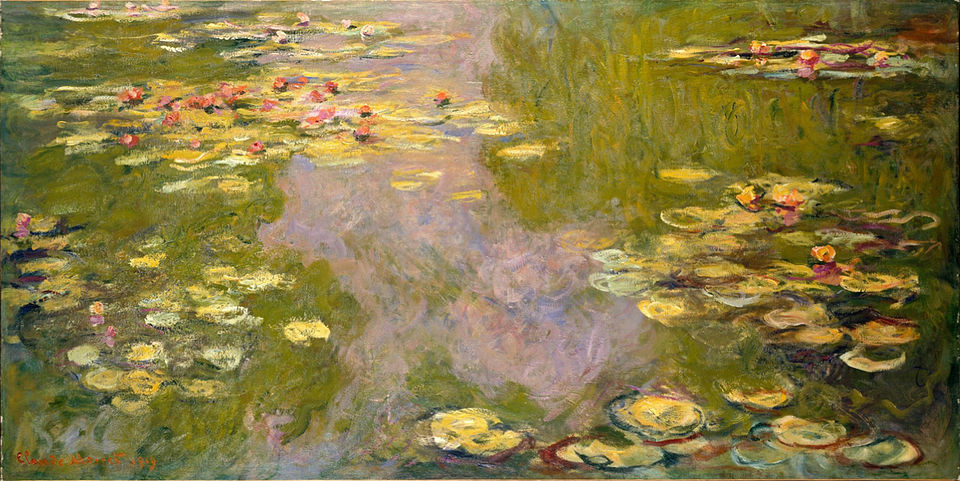
Water Lilies, a 1919 painting by impressionist Claude Monet

Haiku by Neena Singh, Anne Kulou, and Sheikha A. 

border outpost—
the sandbag wall
sprouts weeds 

Neena Singh (India)
hedgerow, #150, October 2025

Commentary from Hifsa Ashraf:

War and conflict-related haiku often resonate deeply with me, as the theme aligns with one of my core areas of interest. This particular poem instantly takes me to a tense border outpost, where I can almost sense the presence of surveillance and patrolling troops. It evokes not just conflict but the psychological barrier that accompanies division and hostility. Symbolically, it’s not the border itself that divides people but the mindset behind it. The em dash after line one adds a subtle pause, creating a link that suggests a deeper association with the border, both physically and ideologically.

The sandbag wall can be seen as a symbol of protection, whether from natural disasters or human threats. It creates a barrier not just to movement but to differing narratives or perspectives. Yet, sand itself represents adaptability as it adjusts itself according to the environment. In this way, the wall becomes a sign of both hurdles and resilience.

The final line, ‘sprouts weeds,’ brings in a hope in a tough element that cannot be stopped, even in a rigid and controlled environment. Weeds may be seen as unwelcome, but they are also symbols of persistence and continuity. Their presence suggests that even in the most restricted areas, life finds a way. It may also hint at the unresolved histories that cannot be buried or walled off entirely and may continue to resurface despite the suppressed and difficult conditions.

Finally, the soft ‘s’ and ‘w’ sounds add to the haiku’s depth, echoing wind, whispering secrets, hushed tension, and quiet movements.  

the faint hum
of the hallway light—
still breathing


Anne Kulou (Germany)

Commentary from Nicholas Klacsanzky:

This haiku explores a quiet moment in which the hum of artificial light becomes a mirror to the poet’s sense of aliveness. The crux of this poem lies in this interaction between the environment and inner self, which is often employed in the best haiku, as seen in poets like Basho, Santoka, Chiyo-ni, and Tohta.

The poem lacks a kigo or seasonal reference, but it definitely has a mood. In my opinion, the atmosphere of the haiku leans towards winter or late autumn, when nights are long, and people stay indoors. The absence of a kigo is not a weakness, as many haiku are traditionally written as non-seasonal, named muki haiku. As more people live in urban environments, non-seasonal haiku is likely to become more prevalent.

With the em dash in the first line, the poet creates a cut, or kireji, that separates the two parts of the haiku. It also brings about a sense of immediacy, whereas with an ellipsis, the reader would think it is more of a continuous scene. The choice of an em dash makes the haiku more raw and present.

In looking at the toriawase, or harmony/combination of parts, the monotonous hum of a hallway light mixes with the continuity of breathing. It demonstrates a synthesis between the human-made world and humanity itself. The word “hum” even suggests that the light is breathing, too. Also, the word “faint” is most likely a reflection of how the poet is feeling in comparison to the light fixture. In this sense, the poet and the light fixture become connected, and fraternity grows between them.

Exploring the haiku on a sonic level, the letter “h” stands out the most. “hum” and “hallway” hit a punctuated, yet light rhythm. Other soft consonants like f, m, l, th, and br help to make the haiku “hum” like the scene in the poem.

The pacing of the haiku is traditional in terms of Japanese haiku rhythm, with a short first line, a longer second line, and a short last line. This pacing lends to the content well, as it gives the haiku an introspective air. The diction is also casual and direct, which is aligned with haiku tradition.

This haiku seamlessly blends past and present aesthetics. With foundational elements of haiku, the poet explores a non-seasonal, urban environment that turns towards self-reflection with artistic precision.

autumn rose 
on his car’s dashboard
—blind date night 

Sheikha A. (Dubai, United Arab Emirates)

Commentary from Jacob D. Salzer:

An intriguing haiku that explores the psychological complexity of a blind date.

The autumn rose as the first line is intriguing by itself, as roses are typically associated with spring. It seems the autumn rose signifies that something or someone has passed away, and there is an unfolding or rebirth of some kind. The man’s previous partner may have passed away, or they may have separated, and now the poet is open to dating again.

A blind date can have a wide range of outcomes, as both people rely on their intuition and questions to get to know each other better, though first impressions can be deceiving. Leaving a rose on the dashboard could show that the man has a hopeful mindset, or it could be a sign that he may be trying too hard to make a first impression. In the dating world, for many people, it is a competition. Who is going to find a true and lasting partner? Perhaps the rose is a way to try to stand out from the crowd. In this haiku, the blind date could have been going to a drive-in movie, or the poet could be saying goodbye and noticed the rose while walking past his car in the parking lot. Was the rose meant for the poet, and he decided not to give it to her? Did he give her the rose, and she didn’t accept it? Or was the rose meant for someone else and was left behind from a previous date? There is some mystery. The autumn rose signifies how so much of our communication is non-verbal. The transient beauty of the rose also comes with thorns, which seem to signify danger and/or protection. Indeed, all relationships have a degree of risk as trust is gradually established. The autumn rose could also relate to how a blind date doesn’t last long but can have its own beauty, even if the blind date doesn’t find rich soil that blossoms into a romantic relationship.

The term “blind date” also has room for more than one meaning. Aside from not knowing the person, what are we blind to within our own self? Sometimes, the person on the blind date can be a kind of mirror that reflects something within ourselves that we didn’t notice or pay attention to.

In summary, this is an interesting haiku that explores the psychological depth and complexity of relationships and dating.

Designed by DMoSan

Haiku by Elliot Diamond, Neena Singh, and Jennifer Gurney

the first hole of a shakuhachi dawn 

Elliot Diamond (USA)
Modern Haiku 55.2, 2024

Commentary from Nicholas Klacsanzky:

This haiku succeeds in seamlessly layering sound and imagery to create a spiritual atmosphere. It juxtaposes the shakuhachi—an ancient Japanese bamboo flute—with the unfolding of dawn. The “first hole” can be read both literally, as the finger-hole that allows the first note to emerge, and metaphorically, as an aperture through which the first light of day enters the world. It also could be a symbol of a threshold between silence and sound, darkness and light. The shakuhachi’s connection with Zen practice further shades the image with spiritual awakening: dawn not only as a time of day, but also as a symbol of enlightenment.

The haiku, being one line, creates a representation of the shakuhachi. It could have been written as three lines, such as “dawn/the first hole/of a shakuhachi.” However, I feel the haiku is more organic and interesting as one line.

The diction is minimal, yet the resonance is wide: the reader can hear the first note, feel the cool breeze of dawn, and perhaps see the bamboo hollowed into an instrument. In addition, the phrasing enjoyably blurs instrument and environment. What we’re left with is not just an instrument or a sunrise but a moment of initiation, where time seems to exhale through the flute.

Though there is no kigo or seasonal reference, the time is evident. There is also no kireji or marker for a break, though there can be a natural pause after “shakuhachi.”

Finally, the sound of the haiku works well with the letter “h” being the most prominent. The breathiness of the letter “h” in “hole and “shakuhachi” illustrates blowing into a flute.

Despite the minimalist aesthetic of this haiku, the poet leaves a lot for the reader to ponder and feel through inner vision.

summer solstice
the busker plays
a tune from home


Neena Singh (India)
2nd Prize, Japan Fair Haiku Contest 2025

Commentary from Hifsa Ashraf:

The haiku’s imagery, anchored by the summer solstice kigo, evokes solitude and introspection through a busker’s tune played from home. The solstice’s long daylight amplifies the sense of isolation, yet the music serves as a cathartic bridge to an unseen audience, blending self-fulfillment with a subtle yearning for connection. The summer solstice, with its prolonged daylight, casts a spotlight on the busker’s solitary performance, evoking and highlighting both isolation and self-awareness.  I see the poem as a catharsis and self-awareness where an artist thoroughly enjoys their talent without having an audience or the audience is unseen.

The haiku conveys the busker’s enjoyment of solitude, longing, or melancholy in the deepest way. The poem balances solitude and loneliness, suggesting the busker finds fulfillment in their music while possibly yearning for the connection typically found in public performance. If rooted in a Japanese context, the busker’s solitary tune might reflect a Zen-inspired embrace of the present moment, deepening the poem’s meditative quality. In any case, it is irrelevant to the person who may be in a meditative state of selflessness or enjoying being alone, only with what they enjoy the most. It also makes me wonder: does the poem suggest the busker imagines an audience, or is the music itself a bridge to an abstract sense of connection?
A “tune from home” could imply the busker is playing from within their home, possibly for an unseen audience. However, buskers traditionally perform in public spaces for passersby, so the shift to a private setting might be a deliberate contrast in the poem, symbolizing introspection or a lack of external validation.

Looking at the technical details, the lack of punctuation and the rhythmic ‘m’ sounds mirror the tune’s fluidity, creating a meditative tone that resonates with both the busker’s inner world and the listener’s sense of belonging.

the branches
of my family tree
together

Jennifer Gurney (USA)
Cold Moon Journal, 6/19/25

Commentary from Jacob D. Salzer:

I appreciate how this haiku offers at least a few different interpretations. After the first read, I saw many lives joined through her family heritage. This seems to be a relatively simple metaphor, but it can act as a portal into the details of many family members and their stories. After reading a second time, I saw the branches as fallen and now physically gathered together. This leads to an interesting metaphorical interpretation that perhaps the souls of her family ancestors could be together in a different dimension. After a third reading, I saw the poet viewing a historical family album and/or a historical document/book about her ancestors.

As a creative writing exercise, I recently wrote a letter to my first great-grandfather, who settled in the U.S. I tried my best to transport myself back in time and asked many questions about his life. In addition, my father shared historical records of our ancestors. This has deepened my understanding of our family tree and makes me realize how much has changed in a relatively short amount of time. All this being said, I appreciate how this haiku encourages us to study our genealogy and history to see what we can learn about our ancestors and ourselves.

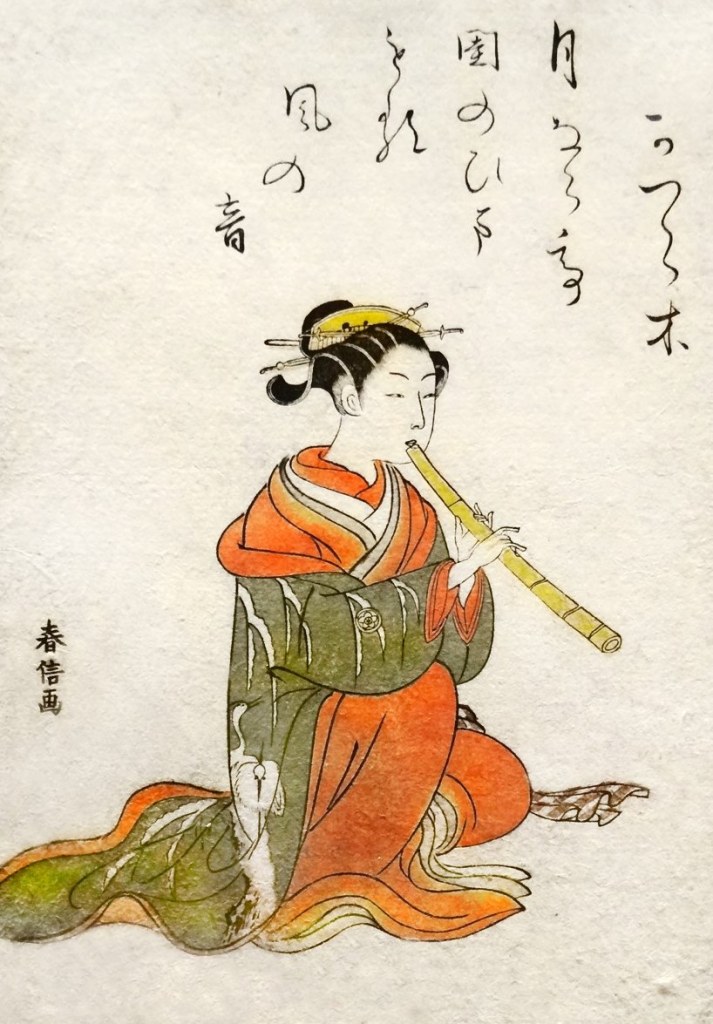
Suzuki Harunobu (circa 1725-1770). Courtesan playing Shakuhachi. Page from: Ehon Seiro Bijin Awase (Picture Book of comparative beauties of teahouses).