
plans for the New Year
my list is turning into
origami
— Urszula Marciniak (Poland)
published in ESUJ-H: English Haiku, December, 2025
Commentary by Nicholas Klacsanzky:
This haiku opens with the common New Year’s ritual of making a list of resolutions. The seasonal reference (kigo) of New Year is extremely traditional in Japanese haiku. Each Japanese haiku master of old has written perhaps hundreds, and even thousands, of New Year haiku. So, the poet leans into this tradition.
The word plans carries weight, as wishes is usually used. This seriousness is undermined or transformed in the second line, though. Turning suggests a shift, and origami being used on its own allows the reader to imagine the infinite possibilities of this artform.
The enjambment in the second line is uncommon in haiku, especially traditional haiku, but it holds readers in suspension. It is difficult to expect origami to be the third line, and the surprise helps the haiku become more endearing. Also, this haiku does not have punctuation but most likely does not need it. If there were a punctuation mark in the first line, it would make that line super long. There is a clear line break between the first and second lines.
The final image in this haiku suggests a mixture of things. It could be showing frustration at the act of creating a list to adhere to. It could also be a sense of whimsy, viewing resolutions as play rather than concrete, business-like aspirations. In another way, it could be suggesting that time is relative and New Year’s rituals are not as important as people think.
Looking at the sound, the opening pl cluster gives a brisk, purposeful feel, while the long vowels in new and year give the first line a sense of expansiveness, befitting new beginnings. Frustration is felt in the short vowels in the second line with list, is, and in. In the third line, every syllable is open and soft, which is a complete contrast to the clipped sounds of line two.
Ultimately, this haiku folds meaning into itself, just as its imagery suggests. It transforms a ritual and tradition into a playful act, which I feel is needed in these harsh days.
await discharge papers
outside the ward window
a fleeting bird
— Tuyet Van Do (Australia)
published in FreeXpresSion, issue 2, February 2026
Commentary by Jacob D. Salzer:
This haiku has considerable psychological weight and significance. According to vocabulary.com, “A ward is a group of rooms or a section in a hospital or prison; in a hospital, different wards deal with different needs, like the psychiatric ward or maternity ward.” The discharge papers signify that the person was in the hospital or prison ward for a number of days, weeks, or even months or years, but we don’t know why.
In this haiku, we are standing at an important threshold between worlds, evident in the transition of being discharged back into society, and noticing the bird glimpsed outside the window. The last line, “a fleeting bird,” could be interpreted as a symbol of hope, that the spirit of the person will have a new kind of freedom and a better life. On the other hand, the word “fleeting” could contain connotations that this hospital or prison stay may happen again in the future. Ultimately, this haiku sparks important conversations about hospitals, prisons, and larger conversations about society in general. For example, in the U.S., there are more people in prisons than in any other country in the world. (Source: https://www.sentencingproject.org/reports/mass-incarceration-trends/)
Why is this the case? How can we prevent more crime to begin with? How can we prevent more illnesses and also give people a better chance at a better life when they are discharged from hospitals and prisons? My hope is that this haiku will encourage more people to take a closer look at healthcare systems and prisons, and take proactive steps to make life better for more people. This is an important and vulnerable haiku that shows deep wounds in society and in people, and, hopefully, also shows signs of true healing, transformation, and a better life.
memory care unit
this rippling twilight
beneath cypress trees
— Elliot Nicely (USA)
published in Modern Haiku, 57.1, 2026
Commentary by Hifsa Ashraf:
The opening phrase, ‘memory care unit,’ establishes a setting most likely associated with aging, dementia, and the fragility of memory. It is a place where care, healing, and support take time, and where hope often persists despite uncertainty. The absence of punctuation leaves the phrase open, inviting readers to read it from different perspectives.
The second line, ‘this rippling twilight,’ introduces a transient and shifting moment of the day. The use of ‘this’ points to a particular twilight, making the experience immediate. The word ‘rippling’ suggests movement and transformation, whether real or imagined. It may refer to light filtering through the trees, reflections on a window, water, or another reflective surface. The poem naturally raises questions: What are the colours of this twilight? What causes the rippling effect? Is there water, a puddle, glass, or the play of light and shadow?
Cypress trees often carry associations with remembrance, longevity, and mortality. Their presence deepens the poem’s emotional and probably psychological resonance. There is a sense of yūgen here, as the poem leaves much unseen. What kind of cypress trees are these? Do they stand in a row, or do they form a canopy through which the fading light filters? The observer’s position also remains uncertain. Are they looking through a window? Standing beneath the trees? Or, is the scene partly imagined?
This uncertainty leads to another important question: Who is the observer? A resident, a caregiver, a visitor, or perhaps the poet? The haiku does not tell us, and that openness enriches the reading.
In any case, I appreciate how the poem connects imagination and nature within the setting of a memory care unit. Amid concerns about memory and aging, the natural world continues to offer moments of beauty, mystery, and reflection.
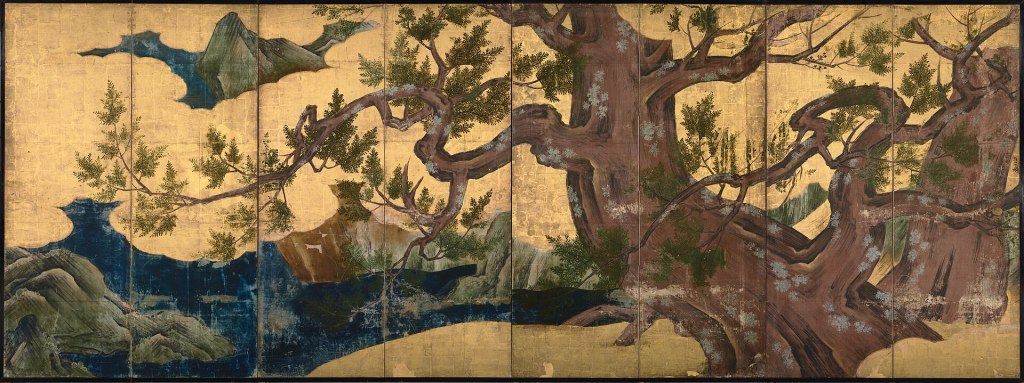
Kanō Eitoku, Cypress Trees, Tokyo National Museum
 Haiku Commentary
A heart-touching selection of haiku for commentary. Enjoyed the insightful commentary by the editors. Congratulations to poets and editors for giving us this treat.
LikeLiked by 3 people