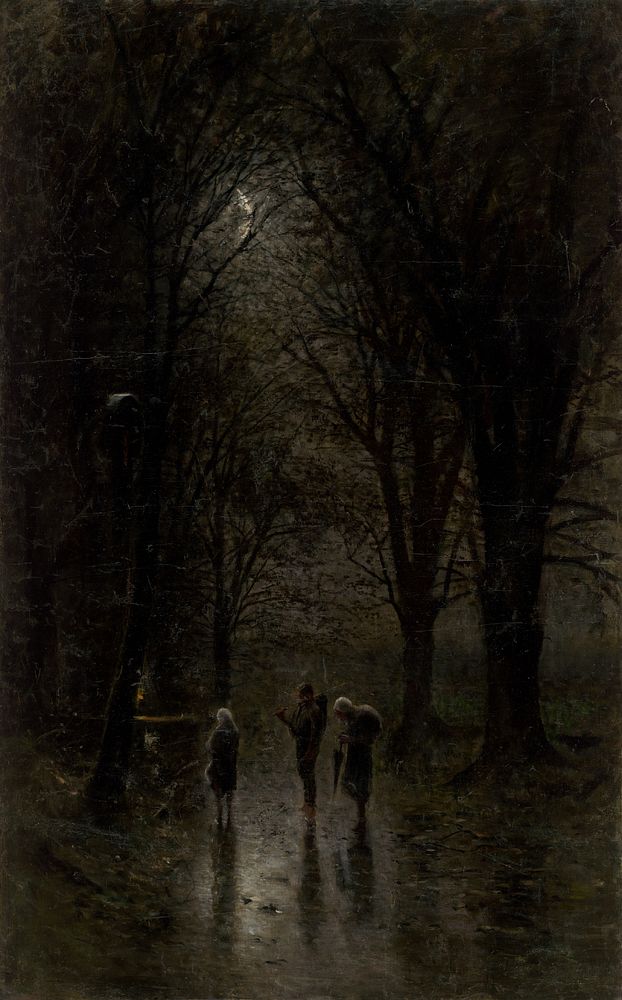
night walk
in the forest
I’m a sound
by Srini
Betty Drevniok Award 2025, Honorable Mention
Commentary by Hifsa Ashraf:
A very simple yet subtle haiku, with almost equal-length lines and no punctuation. The poet focuses on self-discovery, self-reflection, and something therapeutic and meditative in nature.
Night walk makes us imagine a time when most people are resting, their bodies attuned to the rhythm of sleep. Yet, walking at night is not a usual habit for everyone. Is the person sleepless for some reason, trying to unwind after a day’s activities, or intentionally seeking something beyond the ordinary? Does the walk bring comfort or relief, or is it a metaphor for both inner and outer journeys? These possibilities remain open to interpretation.
The forest adds another layer of mystery. Is it an actual forest, perhaps encountered during a long journey, or the forest within ourselves? Who is walking there—a traveller, a wanderer, an explorer, or simply someone taking a routine walk? The answers may shape our understanding of this nocturnal journey.
The last line, I’m a sound, shifts our focus from the outer world to the inner self. The person takes a central position through this declaration, suggesting a heightened, conscious self-awareness. Rather than merely hearing the sounds around, the person becomes a sound, perhaps recognising an ability to influence or even shape the surrounding environment. Could this be a form of self-realisation, or even a kind of self-prophecy, in which the person becomes aware of his/her own presence and power? The haiku leaves these possibilities unresolved, inviting us to explore the delicate boundary between the self and the surrounding world.
I personally see this haiku as a form of self-exploration, where the person is trying to understand the inner self and find a deeper connection with the surroundings during a night walk.
lonely eve
seated on the doorstep
talking with the stars
by Lanka Siriwardana (Sri Lanka)
6th Star Haiku Contest 2025, Honorable Mention
Commentary by Nicholas Klacsanzky:
Though the evening is lonely, the poet has gained the whole universe to talk to. The space between the doorstep and the heavens is vast but seems close in this haiku. Since time immemorial, we have been speaking with the stars and the infinity of the universe. This haiku connects to our primordial nature, and one that is perhaps the most mystic.
The word “lonely” reminds me of classical haiku from the old masters. Phrases like “lonely road” or “lonely night” were more common in the past. In the case of “lonely eve,” I believe it is a nod to autumn or winter. The cold or sparseness would be conducive to this type of emotion. The poet plays with feeling, though, as the poem begins in a depressing mood and changes to something more hopeful.
The lack of punctuation allows the second line to pivot from attaching to either the first or third line, adding two different meanings. If punctuation were applied, I would think an ellipsis would work well to illustrate the stars and the length of talking mentioned in the end.
Interestingly, the first two lines feature the letter “o,” illustrating the sound of loneliness in its long vowel. However, in the last line, quicker and sharper sounds emerge to change the loneliness into an active bond.
In looking at the pacing, I noticed the last line could have been shorter without “the.” However, “the” in the third line gives it a more personal relationship with the stars rather than a generic one.
A lovely haiku of cosmic proportions. I can see why it won an award in a contest.
all the books i have not read new moon
by Quamrul Hassan (USA)
Published in Frogpond, Issue 49.1, 2026
Commentary by Jacob D. Salzer:
While seemingly simple, this one-line haiku (monoku) reminds everyone of how much we have yet to read, how much we have yet to learn (and unlearn), and how limited our time is within a single lifetime to read. Due to our limited earthly lifetime, all of us have to be selective on what books we choose to read and what books we choose to not read, and how do we decide? The poet leaves room for the reader in terms of what books are being referred to, and in terms of context. Are the books in this poem required to read for college? Is there a stack of books waiting to be read for leisure? Or is the poet in the library or a bookstore, looking at the sheer amount of books available to read and perhaps struggling to choose which books to check out or buy? There seems to be a humbling feeling in this monoku that shows the overwhelming amount of books that are available. No matter how avid we are as readers, there will always be innumerable books we simply don’t have time to read.
Regardless of how we choose to engage with this poem, the new moon offers a symbol to contemplate: is this a new cycle or season in the poet’s life? Does the new moon inspire a new beginning, new books to read, and new adventures? Or does the new moon remind us that, while words are important, there is a light and life beyond us (and within us) that is wordless, mysterious, and indefinable?
In short, this is an effective monoku that leads us to contemplate literature, poetry, and the psychology of choosing what books to read. An interesting and effective poem.