Carmela Marino’s first buds

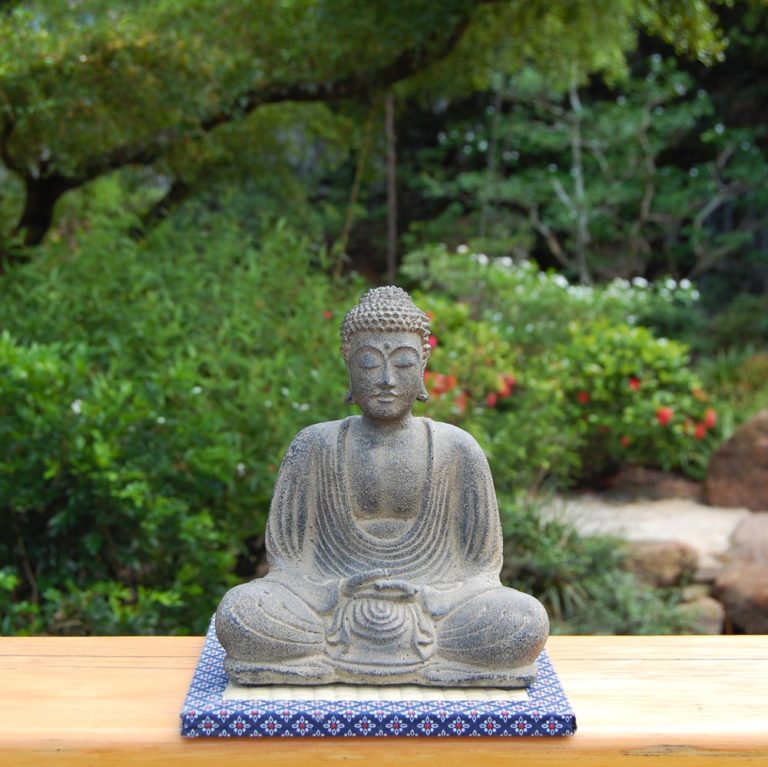
first buds—
I dust the head
of a stone Buddha

Carmela Marino (Italy)
(previously published at the Golden Triangle Contest March 2022)

Commentary

This is an interesting haiku that touches both the hard and soft sides of life deeply and perhaps spiritually. The opening line ‘first buds’ gives some hope of spring—the season of new beginnings, or rejuvenation. The plural form of ‘buds’ makes it a bit mysterious where it looks like there is an abundance of buds on a branch, falling, or stuck on the head of a stone Buddha. But, when I take this haiku as a whole, I find it more intrinsic, more towards ‘self-enlightenment’ and/or ‘wisdom’ where buds can be the lessons of wisdom or Buddha’s philosophy unfurling in different phases of life as a sign of hope, progress, learning, and change.

It only needs some clarity, mindfulness, or crystallization of thoughts which is signified in the second line ‘I dust the head’ where the emphasis is beyond seeing i.e. introspection or meditation. I liked the way the poet blends both the delicate side of nature (buds) with the hard and concrete side of nurture (head) by masterfully using the technique of ekphrasis and yugen which may catch the eyes of many haiku lovers. 

Hifsa Ashraf (Pakistan)

I appreciate the contrasts in the juxtaposition. The flowers are soft: the Buddha statue is not. The first buds symbolize birth, while dust symbolizes death. The flowers are full of color, while the stone Buddha is not (unless he’s wearing a green moss robe). After Enlightenment, it’s been said the Buddha escaped the wheel of samsara: the endless cycles of birth and death. Actually, in a way, it seems this haiku succinctly expresses the essence of Buddhism by showing the nature of impermanence (symbolized by dust). The Buddha shows us that the mind’s attachment to what is fleeting and temporary creates suffering (while nonattachment reveals peace and ends suffering).

This haiku also brings to mind a quote by my favorite Estonian composer Arvo Pärt: “Time and timelessness are connected. This moment and eternity are struggling within us.” 

It seems impossible for the human mind to experience life that is timeless because the measurement of time seems to be hardwired into conditioned thoughts. Yet the timeless ever-flowing “now” is the only time we are ever alive. It seems the present moment is actually something the mind can never identify with because when it tries to describe the moment, it’s already describing a past event. Thus, it seems the experience of living in the timeless ever-flowing “now” is not a mental concept or idea, but rather seems to originate from the spirit without any words or thoughts. Of course, our measurement of time has its place in modern society. We frequently measure our lives in years, months, weeks, minutes, and seconds. We have work schedules, meetings to attend, and appointments to keep. In the world of jobs and making a living, time is money. However, this haiku puts our small human lives into perspective. One day, we will all physically become dust on the stone Buddha. Therefore, who am I?

Interestingly, the fact there is any dust to begin with made me initially envision a Buddha statue indoors somewhere. At first, I only saw human dust. However, on the second read, I see pollen and the poet is dusting the pollen off the Buddha statue in a garden or park somewhere. This also could be true. 

In regards to the first line, the flower buds could be symbols of hope for new generations. It’s also been said the Buddha gave his disciples a flower without speaking a word. This was a transmission of Enlightenment: a wordless unity that is devoid of thoughts. It’s also true that not all flowers bloom at the same time, but they naturally open to sunlight when the time is ripe. In a way, it seems the same could be said regarding our spiritual unfoldment. I also appreciate the saying: “When the student is ready, the master always appears.” For me, this haiku speaks to this quote as well, where the new buds are students. Perhaps most powerfully, without a single word, the stone Buddha guides us to look within, to become still and quiet. It seems only in those silent depths can I begin to realize his Spirit is not separate from my own Spirit. Perhaps eventually, ultimately, the master vs. disciple duality will seem to disappear. 

In short, this is a powerful haiku that expresses impermanence, the timeless flow of the present, and the teachings of the Buddha. 

— Jacob D. Salzer (USA)

Hifsa and Jacob wrote extensively on the meaning and interpretations of this haiku. I will in turn dive a bit into the technical world of this poem.

In the first line, we have a traditional kigo, or seasonal reference, for spring. “Buds” is fairly general, but I think the poet may have wanted to shy away from putting too much attention on the flower itself in order to focus more on the Buddha. Also in the first line, we see a dash used to separate the two parts of the haiku, which is the fragment and the phrase. This is another classical element of this haiku.

The second line brings in the action. Commonly, haiku only have one verb so that we can concentrate on one movement. Here, the “head” could be the head of a flower without reading the third line.

In the third line, we discover that the head is not of a flower but of a stone Buddha. I think it is important that the poet capitalized “Buddha” as she is not referring to not just any buddha but the Buddha in the form of a statue. She is treating this stone as the actual Buddha and giving it proper reverence. Dusting the statue’s head might signify cleaning or clearing the way to enlightenment, as with a clear mind, one can be in nirvana.

Looking at how the lines are arranged, we have a non-standard length of lines according to English-language haiku. The longest line is usually the second, but here it is the last. There is nothing wrong with this, especially since syllables and Japanese sound units don’t match up well. As long as the rhythm flows well and brings about a potent mood, which I think this haiku does. The rhythm present makes “Buddha” stand out more, which is not a bad thing at all.

We have some interesting usage of sound in this poem, too. The “u”s in “buds,” “dust,” and “Buddha” seem to provide a sense of reverence to me. The “b” sounds pop and make the haiku reading more powerful.

In terms of aesthetics, this haiku might show ba. According to Jim Kacian, “If you look up ba in any Japanese-English Dictionary you’ll find it means “place” or “site” or “occasion”. And these are all true in the most general sense—ba is a pointer to a kind of awareness that something of importance is happening in time and space.” I feel this haiku demonstrates a spiritual importance to the moment of dusting a stone Buddha’s head, where it plays with spirituality, physical objects, and manifestation.

An enjoyable haiku with multiple layers of spiritual and religious meaning.

Nicholas Klacsanzky (USA)

Sandip Chauhan’s flowing river

flowing river . . .
the spot where I poured
his ashes

Sandip Chauhan (USA)
(IAFOR Vladimir Devidé Haiku Award 2016 – Runners Up)

Commentary

This is a powerful haiku that sparks a conversation about life, death, cycles, time, and the afterlife. Does a river know of past or future, or any sense of time? Because of its continuity, the ever-present flow of now is the only time we are ever truly alive, while past and future seem to be abstractions. In the river’s flow, the person’s ashes seem to simultaneously conjure up the past and the future of the person’s soul. The interesting part about this haiku is “the spot” because it implies a specific place, but that spot in the river is always flowing. In fact, it seems the spot in this haiku can only be recognized because of a nearby landmark, such as a boulder.

This haiku contains yugen (mystery), leaving room for us as readers. Who is the male persona in this haiku who has passed away? How did he pass away? Because we don’t know the answer to these questions, this haiku can conjure up mixed emotions that relate to our own experience. In addition to grief, this haiku could conjure up gratitude for both the person who passed away and the river itself. To the poet, the male persona in this haiku could be his father, brother, son, another family member, or a friend. Regardless of who he is, it’s clear this is a moment many people can relate to. 

In this haiku, the person’s ashes become one with the river. Perhaps this haiku can inspire us to feel connected with Mother Earth and treat water with more respect before physical death as well. 

In terms of spirituality, it seems the individual soul (jiva) is like a river that eventually becomes one with the universal spirit (Shiva) likened to the sea. According to the spiritual teachings of Sri Ramana Maharshi, if there are karmic mental impressions (samskaras) left at the time of physical death, this necessitates rebirth at the right time, and this is how individual souls are reborn. 

Regardless of our views on death and the afterlife, this haiku brings mixed emotions and ultimately seems to bring a sense of ease that even at the time of physical death, life goes on. A powerful haiku. 

Jacob D. Salzer (USA)

It’s about life and death where ‘pausing and flowing’ comes together. It’s time that heals grief and lets us move on like a flowing river. The ellipsis in the first line shows how meaningful and significant it is to keep going on no matter how difficult life is. ‘The spot’ is the place where life and death depart from each other in terms of letting go and catching on.

I see it as a person, despite grieving over the death of a loved one, trying to console themselves by accepting the bitter reality, which is the ‘departure or death’—ready to accept what comes next. 

Hifsa Ashraf (Pakistan)

I’ll explore the seasonal reference, pacing, language, sound, and meaning.

There is no clear kigo (seasonal reference), but a flowing river probably cancels out it being winter (lack of frozen water). Because of the tone, I imagine this haiku to be autumnal.

The pacing of the lines is a prime example of the English-language attempt at replicating the traditional Japanese rhythm of “go-shichi-go.” The standard is a short first line, a longer second line, and a short third line. As many know, syllable counting does not match the 5-7-5 Japanese sound units on well, and we use the aforementioned rhythm primarily.

In terms of the language, the poet rightly uses simple vocabulary so as to not be formal or verbose. Like the haiku written by the masters, the poet employs language that cuts straight to the reader. The last thing you want to do in a haiku is bog down the expression of the moment in verbosity and formality. From Matsuo Basho onwards, the haiku (then hokku) became a vehicle of vernacular speech and casual expression.

The first thing I noticed about the sound of this haiku was the repetition of “o” sounds. These elongated sounds carry the leisurely but melancholic movement of the river. “S” also features strongly, providing the music of the river in the reader’s mind.

Jacob and Hifsa have discussed the meaning of this haiku already, but I’ll add that this poem gives me feelings of both the importance and triviality of the body—and perhaps identity. The poet knows the exact spot where he offered the ashes of a loved one in the river, but the river is not stagnant or static. The river is ever-changing, which mirrors Heraclitus who said, “The only constant in life is change.” We can try to claim an identity, but even that is constantly fluid and flowing.

Nicholas Klacsanzky (USA)

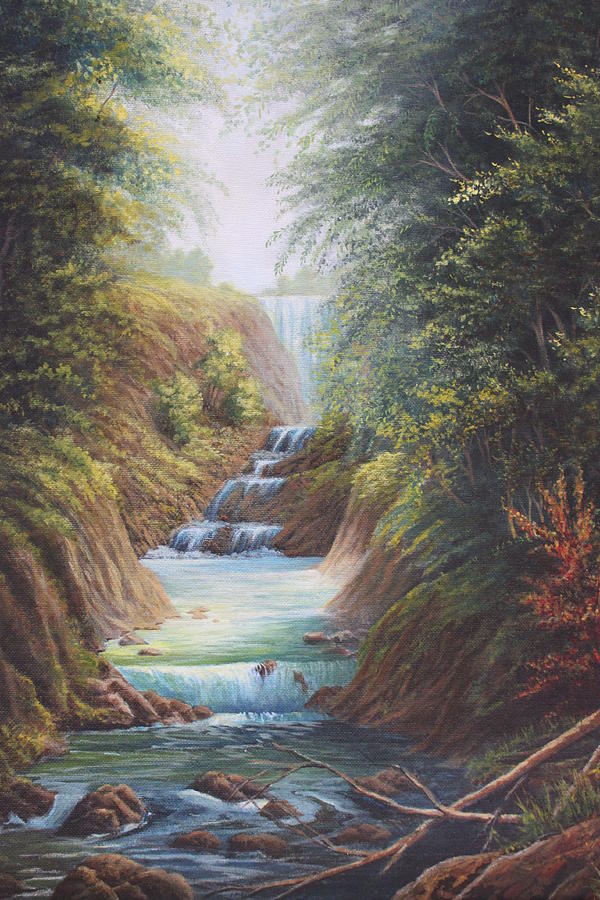
“Flowing River” by Diana Miller

Małgorzata Formanowska’s white morning

white morning
on grandfather’s grave
fox footprints

Małgorzata Formanowska (Poland)
(published previously in Frogpond vol.44.1 Winter 2021)

Commentary

I like the notion of reincarnation or transformation in this haiku. From the untouched snow, new life. Out of death, signs of life. Out of silence, new stories. A part of me wonders if the poet’s grandfather liked foxes and the poet sees their grandfather’s spirit in the fox in some way. 

I like the atmosphere and deep silence in the first two lines. It sets the tone of the haiku and paints a somber mood. Additionally, when I read “morning” I also think of “mourning” sonically, so I feel hints of grief already in the first line and then the mood solidifies in line 2. By contrast, the third line contains new energy that is fresh and alive. Even though we are only seeing footprints, I also see a timelapse of the fox trotting through the graveyard with his or her vivid orange fur against the stark background of snow. 

This haiku transports me into the lives of my own grandfathers and stories I know about them. I appreciate the acknowledgement of the poet’s grandfather in this haiku. I could also see this haiku as being an excellent start to a haibun about the poet’s grandfather and his stories.

Overall, an excellent haiku that pays tribute to family, animals, and the cycles of life.

 — Jacob D. Salzer (USA)

When I visualize ‘white morning’ I feel as if I am drifting through a dream that is not so vivid or clear to my imagination or sight. The white morning adds more subtlety to this haiku as it’s the early part of the dawn—probably pre-dawn or early dawn. The time when a person’s mental faculties revolve around the self that reflect the true or deep meaning of the realities of life.

The grandfather’s grave with fox footprints gives a sort of mystery that takes us on a walk through the white morning or a dream to imagine a cemetery—perhaps an abandoned one or somewhere in a wild place. I could see the fox footprints as memories of the past that are fresh and deeply imprinted on the mind, maybe from childhood. The connection between the grandfather’s grave and fox footprints is elusive as it could be certain family traditions that pass on from one generation to another, or family affairs that seem to be not well settled, or it could be a sign of good or bad omens.  

Overall, I see it as certain deeds or behaviours remaining fresh and unforgettable even after the demise of a person. It’s the next generation who decides how to perceive and interpret them, especially when there are a lot of rumours about them that are not clear, like the white morning. 

Hifsa Ashraf (Pakistan)

We have a clear kigo (seasonal reference) with “white morning,” which refers to winter and specifically snow. In context of this haiku, it brings a sense of coldness and melancholy.

For the pacing, we have a traditional English-language rhythm of a short first line, a longer second line, and a short third line. What is also of importance is that the second line acts as a pivot, where it can be read as connecting to both the first and third line: “white morning on grandfather’s grave” and “on grandfather’s grave, fox footprints.”

Turning our attention to aesthetics, this haiku may contain ma, which is a Japanese aesthetic that stands for not only the unsaid in the poem, but also “the sense of time and space, incorporating between, space, room, interval, pause, time, timing, passing, distanced, etc. More particularly, ma may be taken as the timing of space, as in the duration between two musical notes. Silence is valued as well as sound. It is said that the ma aesthetic is influential upon all varieties of Japanese art” (Simply Haiku, Denis Garrison). There is quite a bit unsaid in this haiku, but we can feel the powerful possibilities therein. In addition, there is a play of time of someone’s passing and the occurrence of fox’s footprints, bringing the past and present into union.

Looking at the sound, I’m drawn to the “o” sounds that elongate the reading and make it more somber in tone. The “i” sounds also give it a sense of urgency.

The language used is simple and effective, and not unnecessarily formal, sentimental, or verbose. It follows the principle of employing just the right amount of words needed to express the moment and feeling.

A haiku with an ethereal quality that makes the reader step inside the emotions and mystery of the moment.

Nicholas Klacsanzky (USA)

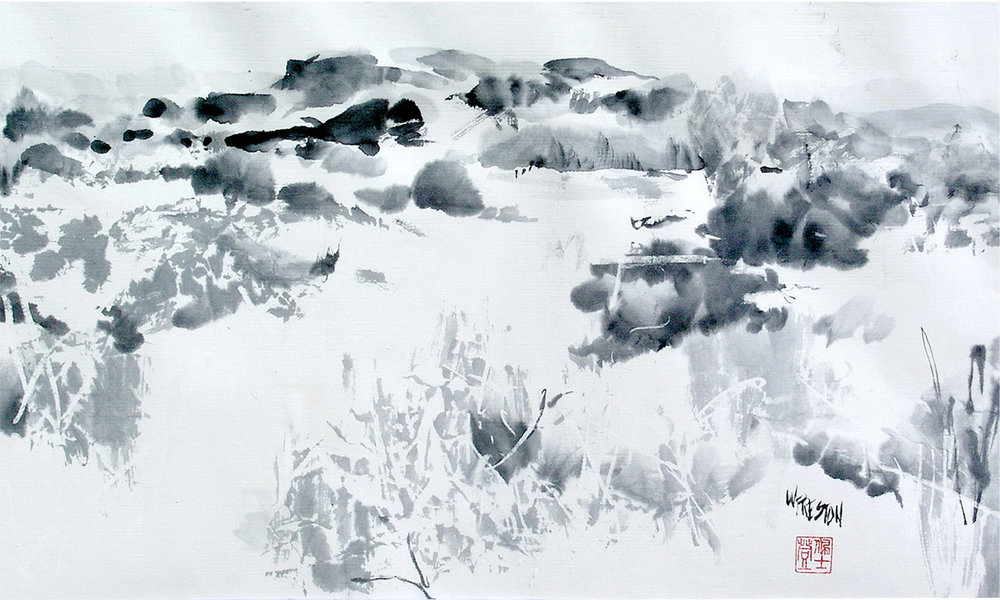
Painting by William Preston