Sandip Chauhan’s Moonbow

moonbow . . .
in a grain of wheat
a farmer’s song

© Sandip Chauhan (USA)

2nd Place, 2014 International Matsuo Basho Award for Haiku Poetry

This haiku starts with subtle feelings. The writer takes us to the world where serenity tickles all the elements of nature. Watching a moonbow itself brings delightful feelings with the deepest effects. The arc of the moonbow reflects the mesmerizing impact of beautiful things around us that bring blessings in our lives. It also is a kind of celebration and/or reward for the hard work one has done in the field.

In a farmer’s life, the only thing that can bring true blessings and happiness is a golden crop that manifests his or her wishes to fulfill his or her desires. A grain of wheat symbolizes prosperity and wealth, where every grain is full of life. No one else can understand this better than a farmer who has given his or her days and nights to bring golden grains to their final stage, when they are called a treasure of life. The farmer’s song on the harvest day indicates that harmony and genuineness of things that complement each other. The moonbow in the sky, the grains in the field, the song a farmer sings as a whole, displaying a perfect picture of the ideal harvest day.

Hifsa Ashraf (Pakistan)

A moonbow is reminiscent of the moonlight on a sickle when, in my country, the wheat is harvested in the light of the full moon so as not to face the June sun. During the night, from the valleys behind the last houses of the village, come the songs of the peasants. In the morning, someone gives us an ear of wheat to wish us luck and that calloused hand slips a little grain and shows it to us with satisfaction.

I found everything in this beautiful haiku. I found the sowing, the harvest, the hope, and also the fear of a farmer who lives a life tied to the seasons and the whims of time. I found our life connected to the seasons and the harmony of a world that follows the cyclic repetition of natural events—a world intimately linked to zoka. A large-scale haiku, in which it is possible to dive in-depth and that transmits calm and serenity with a few simple words.

Margherita Petriccione (Italy)

To me, this reads as a hokku because, in the fragment, there’s a beautiful image followed by a phrase that speaks to me about the sense of time, perhaps fleeting, followed by the ma (thinking space) which are known techniques used for this style of poetry that predates haiku.

I couldn’t find “moonbow” as a kigo reference but this rainbow phenomena happens with moonlight instead of the sun and often appears near waterfalls on a near-to-full moon. So, in a sense, it could be considered a micro kigo which is associated with certain parts during the day e.g. dawn, mid-noon, sunset, etc. But in this case, it’s monthly via the phase of the moon.

What also interested me about this poem is the lack of juxtaposition between the fragment or phrase or in the fragment itself, which further solidifies my thoughts that this is a hokku where there’s “no trickery” in terms of zoka. That is another aspect to this style of writing which Basho is known for. I think his “old pond” hokku did not have juxtaposition either but instead utilized a great use of space and sense switching which led to many scholarly debates.

One can easily argue that this is a haiku as well from a Shiki point of view, who also didn’t use any tricks. Then again, she didn’t use much or any space in much of her work as well.

The phrase is open to interpretation. Perhaps it’s the end of a bountiful harvest or the opposite. It could be a song of jubilation or a somber one with or without the view of a moonbow. Whether this is a haiku or a hokku, the author wrote something very interesting with a beautiful opening line and an intriguing phrase to dive in and ponder on.

Fractled (USA)

I think this haiku is reflective of William Blake’s poem “Auguries of Innocence.” Here is a famous excerpt:

To see a World in a Grain of Sand
And a Heaven in a Wild Flower,
Hold Infinity in the palm of your hand
And Eternity in an hour.

However, Chauhan’s haiku provides a less direct approach and aesthetic, which is common in finely written haiku. She is comparing the subtle, magical, and mystical event of a moonbow with a farmer’s song in a grain of wheat. One might ask how it is possible for a song to be in a grain of wheat. It does seem a bit fanciful but really it isn’t. The vibration of the farmer’s voice can easily physically enter into the wheat. But I think we don’t want a science lesson, so it is better to talk about what this image implies.

Not only does it reflect an interconnection between humanity and nature but also the cause and effect relationship there is between all things. This haiku can call attention to our actions, whether they are positive or negative. In the case of this poem, the (assumed) joy of the farmer is transferred to the grain of wheat and vibrates with positive energy, so to say. A moonbow, with its subtle stream of colors, is also representative of a synthesis of things.

Overall, the mood is cheerful and mystic. The last line surprises the reader and this astonishment brings a sense of wonder. This is a common goal for many haiku poets: to induce wonder in our readers.

Lastly, it works great technically. The ellipsis in the first line allows the reader to pause to imagine the wonderful sight of a moonbow. In terms of sound, the “o”s work fantastically to create a sense of the length of the moonbow and the song of the farmer. Also, the three “r”s give it a twang that is reminiscent of the language of a farmer.

A delightful haiku that is at once spiritual, joyful, and a celebration of the ordinary.

Nicholas Klacsanzky (USA)

If you enjoyed this haiku and commentary, please let us know in the comments.
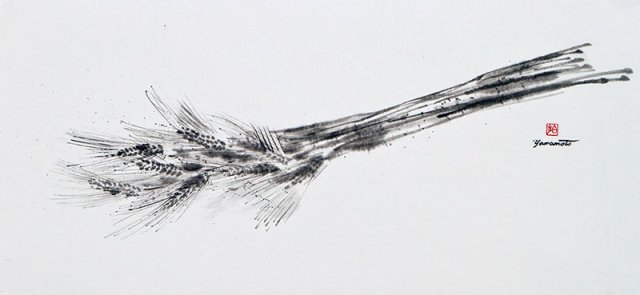
wheat

– Art by © Hiroshi Yamamoto

Elliot Nicely’s New Love

new love . . .
offering the firefly
cupped in my hands

(first appeared in the 2018 Holden Arboretum Haiku Path)

© Elliot Nicely (USA)

We start off with a romantic theme. The use of the ellipsis gives way to thinking about feeling the joy of being in love and bathing in it. It also allows the reader to remember his or her first love and what that felt like.

Then we get into contact with nature. I like the use of “offering” as it is poetic and fits the mood of the first line. I also enjoy the “f” and “i” sounds in this line.

But let’s get into the subject of the firefly. New love is transient, much like the lifespan of a firefly and the light it emits. Offering it to his new lover is poignant. It can symbolize the beauty of something so fleeting yet so enrapturing.

The third line adds to the reverence with which the firefly is offered. “cupped” shows care and also could be a comparison with the “bulb” of the firefly. In addition, the solid “d” sounds in this line add more weight to the last line.

It’s a haiku with a distinct mood and atmosphere. I think Nicely captured the feeling of a new love well with his choice of words, sounds, and imagery.

Nicholas Klacsanzky (Ukraine)

“new love” could be the first, could be the last, it could be a fragile bud after a disappointment, delicate and perhaps ephemeral, like a firefly.

The hieratic gesture of offering the firefly in cupped hands seems to be a part of a pagan ritual. The heart burns to be consumed on the altar of feeling, just as the light of the firefly is consumed in the ritual of mating.

A very simple haiku without sentimentality and, within the limits of the subject treated, with the right amount of detachment.

Margherita Petriccione (Italy)

This haiku to me can be seen in two ways. Without the ellipsis, it reads like a run-on sentence and where there are possibly two people enjoying the presence of a (ホタル) firefly, which is a kigo word for mid-summer to early autumn in Japan. It’s a lovely image if read as an ichibutsujitate haiku (single image with a run-on sentence).

What intrigues me about this haiku is that the ellipses somewhat forces me to pause where I see another interpretation that perhaps the person is alone and finds compassion for the firefly cupped in their hands. The juxtaposition in this haiku is in the phrase, which contrasts and then harmonizes with the first line because the word “firefly” in Japan is also a metaphor for passionate love which contradicts my thoughts of this person being alone. Since there’s a juxtaposition, it now reads as an ichimonojitate haiku, which is still a single-image run-on sentence poem if the ellipses are ignored (there is an ichibutsujitate and an ichimonojitate, which sounds the same, but the latter has a juxtaposition).

Lastly, I like the sound of the haiku between the vowel “o” and “i,” and between that, the words “firefly” and “my.”

Fractled (USA)

If we consider Japanese culture, there are two symbolisms of fireflies. First is love and the second is the souls of dead soldiers who died in the war (“war” here indicates World War II).

If we stick to the first meaning, the fragment evokes an image of first love. The innocence and freshness of first love, along with fireflies, works very well as a spring kigo. The writer knows that adolescent innocence is transient and so is the magic of first love—still she surrenders to the beauty of love by offering fireflies to her beloved. The act of offering fireflies is a poignant metaphor of the fragile courage in giving your heart to someone for the first time.

But if we keep the second interpretation of fireflies in Japan in mind, the meaning of the haiku changes entirely. Now, we know that “new love” is not first love. It is most probable that someone dear has died in the war and the act of offering fireflies to the “new love” is a metaphor for offering memories of ceased love to move forward. The haiku thus becomes a bittersweet expression of human resilience.

Pragya Vishnoi (India)

The feelings of being associated with a new person, along with expectations and hopes, are obvious in this haiku. The word ‘new’ reflects the beginning of a new life that may or may not be associated with the past. Love is an endless journey where a person passes through an evolution process of knowing what is best and that makes him or her move from one relationship to another.

The firefly symbolizes moving through darkness with the light of hope and the rejuvenating emotions that silently seep into one’s heart during the night. It may also reflect the dreams of love that a person yearns for throughout his or her life. Cupped hands, in this case, may reflect capturing a moment of love—holding fast to beliefs and prayers for the fulfillment of desires and longings.

Hifsa Ashraf (Pakistan)

If you enjoyed this poem and commentary, leave us a comment.

2593

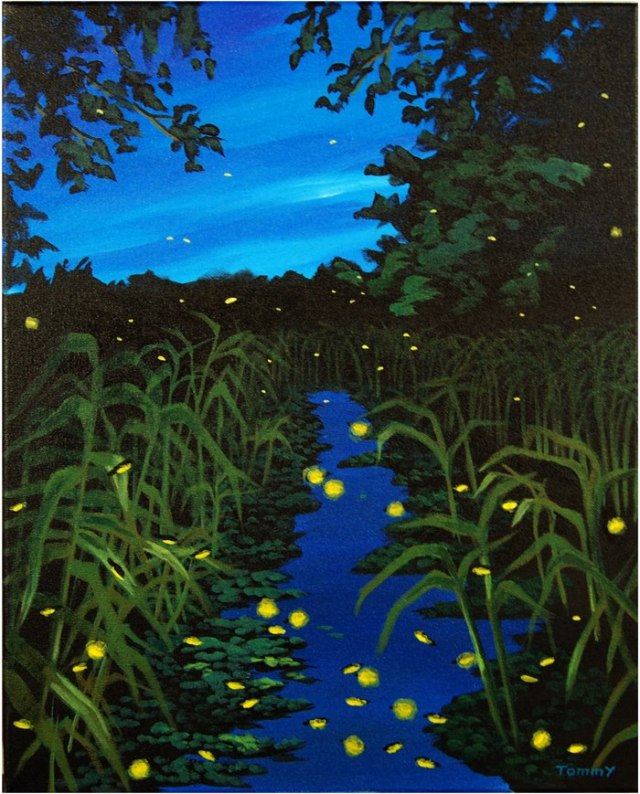
“Lightning Bugs” by Tomas Philips


Michael Dylan Welch’s Frisbee

a floating Frisbee—
the river widens
as it nears the sea

© Michael Dylan Welch (USA)

(Published in “Nesting Dolls,” the 2018 Yuki Teikei Haiku Society annual members’ anthology)

A floating Frisbee… in water or in the air? The image of this Frisbee remains mysteriously suspended, as the power of the river appears suspended when reaching the limit of its course, it spreads beyond the banks dividing into a thousand rivulets, almost reluctantly…. The river and the sea are made of the same substance at the bottom, even though each has its own identity—yet in the culminating moment of total unification, it seems the river draws back.

I can’t penetrate the emotion that pushed the haijin to write this verse, but I have had the same feeling when, during a form of meditation, I feel that something is blocking the overcoming of my mental conditioning and hindering my awareness. The poem engaged me with its melodious rhythm and aroused feelings from heart to heart as with the best haiku.

Margherita Petriccione (Italy)

While some may scoff at the double article word “the,” how this rhymes, the use of two verbs, and what reads as “matter of fact” in the phrase of this ku, one must combine the three lines and loosen their grip on the rules to see that content matters more, which this haiku has plenty of.

Starting with the first line, note that the word “Frisbee” is capitalized, which to me instantly conjures an image of a concave disk that’s used as a pastime or for sport (ultimate) with an emphasis especially with the em dash after the word.

In combination with the phrase where the magic begins, I wonder if the frisbee as defined exists at all in the haiku. The frisbee could also be a whirlpool, hurricane, or a tornado where all have concave disk shapes that spin as a frisbee does, widening the river as it floats to the sea. Perhaps the frisbee does exist but I asked myself, “can it widen a river or is it the writer’s intention to juxtapose an object with the unsaid images not written in the haiku for the reader to fill in?” If so, it’s a masterful technique the author used very well.

Lastly, I believe the technique of “narrowing focus” was used in this haiku but in reverse. Rather viewing it from the top down, in this case, the sea is the wide lens, the river is the normal one, and the frisbee’s focal point is the narrow one, which makes this write all the more interesting.

Fractled (USA)

It takes a lot of time to understand the depth of a haiku that is written by a haiku master.

This well-constructed haiku reflects the depth of creativity and imagination.
One aspect of it gives me the image of a gliding frisbee that floats freely like our happy feelings and cheers us up both by our recreational and aesthetic senses. When someone is carefree, calm, and relaxed, he or she loves to enjoy the bounties of life and imagine life as free as a flying frisbee.

The other two lines of this haiku show the depth of our feelings that may initiate with a small action but it has a ripple effect. The river may look like a wide smiling face with profound effects that can bring great inner satisfaction.
The other side of this haiku could be a kind of cyclone that may look like a frisbee and bring turbulence in the river’s waters before it ends up in the sea.

Also, the capital letter ‘F’ in frisbee is intriguing, which may reflect the association of the writer with a particular type of frisbee.

Overall, this haiku is a combination of our cheerful feelings or childhood memories that bring its deep effects on our mind and heart.

Hifsa Ashraf (Pakistan)

Although I am an editor, I did not know before reading this haiku that “Frisbee” is sometimes capitalized. Since it is a registered trademark of the Wham-O company, it is indeed capitalized. Knowing that Welch is an editor, I admire him for sticking to the original.

Anyway, the first line is meditative. The reader takes in the movement and floating of the Frisbee more with the em dash, acting as a pause marker. The musicality of two “f”s in succession makes me think about the sound of the Frisbee tearing through the air.

The second line opens up with the juxtaposition. We come from a Frisbee perhaps in a park to a river. The river could be next to the park, but it could also be miles away. Regardless, I like the image. The intuitive feeling between a Frisbee floating and a river widening is definite. The shape and spin of the Frisbee give rise to the connection. Note also the musicality of the “i” sounds which bring a sense of sharpness.

The third line changes the scene and resolves the second line. When a Frisbee reaches the catcher, it starts to slow down and drag more. This is akin to the widening of the river before it reaches the sea. However, there is more to this image than the facts. I think this is a metaphor about how we act and feel when meeting our death or a goal. We open our hearts and minds more. Luckily, when coming to our end or when obtaining a goal, we approach it with open arms. On a side note, I enjoy the “ea” sounds in “nears” and “sea,” which to my mind brings a calming effect.

This haiku looks simple at first glance, but with its underlying metaphors, meditativeness, and musicality, it is an excellently crafted poem.

Nicholas Klacsanzky (Ukraine)

Did you enjoy this poem and the commentary? If so, please let us know in the comments.

tumblr_oliw1gOUMy1qbidlso1_1280

Art by © Naomi Tydeman