
my glasses missing
I see impressionistic
paintings all day
— George Klacsanzky (1956-2003) (USA/Hungary)
I appreciate George’s insight into sight itself. How many of us take vision for granted? The saying “Beauty is in the eye of the beholder” comes to mind when reading this haiku. I also like his sense of humor in “my glasses missing.” It seems some people have become numb to modern-day conveniences and items we use daily. But when a useful item goes missing, like glasses, then it seems we regain an appreciation for it and no longer take it for granted. In this way, George’s haiku could point to experiencing life without conveniences but also gently reminds us to not take things for granted. A beautiful haiku.
— Jacob Salzer (USA)
First of all, it is a great honour for me to write commentary on this brilliant haiku of George Klacsanzky. He is truly a great and inspirational haiku poet.
The opening line gives an impression of a person’s view of the world without any artificial sight. It reflects the genuine connection of a person with nature or their surroundings where they enjoy nature or any imagery without any barrier (glasses) by using their insight or perception. I love the use of the word ‘impressionistic’ which conveys a strong image of what the person is viewing. It may also be a vivid memory that a person is cherishing or reminiscing about. There can be various interpretations of ‘paintings all day’. A person may be seeking solace in nature, their surroundings, a memory, or they are enjoying the deep elements of an image with the help of insight’s lens through daydreaming.
— Hifsa Ashraf (Pakistan)
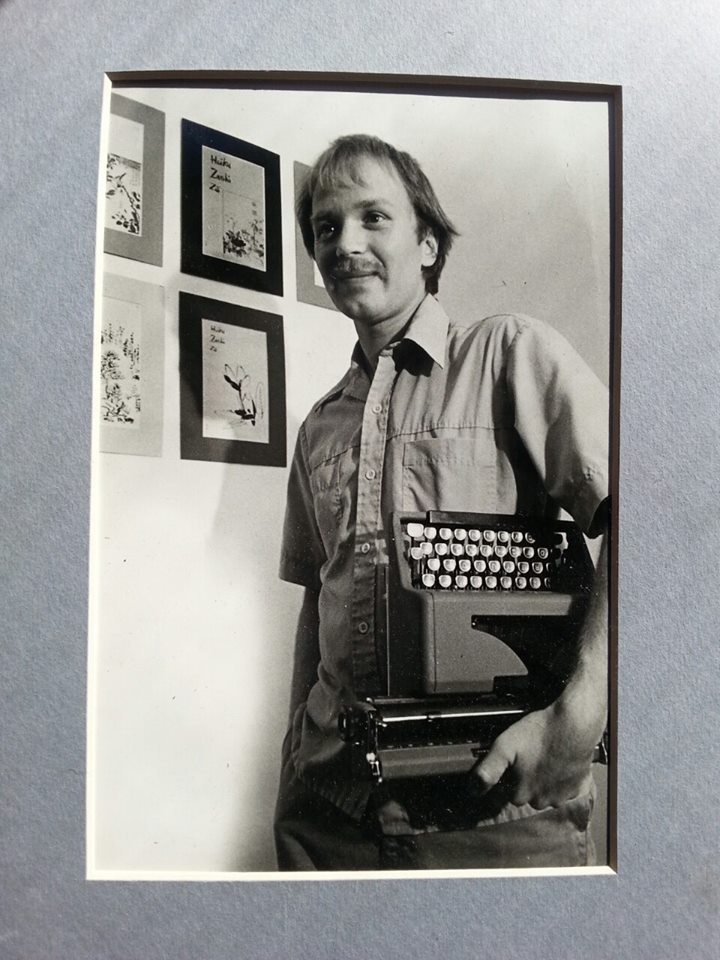
My father, George Klacsanzky, wore thick glasses. I think if he took them off or lost them, he would be seeing the world as if it was an impressionistic painting. But I think besides the humor in this haiku, I believe my father was expressing the fact that our experience as human beings is based on our subjective sensorial perception. Though our sense organs are tangible, the results they produce are variable and depend on each individual’s facilities. In a way, it seems my father was pointing to the illusion of our so-called reality.
I enjoy how the second line has enjambment. It is a witty line break that sets up a surprise in the last line. In terms of sound, it appears that the letter “s” takes the cake. From this string of “s” sounds, I can hear a paintbrush against a canvas. The letter “l” is also employed well, which gives the reading a more weighted feeling, in my opinion.
Another haiku by my father that on the face seems to be only comical but has deep philosophical undertones.
— Nicholas Klacsanzky (USA)
 Haiku Commentary