John Hawkhead’s apple tree

in the apple tree
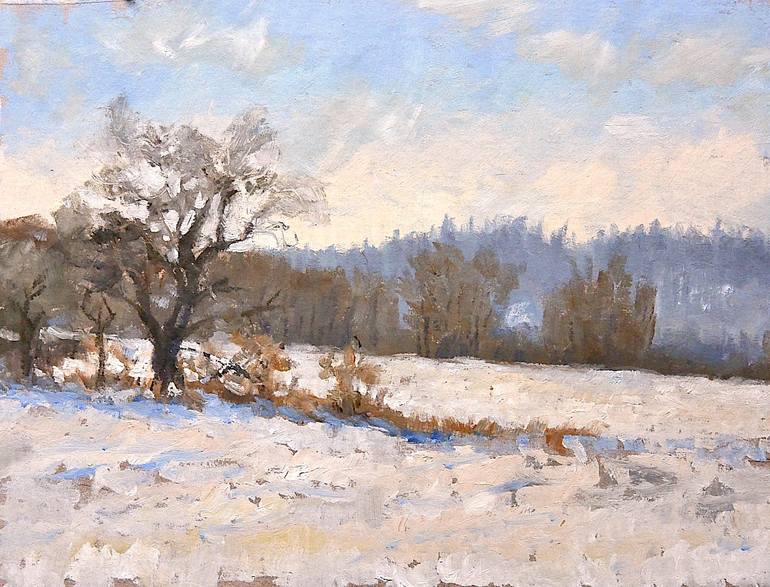
a nest full of snow
the wind’s soft whistle

— John Hawkhead (UK)
(Presence magazine, issue 70)

I appreciate how this haiku depicts the cycles of life, and also hints at life after death. I feel the last line could be (or include) the spirits of the birds. The contrast of the warmth that was once present in the nest with the stark cold snow gives me a feeling of impermanence and letting go. I also interpreted this haiku as a metaphor for human families when children go off to college and the parents become “empty nesters.” The children’s bedrooms become empty and are sometimes remodeled for other purposes. It seems emptiness is what allows life to become full. Even if the glass is empty, I see this as a creative space, filled with possibilities vs. an absence devoid of life.

I miss the presence of birds in this haiku and their songs. They may have passed away long ago, or simply migrated to another tree that provides more protection. However, despite the winter season, the main feeling I get from this haiku is gratitude, acceptance, and beauty in the mystery of both life and death. I get a sense that when winter fades to spring, perhaps at least part of this nest will remain for future bird families.

All this being said, I feel a combination of melancholy and abundance in this haiku at the same time. I also appreciate how this haiku engages our senses. I can smell the snow in this haiku. I can even smell the apples from past seasons. I can hear the wind and the memories of birds singing that are also linked with other memories. I can feel the coldness in my bones, and the reassurance that even in death, life goes on. A beautiful haiku.

— Jacob D. Salzer (USA)

This haiku starts with a tinge of mystery where the poet takes us to the ambience that is only observed by those who focus on the intricacies of nature. ‘Apple tree’ is often symbolized as a sacred tree or a tree of love, which makes the opening line more significant by pausing our thoughts for a while.

Visualizing a nest full of snow on an apple tree gives an idea of ‘filling the void’ in life where snow as a temporary and the most delicate phase may either project abandonment, emptiness, melancholy, and loneliness or replacement, the yearning of dreams, and hope. In both cases, it shows how fragile and uncertain this life is when one does not remain productive. The wind’s soft whistle gives some hope and positivity besides the melancholic imagery of this haiku. It also indicates the continuity or flow of life even in the most unfavorable circumstances.

From apple tree to soft whistle, this haiku gives a holistic picture of different phases of life and nature that are interconnected and depend on each other for survival. I also see this haiku as an incubation period of creativity where the poet as an observant seeks solace in the delicacies of nature by synchronizing all thoughts and feelings.   

— Hifsa Ashraf (Pakistan)

Jacob and Hifsa discussed the meaning behind this haiku well. I now want to delve into the more technical aspects of this poem.

The thing I noticed first was the lack of punctuation in the second line. The break between the two parts is defined by the line break, though. If it were me, I might have added an ellipsis. However, nothing is taken away from the haiku due to a lack of a dash or ellipsis to act as kireji.

The kigo is easy to identify with “snow.” The desolation of this season is expressed even more in the third line.

Though there are three articles in this haiku, each one is used appropriately and meaningfully. Concision and brevity play a large part in the success of this poem.

In terms of sound, a lot is going on that helps the haiku read well. The “l” and “o” sounds are the most beautiful, bringing a lilting feeling and a softness if read out loud. In contrast, the “i” sound displays starkness that coincides with the imagery.

The last line for me is the most significant. The whistle can be a chilling reminder of the fragility of life and its harshness. It can also be a tribute, a soothing song, or nature being playful despite the circumstances. The poet leaves the interpretation up to the reader.

— Nicholas Klacsanzky (USA)
Painting by Wolfram Diehl

Agus Maulana Sunjaya’s swirling leaves

ten little fingers
of my deaf son …
swirling leaves

— Agus Maulana Sunjaya (Indonesia)
(Cattails – April 2021)

The depth of this beautiful haiku is difficult to decipher in a few words, as it has many dark and light shades of life a person may pass through. I don’t see it only from a disability perspective but the far side of certain realities that we may not be able to hear or feel.

‘Ten little fingers’ depict the deep connection that one has with the outer world that doesn’t need to be only heard. The sense of touch is a powerful sense that lets us feel the presence of both tangible and intangible things, which in this case may look more rhythmic where a deaf boy tries to feel the sound wave with his fingers.

I can see three aspects here. One is the sense of enjoyment where the boy feels the pulse of the wind that may be the autumn wind who confided in him and shares the secret of autumn like uplifted dry leaves, making them alive one more time before annihilation. The second aspect can be of mysticism or spiritualism—the third eye that becomes active usually when one has a disability. So, in this sense, the swirl of leaves looks more like a whirling dervish who is selflessly enjoying his life despite having flaws. The third angle is the sense of despair where the connectivity of his sense of touch brings nothing but a deep autumn where everything is scattered around him, and he, out of curiosity or confusion, wants to know what’s happening in his surroundings.

In terms of the kireji, the ellipses after ‘my deaf son’ shows how deeply the father feels and understands the pain of his son but is helpless to help him. It also alludes to the father’s anxiety about his son’s life, especially his future that he may perceive as swirling leaves, not settled well, but moving towards annihilation.

— Hifsa Ashraf (Pakistan)

This is a touching haiku. I directly resonate with nonverbal communication and the wordless space in this haiku. Especially because the word “little” is used, I imagine a baby. This leads me to believe the baby may have been born deaf. This by itself is very interesting. I’ve read that babies hear sounds in the womb as their brains are developing. I wonder if this is the case for babies who are born deaf. More specifically, in the mother’s womb, I wonder when exactly did this baby lose the capacity to hear? 

I’ve also read that people who are deaf see things more vividly as it heightens other senses. The last line gives me a playful, lighthearted feeling and also wonder.

As another interpretation, this haiku could lead me to imagine the poet’s young child is learning ASL and communicating in that way. I took ASL (American Sign Language) in college. One of my assignments was to live one day without speaking, wearing earbuds. At the grocery store, I relied on taking notes and reading body language to communicate. 

This is a beautiful haiku that makes me grateful for the ability to hear, and also makes me grateful for silence, where I feel a lot of love, gentleness, mystery, and compassion. 

— Jacob D. Salzer (USA)

This haiku caught me off guard because of its poignancy. The connection between the two parts of the haiku creates palpable imagery of beauty and a sense of sadness. Swirling leaves relate well to the motion of sign language, and readers can easily imagine the movement for themselves. With the autumn tone of this haiku, I can see wonder and melancholy.

Sonically, the stark sounds of “i” or “ee” in the haiku make me feel that the father is concentrating on his son and reflecting on his condition. It also brings about a sense of awe to my attention.

A touching haiku that can be felt as much as it can be thought about.

— Nicholas Klacsanzky (USA)

Painting by Hishida Shunsō

Jay Friedenberg’s fading dream

fading dream
the shape of her curve
in empty sheets

— Jay Friedenberg (USA)

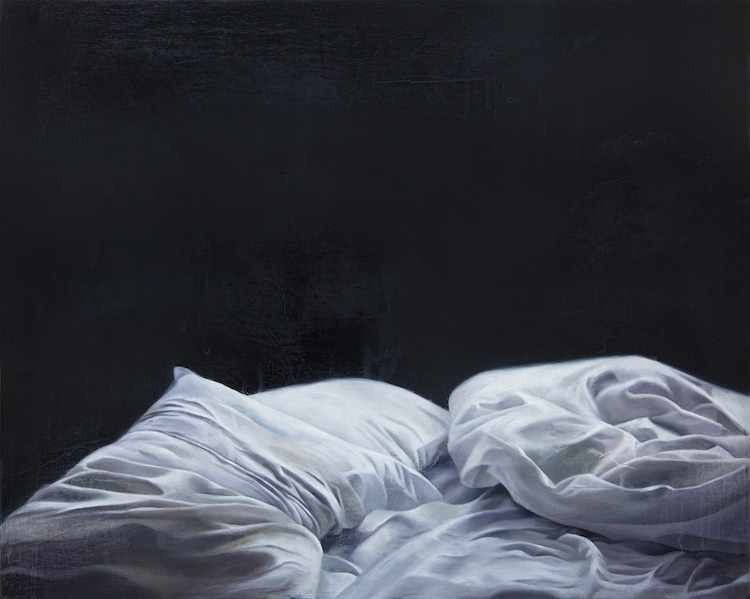
Melancholy is the first impression (pun intended) I get from this poem. The impression of this woman’s body on the bedsheets seems to point to a relationship that has ended or is ending. I get the feeling this woman got up early in the morning before the poet did and left without a sound. There is some mystery as to why she left. There is also a mystery as to what the dream entailed. Did the author have a dream of raising a family with this woman? Did the poet have a dream that the woman had no interest in? Or did she leave for other reasons and the poet’s dream is left unsaid? The poet did a good job leaving room for the reader to enter the poem. 

Specifically, the words “fading” and “empty” carry a heavy emotional weight in this poem.

Sometimes it seems someone’s silence (or absence) can speak louder than words. This poem sparks a conversation about what dreams we can have with a partner and perhaps what dreams are best to be avoided. I also think this poem could imply the dream(s) we have can adversely affect our relationships and blur our vision without even knowing it. In other words, it seems if someone is preoccupied with (or attached to) his or her own dream (or a vision of what they want a relationship to be), it could narrow their mind and result in negative outcomes. This dream could also be subconsciously influenced by society and mental programming of what is believed to be “normal” in a relationship. For instance, I think of “the American Dream” and honestly wonder what those words mean from person to person. Regardless of our answer, it seems by being attached to a specific dream, we can close the doors to other possibilities with a partner and it seems this can sometimes lead to the end of a relationship.

In short, this is an emotional poem that sparks an important conversation about our values, and encourages us to explore the complex psychology of our relationships and dreams. 

— Jacob Salzer (USA)

The mystery in this haiku makes it a manifold poem that is a bit challenging to interpret. This haiku starts with hopelessness where something is slipping out of a person’s hand—a ‘fading dream’. It seems the person yearned for this dream for a long time, held it dearly, strove for it, and longed for it. To see your dream fading in front of you is more like missing a train that goes away in front of your eyes and you can’t stop it or catch it. ‘Fading’ indicates that the dream is still there but not strong enough to be fulfilled, or the person gave up on it which leads to restlessness, anxiety, and frustration, as it can be observed through ‘the shape of her curve’ where she is sleepless and passing through some deep pain left by the dream. ‘Curve’ shows how complicated the situation is where there is nothing straight or clear, making the situation more ambiguous.

‘Empty sheets’ depict loneliness, detachment, and emptiness that a dreamer faces when they can’t fulfill their dreams. This also indicates that the person is fearful and not ready to sleep again to yearn for another dream. The possible white sheets may also allude to a ‘shroud’ where the person metaphorically is thinking to shroud the dream in white sheets before burying it.

Overall, the depth of this haiku makes the reader pause, and explore various dimensions before reaching a conclusion.

— Hifsa Ashraf (Pakistan)

Jacob and Hifsa went over the substance and word usage well. I want to cover a bit more of the technical areas of the haiku.

There is not a direct kigo expressed but the word “fading” might refer to autumn. The word “empty,” however, might refer to winter.

In terms of kireji, there is no punctuation marking the separation between the two parts of the haiku. But as with many English-language haiku, a line break is commonly sufficient to show this distinction.

For the format, the length of the lines is standard for English-language haiku, with a short first line, a longer second line, and a short third line.

When looking at the haiku sonically, the “i”, “y”, “ea”, and “ee” sounds in the first and last line adds to the melancholy of the scene.

No word used is excessive and overall this haiku is concise. It is written in a simple, natural style that is a hallmark of fine haiku.

— Nicholas Klacsanzky (USA)

Painting by Stephanie Serpick