Saumya Bansal’s radish harvest

radish harvest—
a child’s tug of war
with the earth

— Saumya Bansal (India)
(Grand prize winner at the 25th International Kusamakura Haiku Competition, 2020)

This haiku speaks to me in several ways. 

The child specifically struggling in a tug-of-war with the radish tells me the child may not be physically strong enough yet and could be very young. In fact, it could be the very first time the child has tugged on a plant before. The tug-of-war could also mean the soil conditions are not ideal. According to my research on https://www.gardeningknowhow.com, it states: “…a good way to tell if the radishes are ready to be harvested is to simply pull one from the soil. If the soil is particularly crusted or hard, use a garden fork or trowel to gently lift the root from the soil.” With this in mind, perhaps the tug-of-war has more to do with dry soil. In that interpretation, climate change could be a part of this haiku, contributing to drought. The tug-of-war could also mean the radishes are not ready to be pulled, yet the child still pulls simply out of curiosity, not knowing if it’s ripe yet. In that sense, I feel this haiku speaks to the importance of patience and timing. The word “harvest” tells me there is an abundance of radishes here, so it seems this child is growing up on a farm.

This haiku, however, goes beyond just pulling radishes and expands to include the child’s long-term relationship with Mother Earth and food. It sparks an important discussion about what we teach our children about food and how we care for each other and the Earth sustainably. On the note of parenting, I wonder where the child’s mother and father are in this haiku? Did the child wander out alone to pull radishes? Is this child lost? Did he/she run away from home for unknown reasons? Is the mother and/or father nearby watching over the child? There is some mystery here. 

There is another connection regarding the nutritional value of radishes that will become an integral part of this child’s life. According to my research on: 

https://www.healthline.com/health/food-nutrition/the-benefits-of-radishes#5-health-benefits-of-radishes: “…radishes have been used as a folk remedy for centuries. They are used in Ayurveda and Traditional Chinese Medicine to treat many conditions such as fever, sore throat, bile disorders, and inflammation.” Radishes have a wide range of other health benefits as well. They have anti-cancer properties, help prevent cell aging through antioxidants such as Vitamin C, are high in fiber and help with our digestive system, and have antifungal properties. Another site states: “Radishes are rich in antioxidants and minerals like calcium and potassium. Together, these nutrients help lower high blood pressure and reduce your risks for heart disease.”

 (source: https://www.webmd.com/diet/health-benefits-radish) 

We know sustainable farming methods were well-developed in indigenous communities for thousands of years. They took only what they needed and harvested crops not only to feed themselves but also future generations. I appreciate their strong communities. In this modern age, I think we can learn a lot from indigenous people and their care and reverence for the Earth.

In short, it’s clear to me this child (at a very young age) is developing a deep physical and psychological connection with radishes (and presumably other crops) that will last for the rest of his or her lifetime. It has become an integral part of the roots of the child’s upbringing. This haiku sparks an important conversation about how we relate to food and sustainably care for each other and Mother Earth.

— Jacob Salzer (USA)

Radishes are cultivated and harvested normally from October to November—the time when the season is transforming and summer is replaced with autumn. This is also the time for focusing within as our inner energies are at their peak. Since a radish is a root, it can be easily related to one’s deep-rooted feelings and emotions. A child is usually curious about their surroundings and being impatient, they need to reach a conclusion very quickly regardless of whether it will fulfill a purpose or not. The relationship between a child’s curiosity, impatience, and fighting (tug of war) may also point towards needs that are not being fulfilled due to various reasons. The earth metaphorically may be the circumstances that are given to that child, and their survival instinct pushing them to fight for their primary needs. As it is the season of transformation, the child maybe has developed or learned how to fight for their primary needs. 

Overall, this poignant haiku reflects how in the early stages of childhood, life teaches us how to become aware of our primary needs and how they can sometimes even go against nature. 

— Hifsa Ashraf (Pakistan)

Jacob and Hifsa amply explored this haiku already. However, I can lend a bit more observation.

Radish harvesting could be a kigo for several seasons, depending on the type of radish and the place. For instance, daikon radishes are often pulled out before winter truly sets in. Radishes can be harvested as little as three weeks from their planting, though. So, pinpointing the kigo for this haiku can be difficult.

The em dash in the first line works well to set the mood and to separate the two parts of the haiku. Also, the pacing and the length of the lines match approximately with the rhythm of traditional Japanese haiku, with a short first line, a longer second line, and a longer third line to make the “go-shichi-go” rhythm.

The usage of the article “a” for the child shows that the poet wanted to put more focus on “the earth.” It perhaps speaks to the grandiosity of the earth in comparison to the child.

In terms of sound, I notice that “i” and “r” feature strongly. I feel a sense of starkness from the “i” sounds and a feeling of being grounded by the “r” sounds. Anyway, they both add to the musicality of the poem.

This is a haiku that can mean many things to different people. It’s not easy to achieve that universality when writing haiku.

— Nicholas Klacsanzky (USA)
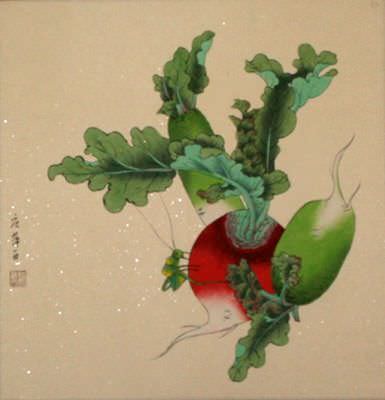
Painting by Qing Ping


Goran Gatalica’s glint

daughter’s wedding —
glinting in moonlight
the first snowflakes

— Goran Gatalica (Croatia)
(published in The Mainichi, 1/13/2021)

The haiku starts with one of the most precious and emotional days of a person’s life. The festivity, reunion, laughter, and collectivity at a daughter’s wedding may not surpass the deep feelings that are contrary to the celebrations, as it’s a day of departure as well. The subtlety of a parent’s feelings is well interwoven with the weather outside. The first snowflakes are light in weight but still leave behind heavy hearts due to old or new memories—particularly the memories of loved ones that glint or get highlighted in the moonlight where a person, especially parents, reminisce about those memories near the window or fireplace. The winter hush usually brings to the surface feelings of special days and it seems time slows down like a flurry of snowflakes that takes its time before finally touching the ground.

The em dash in the first line pauses one’s thoughts and feelings to imagine the whole scene of the wedding day. I loved the way the writer linked this special event with the subtlety of moonlight and the silence of snowflakes.

— Hifsa Ashraf (Pakistan)

Written from the perspective of a mother or father, I immediately feel the special connection between the parent and daughter in this haiku. This allows me to step into the parent’s shoes and reflect on the long journey it took to arrive at this moment. 

I think the juxtaposition between the daughter’s presumably white wedding dress and moonlit snowflakes is a stark comparison, showing the fragile, delicate nature of a marriage, yet also its beauty. I see her wedding dress made of delicate patterns that are interwoven, just as so many lives have been interwoven in the daughter’s life that has led her to this significant event.

The connection between women and the moon is well-known with a long history, stretching back to ancient indigenous cultures on this Earth. In that light, it seems the moon in this haiku connects the daughter with past generations of women and her family lineage. I like how the moon in this haiku links to the mysteries of women and the cycles of life. In a more spiritual sense, during a reverential moment, I can see the daughter’s mind becoming quiet and reflecting a kind of hidden inner light, just as the moon reflects sunlight in silence. It’s interesting to note the daughter’s wedding has continued into the evening hours. I normally associate weddings as a daytime event, but I like how it seems the celebration started in the day and has continued into the evening. I feel this depicts a more romantic and mystical atmosphere. 

In the last line, I like how the first snowflakes mark new beginnings, as the newlywed couple starts their journey together. At the same time, I like how snowflakes mark the eventual depth of snow over time, and the depth of the relationship, that ultimately, will seemingly melt and evaporate, “’till death do us part” or perhaps the couple will eventually be reincarnated and meet in another life or in another dimension. Either way, juxtaposing snowflakes with marriage allows me to reflect on the nature of marriage, our human impermanence, and the importance of a spiritual dimension in a partner relationship.  

Finally, I like the implied contrast of warmth and coldness in this haiku, and the contrast of darkness and light. I can feel the warmth of people, the glow of lights, and a hopeful, uplifting atmosphere at this wedding, despite the cold, dark night. A beautiful, touching haiku. 

— Jacob Salzer (USA)

Hifsa and Jacob went into great detail about the subject of this haiku and its symbolism. I want to provide a bit more technical insight.

I enjoy and respect that the poet used an em dash in the first dash to make the two parts of the haiku distinct. Without it, the second line would act as a pivot, which might not have made sense in this instance.

The length of the lines is in the common range for English-language haiku. Brevity was employed well. The pace and flow of the haiku are smooth, and mirror the original pace of Japanese haiku appropriately.

We have a definite kigo with “first snowflakes,” placing the haiku in early winter. The comparison between such a jovial time as a daughter’s wedding and the enchantment of seeing the first snowflakes is poignant.

The haiku is quite vivid, with the imagery of moonlight on snowflakes, and them glinting during a wedding. There is a lot to imagine for the reader, and that is always a plus. Moods of mirth, eeriness (moonlight), wonder, and more are here.

In terms of sound, I can say that the letter “t” holds sway. With five appearances, and perhaps a semi-appearance of it in “wedding,” I can feel the classiness and tenderness of the event.

It is a fine haiku that illustrates the power of humanity’s connection with nature and vice versa.

— Nicholas Klacsanzky (USA)

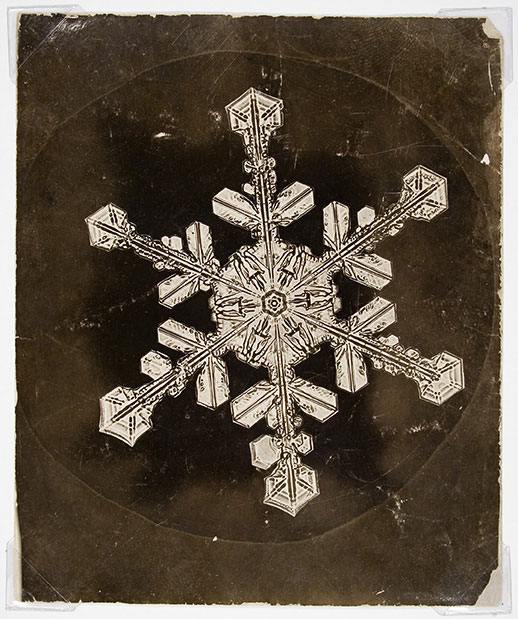
Photograph by Wilson Bentley

Carmela Marino’s starry avenue

starry avenue
the same thought
after a year

— Carmela Marino (Italy)

(published previously in Stardust, January 2021)

I appreciate the atmosphere of this haiku. I see an avenue full of puddles after rain, and each puddle is reflecting the stars. I feel the silence of the evening. I see the poet walking alone, contemplating. Combined with the silence after rain, I feel the poet’s deep meditation and possibly a feeling of déjà vu. 

I like how we don’t know what “the same thought” is. This opens up many interpretations for us as readers. Here are 5 interpretations that come to mind:

1) The poet could have made a New Year’s Resolution (or a birthday wish) and now the poet’s resolution or wish did not come true after one year (possibly because of barriers such as the COVID-19 pandemic or other things) and this could bring a sense of melancholy and struggle. If it’s the poet’s birthday, perhaps the unfulfilled wish brings a real sense of longing. In a more humorous sense, it could communicate how New Year’s Resolutions are sometimes forgotten and get brushed under the rug, only to reappear after a year. 

2) Sometimes, it seems our New Year’s Resolution or birthday wish can take longer to appear than we originally thought. In this light, I can feel the value and wisdom of patience in this haiku. A favorite quote by haiku poet and teacher Alan Summers comes to mind: “The best things in life should rarely be rushed.” 

3) The same thought in this haiku could be a repeated question or problem the poet is contemplating that still doesn’t have an answer after one year. This question/problem could be personal, scientific, or philosophical among many other things. One possibility is the poet could be asking a question such as: “What is the cure for the disease ALS (amyotrophic lateral sclerosis)?” Because there is no known cure for ALS, the poet could be internally asking the same question, digging deeper for answers. 

4) The poet could have a focused thought of recovery from some form of addiction, and each day, after one year has passed, continues to show dedication and perseverance through focused attention on one single thought. This haiku moment could be a celebration of the poet being sober from drugs or alcohol for one year. 

5) Along similar lines, the poet could be focused on a single thought devoted to the Divine and the Great Mystery each day after one year has passed.  

There is a great balance in this haiku between the known and the unknown, between concrete imagery and mystery. Regardless of what thought comes to mind for us in the haiku, I appreciate how this poet opens the door for us to enter a serious, or humorous, contemplative mood. Ultimately, it seems this haiku reminds us of the power of attention. With the one-pointed mind of concentration, we can get a lot more done each day with few distractions to reach our goals. Spiritually, with a focus on the Divine and the Great Mystery, it seems ordinary life and, indeed, even an ordinary street, can become extraordinary and meaningful. In a world where everything is connected, it seems every single thought and action we take makes a difference in ways that are far beyond our ability to comprehend. In light of this interconnectedness, this haiku reminds us to be mindful of what we pay attention to. As I walk with the poet on the quiet, star-filled avenue, I’m immersed in a space of deep meditation, contemplation, and reflection. 

— Jacob Salzer (USA)

A starry avenue is always a source of inspiration, dreaming, and hope. This haiku connects us not only to the ambiance of a starry avenue but also alludes to the big constellations that one makes to redirect their imagination, thoughts, and feelings. I feel a sense of connectivity between the person and that place where they like to explore more and more in their thoughts. A year’s gap may be due to the pandemic year, which has changed nothing about them and this place.

The intangible aspect of this haiku is related to the creative or aesthetic part of life. Irrelevant of the circumstances, a person remains curious about their imaginative world, daydreaming that takes them away from worldly chaos. They feel a connection between the Earth and the sky that can be felt through the strings of imagination, daydreaming, and a curious mind. 

— Hifsa Ashraf (Pakistan)

Jacob and Hifsa went over the possible interpretations and meanings of this haiku in depth. I’ll now look over the more technical elements.

As Jacob mentioned, this might be a New Year’s haiku. So, the second and third lines could be a kigo for New Year’s Day. This might relate well with “starry avenue as well, as fireworks have a similar look to stars.

The line break in the first line is a sufficient supplement for kireji, or a cutting mark in Japanese haiku. The cut is obvious without punctuation, though an ellipsis would have worked well too.

The connection between the two parts of the haiku, or toriawase, is not too close or too distant in its association. This is a sign of a skillful haiku. The stars being reflected from the sky onto water in an avenue is related to having the same thought after a year. Or, the stars are seen in the sky through the narrow confines of an avenue, and that limitation is felt in having the same thought after a year. The poet tells readers of this echo between humanity and nature without stating it directly.

The poet does well to match the original rhythm of Japanese haiku with a short first line, a longer second line, and short third line. It was also composed with brevity in mind and common language, which is also essential to the art of haiku.

Finally, sound plays a role too, with “s” and “t” letters make readers feel the power of the moment more.

All in all, this is a well-composed haiku that follows the traditional art of this genre and brings about a fresh image for us to take a deep meaning from.

— Nicholas Klacsanzky (USA)

A discussion of The Starry Night by Vincent van Gogh
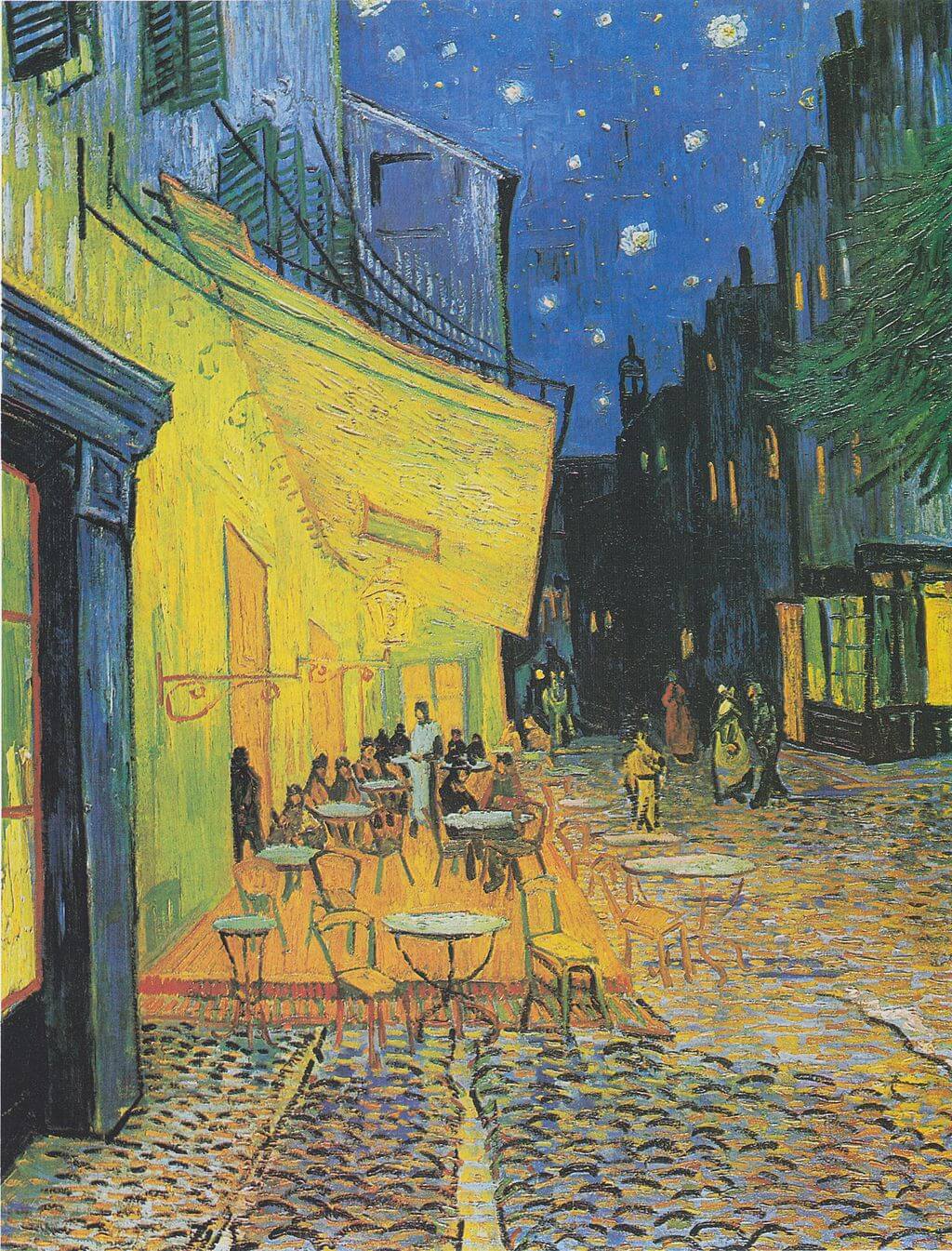
Café Terrace at Night by Van Gogh