
Elaine Wilburt’s Shadow

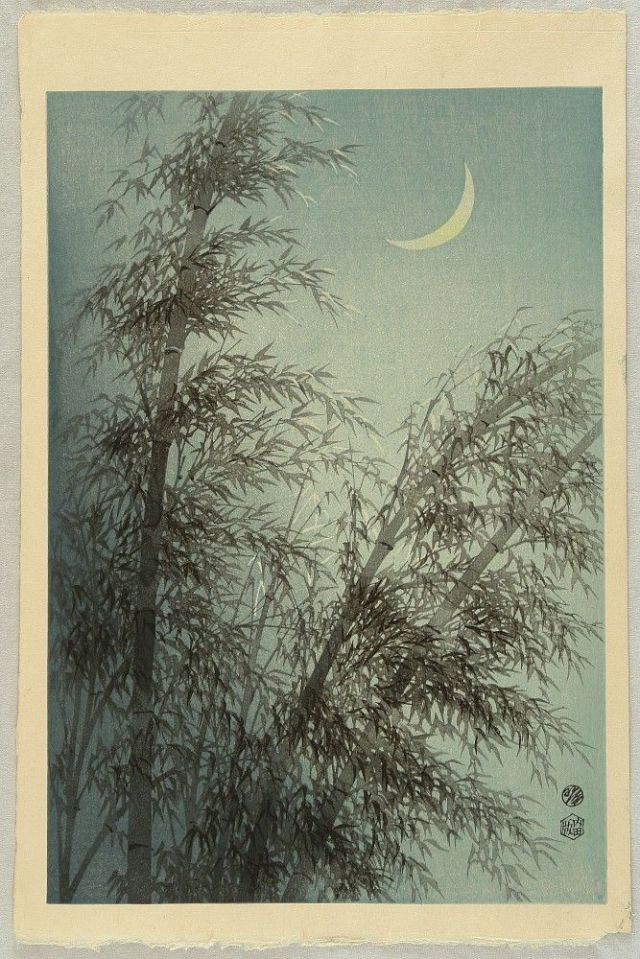
crescent moon —
enough shadow
to imagine

– Elaine Wilburt (USA)
Published originally in Chrysanthemum 26, 2019

A crescent moon or a new moon is the start of a new month, which brings hope and energy with it. I take the crescent moon as a source of yearning for new dreams and plans.

“enough shadow” metaphorically has two meanings here: the dark side of the moon that goes into the light with lunar phases and becomes visible to the eyes, and the shadow of a person, which can be called a persona. In both cases, shadows reflect our desires that need time to get fulfilled. I could see a close connection to life’s stages and lunar phases, where a person grows physically, spiritually, emotionally, and mentally over a period of time. But before that, every aspect of life remains a mystery, like a shadow, and becomes visible once it gets enlightened by time and reflects our true self and/or potential.

– Hifsa Ashraf (Pakistan)

I feel this haiku represents a “glass half full” perspective. It makes me think about how something negative, depressing, or solemn can be seen in a positive light. Also, as Hifsa noted, a crescent moon represents a fresh beginning. With that, I believe the poet is expressing optimism for the path ahead on a new journey.

You can say, in addition, that when we look at a crescent moon, we sometimes to fill in the dark space with light through our imagination. We try to view the moon as full, even though it is crescent. So, the haiku could be speaking to our desire to fill in the holes in our perception.

The word “enough” is strong in this poem. It paints the scene perfectly, as it refers to dusk and the shadows that creep in at that time. It demonstrates the level of awareness the poet had when she wrote this haiku.

There is a potent sense of sound in the poem as well. With strings of “o”s, the pace slows down, reminiscent of dusk. With the ample “n”s it has, a feeling of dignity is given to its reading.

Lovely phrasing, imagery, and sound make this haiku impressive.

– Nicholas Klacsanzky (USA)

If you enjoyed this haiku and commentary, please leave us a comment.
f26763ca0bec1bb194185f083953fa73
Painting by Kotozuka Eiichi(琴塚 英一 Japanese, 1906-1976)
 

Anna Maria Domburg-Sancristoforo’s Lake Twilight

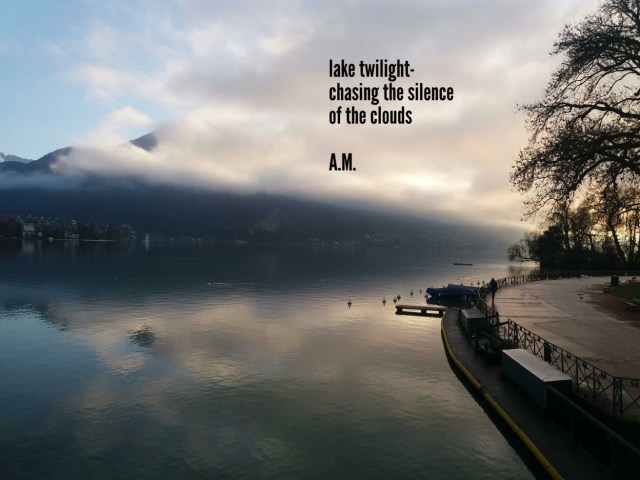
aviary-image-1517294710424Photograph by Lorena Campiotti, haiku by Anna Maria Domburg-Sancristoforo
Published in Failed Haiku, issue 28, 2018

I enjoy the mystical sense this haiku brings. With the comparison of twilight at a lake and the chasing of clouds’ silence, the reader looks through their mind’s eye to imagine a meditative experience. The poet is perhaps wanting to leave her ego behind and become one with something more primal and foundational: the silence of nature.

Twilight is a time of being between daylight and darkness—something difficult to grasp or pin down. The “chasing” of the silence that clouds contain, either by the narrator or twilight itself, is another thing of abstractness and obscurity. This is akin to the Japanese aesthetic of yugen, which suggests subtle profundity and is associated with mystery.

The structure of the poem fits the rhythm of traditional haiku well and has a clear cut marker (kireji) in the first line to bring about more complexity and a juxtaposition. The strongest sounds in the haiku are the “l”s and “i”s.  Both supply us with a lilting feeling, which in an abstract sense is like the movement of clouds.

The photograph conjures an epic scene to take in and sets the environment well. It compliments the haiku, as it does not go directly into the “chasing” part. It delivers the scene to us so we can dive more into the mind of the poet.

– Nicholas Klacsanzky (USA)

The opening line of this haiku takes us to the colourful sky that can be observed at twilight. Mostly, twilight has fading colours i.e. red, purple, yellow, and blue. These fading colours reflect the colours of an aura that we have in the evening, especially at twilight. So, the lake’s twilight complements or blends with the colours of our aura. I can feel the deep silence of the lake at twilight that is due to either the migration of birds or other lake creatures, or due to abandonment. In both cases, the lake reflects the colours of twilight, as well as the mood of the person who was observing it.

Chasing silence may indicate the meditative thoughts that are closely embedded in the silence of the lake and intertwined with the colours of the sky. The narrator may have had profound experiences of seeing clouds, which may also be her ongoing thoughts (maybe chaotic), and she wants to move beyond those thoughts to finally get a peaceful mind.

This haiku beautifully presents the whole image in a subtle way, where we can observe a deep relationship among twilight colours, clouds, silence, and mood. It reveals the mystery of human curiosity to go deeper into one’s thoughts and feel the depth of subtle experiences. Overall, I enjoyed the imagery of this haiku which moved me to vividly experience a lake twilight.

– Hifsa Ashraf (Pakistan)

If you enjoyed this haiku and commentary, please leave us a comment.

Goran Gatalica’s Tadpoles

starlight —
the tadpoles vanish
in a blurry pond

– Goran Gatalica (Croatia)

Under the Basho, (modern haiku), March 2019

This haiku resonates with the things that don’t get a lot of importance in our lives. The opening line ‘starlight’ symbolizes two aspects in the context of this poem.

– It glows but remains unnoticed, especially when the stars are far away from the earth.

– A light dot that is mysterious in many ways.

The tadpoles depict the initial stages of life when things remain insignificant and mysterious, like the tiny stars that are in fact huge.

The blurry pond may symbolize our limited vision and perception of not seeing things beyond their looks. We don’t go into the depth of things that look small in shape and size.

The starlight and tadpoles in a blurry pond lose their impact and significance once they lose their reflection.

– Hifsa Ashraf (Pakistan)

This is one of those haiku that takes us by surprise with its juxtaposition. At first, we might be puzzled by the comparison or contrast being made.

Starlight can take many light years to travel into our view. Also, if we look directly at a distant star, due to it being so far and surrounded by darkness, it can escape our vision after a while.

This all might relate to tadpoles vanishing in a blurry pond. Tadpoles are very small and are hard to spot in a body of water, like stars in the sky. We can easily lose track of them. Plus, the next time we see the tadpoles that we saw before, they might have grown up as a frog or toad. This length of time connects to the duration it takes starlight to travel into our perception.

In another way, the haiku could be presenting a contrast. Tadpoles are larvae and new to life, whereas starlight may be luminescence from a star that has already died. Yet, the shape of a tadpole and starlight are very similar. So, the aesthetic of “as above, so below” in Japanese poetry is demonstrated.

There is a lot of sound in this poem to notice, though it is small. Check out how each line has “l” sounds. There is also a prevalence of “r”s and “p”s. Not only does this make the haiku more musical and a joy to read, but these consonants give the reading more weight.

The format works well, which has the standard pacing of English-language haiku. The dash in the first line gives a clear cut between the two parts of the poem, allowing the reader to easily see a juxtaposition is being made.

Overall, this is a subtle haiku that can swing from being a comparison to contrast in imagery, which can bring about the feeling of connection between mundane life and the cosmos.

– Nicholas Klacsanzky (USA)

If you enjoyed this haiku and commentary, let us know in the comments.

gieorgia-night-sky

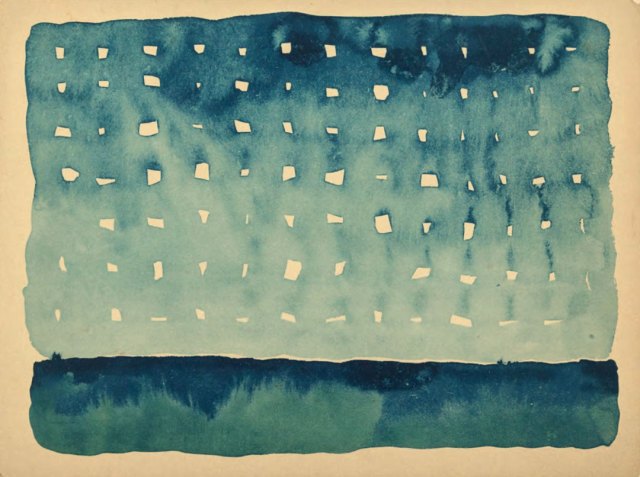
– “Starlight Night” by Georgia O’Keeffe