Christina Sng’s Hospital

pale against
the hospital pillow
winter snow

– Christina Sng (Singapore)

There are times when we are down due to an illness or disease, where everything around us looks dysfunctional and depressing. We try to relate to our feelings with our surroundings, especially the weather. We strive to console ourselves by finding out our shortcomings in the outer world.

This haiku depicts exactly that situation, where the illness of a person can be connected to winter snow as both bringing depressing thoughts and feelings.

The word ‘pale’ indicates dullness and the fragile condition of a person who is seriously ill and depressed due to his or her illness. This colour also indicates autumn, where leaves change their colours and fall down—ultimately looking pale. Here, paleness also suggests a departure or farewell due to a serious illness. A person in this state might feel as if he or she is close to death. So, the feelings of departure itself bring a lot of pain, melancholy, and depression.

Metaphorically, paleness also depicts negative emotions, where a person feels lonely and stressed out, which further suggests the poor mental health of a person.

The hospital pillow could be a metaphor for the cause of depressing and broken thoughts. Paleness against the pillow is the expression of those thoughts that a person has during a time of illness.

Winter snow, especially when someone projects his or her feelings on it, becomes a source of annihilation, a passive mindset, or negativity. It brings life to an end by slowing down the system of both the inner and outer worlds. It gives deep silence and melancholy where a person feels more close to his or her self and cannot avoid all the memories and traumatic events that have happened in his or her life. It brings coldness that turns down positive energies, especially will power.

Overall, it’s all about the deterioration of life’s processes, whether it’s nature or our body.

– Hifsa Ashraf  (Pakistan)

The image in this haiku is intriguing. We are not told if the pillow is outside and snow is falling on it, or that the reflection of snow from a window or elsewhere is shown on the pillow. Or, the poet is watching snow tumble down outside from within a hospital room. Leaving that kind of space in haiku is important. In fact, it’s an unspoken rule to try to leave out something when composing haiku.

As Hifsa pointed out, “pale” has many connotations. In a way, it personifies the snow and tricks us into thinking that maybe even the snow is sick. It also gives a sense that the snow is partaking in the experience of the poet or narrator.

There is an idea of purity being implied here as well. Snow is usually bright white, especially winter snow. The haiku could be conveying that the hospital pillow, though artificial, shines in its whiteness more than the snow. This provides the feeling of coldness and of perhaps death. The imagery also suggests that we have made a world where human-made things are now more “pure looking” than nature itself.

In terms of sound, the two “p”s pop out and so do the “l”s and “o”s. Christina’s work is commonly extraordinarily musical. The “p” sounds perhaps emphasize the stark nature of the scene, whereas the “o” sounds slow down the pace and mirror the solemn tone of the poem. The “l”s just make the haiku sound better, in my eyes.

For the format, we have the usual short line/long line/short line form. That tried and true pacing works great for the content.

A haiku with notions of purity, artificiality versus nature, and life and death intermixed. Another strong haiku from a contemporary master of the form.

– Nicholas Klacsanzky (USA)

Did you enjoy this poem and commentary? Please leave us a comment if you did.
dissnowsumi

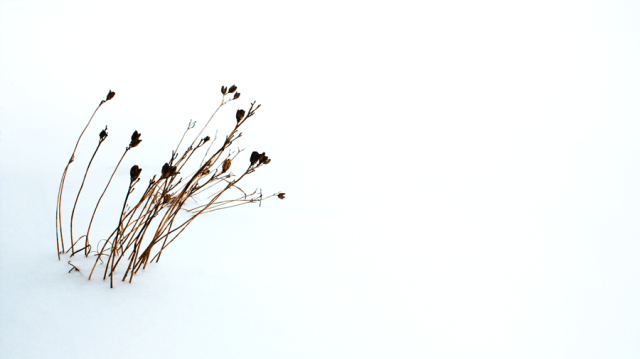
Photograph by © David Hutchison

Vandana Parashar’s War Zone

war zone…
no one left to decide
who is right

– Vandana Parashar (India)
Cattails, May, 2017

I see two ways readers can interpret this haiku.

1) Both sides of a conflict have sustained great casualties, and ideas of morality are left outside the realm of comprehension.

2) War always engages in violence and in that respect, neither side should be able to decide what is right or wrong.

Both interpretations contain a sense of irony. It is ironic that we try to be moralistic when it comes to killing other people for land, resources, domination, and more.

I feel the ellipsis conveys the tragedy of the circumstance and the silence after an intense battle. The structure is standard, but the chilling “o” sounds strung through the haiku provide a strong impact.

I think this haiku, or even senryu, makes for striking but subtle commentary on the irony and tragedy of war.

– Nicholas Klacsanzky (USA)

This poignant haiku takes us not only to the actual battlefield but also to the daily grudges and rows that are mostly endless and bring harmful effects to our lives. I have observed such situations many times in my own life where fights based on egos don’t end just because everyone thinks he or she is right and the next person is wrong.

The first line of this haiku is about a war zone: a zone that is a territory full of danger and harmful effects. The war zone indicates our mindsets and our egos with negative thoughts and feelings that disturb us mentally, physically, and spiritually, that bound us to not see out of the box, that steal our positive energies and act as a slow poison.

When one is in that war zone, one is not able to think or act rationally or logically. This is the level where we don’t go beyond our limited perceptions of the world and relationships, which makes us judge our relationships without having set criteria. We hallucinate about our surroundings and defend ourselves, merely giving reasoning to what is delusional and not reality. We feel that we are right and we justify our point of view with arguments without logic. We live with such delusions all the time which takes us to the comfort level of not being rejected, defeated, or surrendered.

Overall, this haiku is all about our negative attitude towards relationships when we are having trouble handling issues and problems. We end our relationships without even reaching any conclusion about who is wrong and who is right. We have a false self-image and we live with it all our lives and get involved in an endless war that we pass on from generation to generation without reaching any finality.

– Hifsa Ashraf (Pakistan)

If you enjoyed this poem and the commentary, leave us comment.

uUBtMiF

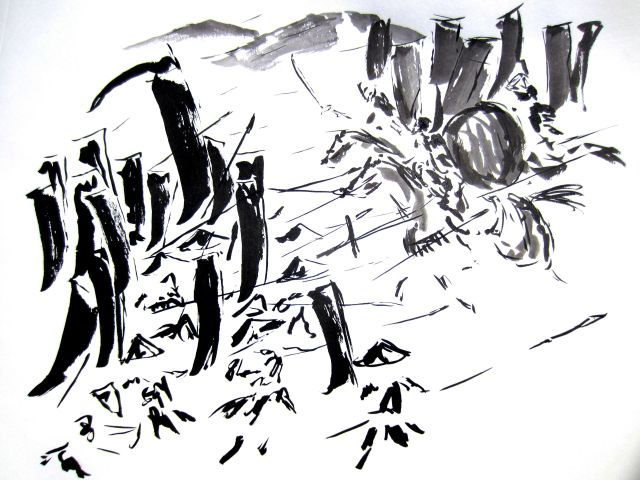
“The Battle of Sekigahara” by Kris Knapp

Wiesław Karliński’s Agave Flower

agave flower
in a gardener’s notebook
last entry

– Wiesław Karliński (Poland)
Akisame 43:1, 2016

Understanding this haiku takes a bit of know-how about the agave. This extraordinary plant only blooms once, and when it does, it is a sign that it will soon die. It is even nicknamed “century plant,” as it can take 100 years for it to bloom.

So, the gardener, before his or her passing, wrote about an agave in bloom. It is a sign of not only interconnection but also that humans are not so distant from plants. Both the agave and the gardener perhaps both lived for up to 100 years and also had one true shining moment in their lives that could be said to be the pinnacle of beauty or realization.

We can assume that the gardener died around the same time as the agave. However, maybe the gardener was so affected by the passing of the plant that he or she ceased from writing. It could be a testament to how much the gardener felt for the plants he or she cared for.

In a technical sense, the poem is minimalist and lets the imagery and the implied notions do the work. I am always impressed when I see haiku written in such few words that carry enormous weight.

In terms of sound, the “r”s that run through the poem give it a serious tone. The sparse language points to the stark nature of the content.

This haiku is layered: it is intriguing at first read, aesthetically pleasing at second read, and greatly nuanced at third read.

– Nicholas Klacsanzky (USA)

If you enjoyed this haiku and commentary, please leave us a comment.

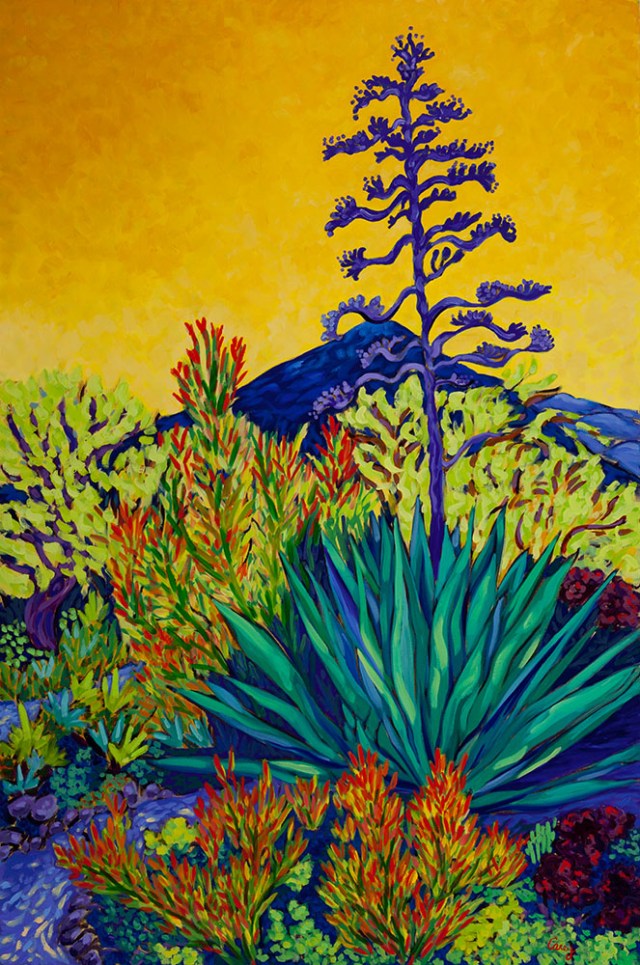
agave-azure-web– “Agave Azure” by Cathy Carey