letting the moon
into your lung
the bullet hole
by Michael Dylan Welch (USA)
2026 Editor’s Choice Confluence Award
Commentary by Hifsa Ashraf:
When I read the opening line, letting the moon, I paused and tried to consider the different possibilities contained in this multifaceted phrase. Letting suggests an intentional act, something allowed to happen rather than something forced. The moon here can be read both literally and metaphorically. Why let the moon in? Is it an act of surrender, acceptance, exhaustion, or simply an unconscious response to something beyond one’s control? The line leaves these possibilities open. The moon also carries a long history of association with solitude, longing, beauty, silence, and the inner self. Yet the poet does not tell us what kind of moon it is. Is it full, half, waxing, waning, eclipsed, or barely visible? This uncertainty adds to the poem’s mystery and allows the reader to bring their own moon into the scene.
Then comes the striking second line, into your lung. The movement from moon to lung creates an unexpected connection between the external world and the body. The moon is no longer simply something seen in the night sky—it somehow enters the body. The line can suggest breathing, inhalation, or the absorption of a scene through the senses. I also read the lung metaphorically, as a place where something is taken deeply inside, retained, and perhaps left unspoken. What enters the lung is not necessarily expressed through words. It may remain suspended in silence.
The final line, the bullet hole, radically changes my understanding of the first two lines. Suddenly, the moon may be visible through a bullet hole, perhaps in a wall, a door, a window, or some other structure marked by violence. At the same time, it may suggest a person being shot in the chest, with the bullet piercing the lung. I find myself visualizing a war scene where the bullet has left a hole in the body, creating a haunting opening through which moonlight seems to enter. The image brings together violence, death, and the quiet beauty of the moon in a deeply unsettling way. The hole could even frame the moon, creating an unsettling juxtaposition between beauty and destruction. The reader is left wondering where the bullet was fired, what it struck, and what happened before this moment.
This is where I find the haiku particularly powerful. The poet does not explain the violence or resolve the image. Instead, the three lines allow the moon, the lung, and the bullet hole to exist together in a space of silence and uncertainty. The juxtaposition preserves yūgen, leaving enough mystery for the reader to wander through different emotional and visual interpretations.
There is also an interesting sonic quality in the poem. The repeated long oo sound in moon and your, followed by the harder sounds in lung and bullet, creates a subtle movement from softness to impact. The closing hole returns us to the open vowel sound, leaving the poem with an almost hollow resonance. Rather than directly expressing sadness or remorse, these sounds may contribute to the poem’s quiet, lingering sense of grief and aftermath.
last frost–
the mailbox lid
comes free
by Elliot Diamond (USA)
Honorable Mention, Robert Spiess Memorial Contest 2026
Brad Bennett wrote the commentary below, which was printed in the recent Modern Haiku Journal, Summer 2026:
By using a traditional kigo, this poet is participating in a centuries-old haiku community conversation and exploration of the natural, cultural, and emotional meanings of “last frost.” It’s a kigo of transition, winter into spring. The poet delightfully juxtaposes that last frost with a mailbox lid coming free. They could have used “falls off.” That would imply that the mailbox has broken, leading to feelings of frustration—now it’s gotta be fixed. “Comes free” is a much more exciting and hopeful way to end this haiku and even, dare I say, gives the mailbox lid some agency. The lid has chosen to free itself. This feels like an act of hope and freedom. And the mailbox in this haiku has great metaphoric potential. We no longer need to hide ourselves inside a metal box. We are free from the constraints of winter.
Additional commentary by Nicholas Klacsanzky:
To add to Brad Bennett’s great commentary, I would like to mention the punctuation, sound, and pacing of this haiku. The em dash in the first line not only gives the reader time to pause and feel first frost, but it also provides a sense of finality to the haiku. The “o” sounds in each line make “comes free” feel tangible and reinforce the haiku’s imagery. Finally, the short line/longer line/short line format excellently approximates the traditional Japanese haiku rhythm. The brevity of the haiku (7 words total) corresponds well with haiku tradition, as most traditional haiku are written in 6-9 words or characters. This haiku has a lovely aesthetic and feel. It’s easy to see why this placed in the Robert Spiess Memorial Contest 2026.
scintillating scotoma
a glimpse
beyond the wall
Joshua St. Claire (USA)
Commentary by Jacob D. Salzer:
An intriguing haiku. If the eyes are, indeed, the windows of the soul, here we have a haiku that involves vision and the medical diagnosis of a scintillating scotoma.
An online search reveals that a scintillating scotoma is a type of visual abnormality, typically a blind spot that often appears jagged or wavy. It can result in light or darkness due to a disruption of electrical signals. People can experience this when they have a migraine with aura, but scintillating scotomas usually don’t last long.
In terms of human anatomy, the retina is a layer at the back of the eye that converts light into electrical signals. The optic nerve sends those signals to the brain. A scotoma is often a spot on the retina where the nerves don’t work and therefore can’t send signals to the brain, resulting in a visual impairment or blind spot. Unsurprisingly, the word scotoma is the Greek word for darkness. We also don’t know what wall is being referred to in this haiku, which gives room for readers to imagine different scenarios. There is also the simultaneous possibility of a metaphorical wall, or an internal, mental, or imaginary wall that is being referred to in this haiku, which inspires the question: how do our internal thought processes, beliefs, or mental programs affect the way we visually see the world? What walls are created by thoughts we attach to? Do we sometimes blindly believe a thought without questioning it?
In short, this is an intriguing haiku that sheds light on the anatomy of vision. It gives us a glimpse of what it’s like to live with a visual impairment. Clear vision is a gift that many people seem to take for granted. This haiku also perhaps gives us a glimpse into the poet’s soul or someone else’s soul. An important and interesting haiku.
Sources:
https://www.merriam-webster.com/dictionary/scintillate
https://my.clevelandclinic.org/health/diseases/24687-scotoma
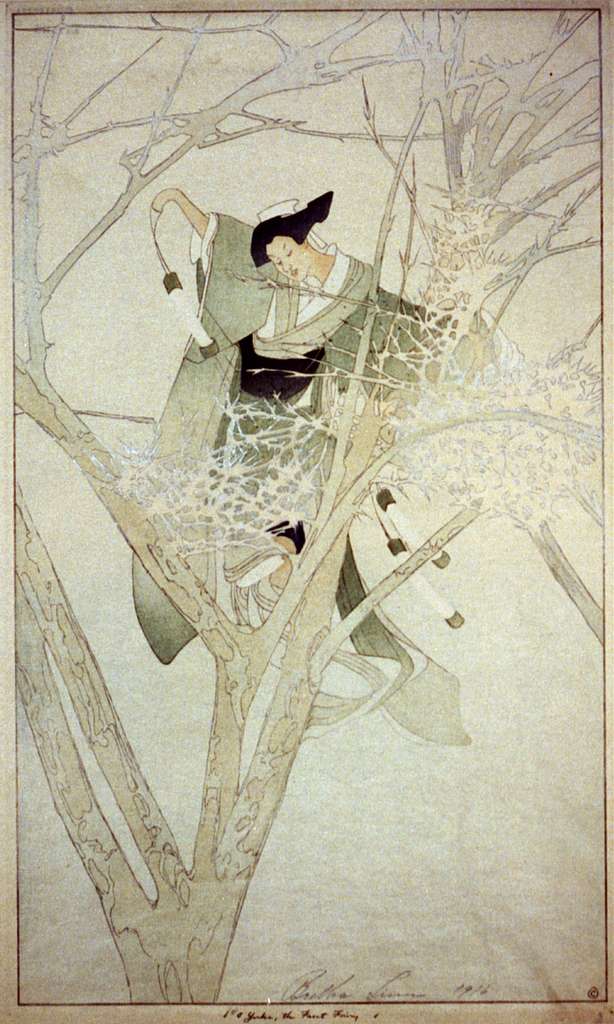
Woodblock print by Bertha Lum

