
Haiku by Kala Ramesh, Jas Asencio Ramirez, and Royal Baysinger

milky way …
the city’s debris choking
what is left of its river

Kala Ramesh (India)
first published in Acorn, fall issue, 2025

Commentary by Jacob D. Salzer

This is a revealing haiku that speaks volumes about the amount of waste produced in cities. This haiku also shows how poorly waste is often managed, leading to polluted water, soil, and air. The first line provides a much broader perspective on the Milky Way galaxy that shows how ignorant much of humanity is, creating a narrow-minded economic system based on scarcity, supply-and-demand, competition, and a refusal to take care of the Earth. The Milky Way and the Earth have been revered for thousands of years, especially by Indigenous Peoples, environmentalists, and spiritual people. Indigenous Peoples also often live near rivers, lakes, and oceans. Indeed, where there is water, there is life. If a city’s debris is choking a river, that’s a clear sign that we have built too much, too fast, and now we are all taking the consequences. In the end, we all share our brief human lives on this small Earth, and we are all temporary visitors here. What will we do with our limited time here?

This haiku sparks conversations about ways we can protect the Earth and reduce the sheer amount of waste we produce on a daily basis. This haiku also inspires questions about where products come from, and how they are sourced and created. Hopefully, this will lead to more mindful and informed consumers who are not fooled by clever or misleading marketing campaigns.

Finally, in a much broader sense, this haiku urges us to think about our values and how we want to live on Earth with our limited time here.

According to the Global Waste Index 2025 by Sensoneo, “After a comprehensive analysis of waste management in 38 countries, Israel has emerged as the country with the highest per capita waste generation, producing up to 650 kg of municipal waste per person annually. Of this amount, 524 kg is landfilled, representing 80% of the country’s total waste  – the highest landfill share among all analyzed nations. Consistent with data from 2019 and 2022, Chile and the United States continue to rank among the world’s most significant waste polluters.

On the other end of the spectrum are two Asian countries. Japan jumped to first place from seventh in 2022, thanks to low rates of waste generation and landfilling. South Korea secured second place with the highest recycling rate among all nations – 54%. Surprisingly, Estonia joined the top three with almost no waste sent to landfills. Positive rankings were also achieved by Scandinavian countries such as Sweden and Finland, as well as by DACH region countries, Germany and Austria.”

Source: https://www.sensoneo.com/global-waste-index/2025/

An important haiku.

winter breath 
floats through chilled air-
child tries to catch it 

Jas Asencio Ramirez (USA)
first published in Brussels Sprout, Volume XII:3, 1995

Commentary by Nicholas Klacsanzky:

The season the haiku is placed in is shown in the first line with “winter.” It is reinforced with “chilled.” The cold and sparseness of winter is contrasted by the third line. A child tries, in its innocence and playfulness, to catch the visible, floating breath. But, like the breath, a child’s carefree nature eventually dissipates. Sometimes, it seems to parents that their children grow up too fast. Classic haiku often focus on a fleeting moment, and this one is built around impermanence. The attempt by the child to catch the breath is doomed from the start. The imagery is hopeful at the same time, capturing a child’s innocent belief that something visible must also be graspable.

In the second line, there is an approximation of kireji, or a cut marker, to delineate the two parts of the haiku, with the introduction of the dash. The line break after “floats through chilled air—” creates a small pause, mirroring the way breath hangs in cold air before scattering.

The letter “r” in this haiku seems the most prominent to me, which brings a sense of heaviness. This provides more weight to the visible breath. Light letters like “t” and “i” also provide tenderness to the musicality of the haiku.

In terms of pacing, the haiku follows the short/long/short line lengths. This reflects the traditional Japanese haiku rhythm. Though this haiku is not so focused on absolute brevity, the word choice by the poet unfolds an emotional response from the reader. The poet captures a poignant moment with clarity to allow readers to ponder the relationship between innocence and experience, transience and staying power, and hope and realism.

as the heatwave settles a swell of cicada songs

Royal Baysinger (Canada)
first published in Frogpond, 46.3, 2023

Commentary by Hifsa Ashraf:

This monoku reflects a moment of seasonal transition, where one phase of summer gradually transforms into another. The opening phrase, as the heatwave settles, suggests that the speaker has been enduring and observing an extended period of oppressive heat, waiting for the moment when its intensity finally begins to ease. The word settles becomes the hinge of the poem, marking not only a shift in the weather but also a quiet change in the speaker’s emotional state. As the heat subsides, so too does the inner tension, creating a sense of relief and anticipation.

The phrase a swell of cicada songs evokes both a rising chorus and a wave of renewed life. The word swell carries a double meaning: it suggests an increase in sound while also recalling the movement of a wave, reinforcing the poem’s sense of transformation. The cicadas seem to celebrate this subtle change in the season, their chorus becoming a natural announcement of renewal. Their songs may also foreshadow the coming rains, or express the instinctive joy of a landscape awakening after oppressive heat.

Beyond the seasonal scene, the haiku resonates as a metaphor for human experience. Just as the heatwave eventually settles, periods of hardship also come to an end. The swelling chorus of cicadas becomes a symbol of hope, resilience, and inner renewal—a reminder that difficult times can give way to fresh understanding, joy, and transformation.

The poem’s music further deepens its effect. The repeated s sounds in assettlesswellsongs, and cicada create a soft, whispering rhythm that mirrors the gradual easing of the heat, while the w sound in heatwave and swell suggests the motion of a wave carrying the poem from stillness toward renewal.

Photo by Jon Washburne
Haiku by Maurizio Brancaleoni, Kala Ramesh, and Sarah Mirabile-Blacker

small green leaves —
the ticket machine
is acting up


Maurizio Brancaleoni (Italy)
Trash Panda, Vol. 7, Summer Issue 2024

Commentary from Jacob D. Salzer

I appreciate the message and humor in this haiku. On first read, I saw the small green leaves being stuck in the ticket machine, preventing it from working. Alternatively, the machine could be malfunctioning for other reasons. In terms of a visual comparison, this haiku reminds me that ticket machines have semiconductor chips that are very small. What happens when a ticket machine (that has become a normal part of life) stops working? That moment of humor and frustration comes through this haiku. We also don’t know what kind of ticket machine is being referred to in this haiku. I like that it’s left open for the reader.

Sometimes, I think certain technological interruptions in daily life can reap many benefits and different points of view. It can break habitual thought patterns and offer fresh perspectives on life. As Gururaj Ananda Yogi has said, “Life is not meant to be lived like a machine. Life is an art.” This haiku also brings to mind haiku about power outages and how a power outage can open up new perspectives and ways of living and being in the world. Parallel to this observation, I think that because the machine is not working in this haiku, the poet is able to notice Nature. I find there is beauty in that. In general, perhaps if more people spent less time with technology and less time on their phones, they could notice more beauty around them.

In my city, there are various machines along streets and bus stops, including parking ticket machines, that help generate revenue for the city budget. How much money do cities make per year in parking tickets alone? According to qz.com, “San Jose made $11.4 million through parking tickets in 2019, an amount that doesn’t include the fees that weren’t collected.”

In short, this is an interesting haiku that explores the various intersections between Nature, psychology, money, and technology in modern life.

cycling   the moon and i    in sync

Kala Ramesh (India)
Wales Haiku Journal: Summer 2025 edition

Commentary from Hifsa Ashraf:

This haiku elegantly captures the interplay between nature and personal experience, linking the lunar cycle to the menstrual cycle. Even without an accompanying description, the connection between the average 29-day menstrual cycle and the lunar cycle remains clear. The term “cycling” conveys more than temporal alignment; it signals synchronized phases—waxing and waning, thickening and thinning—of both the moon’s surface and the womb’s lining. This suggests profound harmony between human biology and cosmic rhythms. “Cycling” carries layered meanings: endurance, patience, and transformation, whether physical or subtle, in both body and moon. Its repetitive nature reflects the universe’s order—growth and decline, life and death, beginnings and endings. These parallel the shared journeys of nature and humanity. Finally, the moon emerges as a symbol of life, fertility, love, rebirth, and transformation. It shares an intimate, almost invisible connection with the womb.

The monoku’s use of “i” in lowercase conveys humility and grace. It embraces the cyclical nature of both body and moon. The poet forges a unique bond, aligning the feminine essence of the moon and the self in harmony.

The word “sync” acts as a clever pivot. It implies both alignment and an inevitable pause—perhaps signaling transformation, rebirth, or menopause, where cycles break before renewing. This pause invites meditation, renewal, or a shift in life’s course. It offers a moment of rejuvenation after exhaustion.

The monoku’s spacing encourages reflection on each word, slowing the reader’s rush to judgment. This structure, combined with the lowercase “i,” underscores humility and invites the contemplation of the interconnected cycles of nature and self, unified in their feminine essence.

dusk —
riding tandem
with his shadow


Sarah Mirabile-Blacker (Switzerland)

Commentary from Nicholas Klacsanzky:

This haiku captures a fleeting yet intimate moment between self and shadow, set against the liminal time of dusk. “dusk” isn’t a conventional kigo (seasonal reference), but it functions evocatively. Dusk carries universal associations with transition and ending—themes rich with emotional and symbolic resonance. Although not tied directly to a season, it offers a subtle kigo-like atmosphere, hinting at cyclical closure or introspection.

The dash after “dusk” pauses the reader, allowing the scene to transition—between day and night, visibility and obscurity. The dash puts “dusk” into “solitude” before introducing the duo of the rider and his shadow. That separation allows the two elements—time and action—to resonate individually, then recombine through the act of juxtaposition. The dash is an approximation of kireji, the Japanese cut marker in a haiku.

“Riding tandem” suggests companionship and rhythm. To “ride tandem with his shadow” conveys both literal imagery—a cyclist lengthened by his dark double—and metaphorical resonance. The shadow is no longer a passive outline; it becomes an equal partner, keeping pace, inseparable yet independent. “his shadow” could also refer to the narrator riding alongside the shadow of a friend, husband, or family member.

Looking at the sound of the haiku, dusk closes with the hushed consonant cluster -sk, trailing off like something that is dimming. shadow ends in the long, fading vowel -ow, evoking dissolving, like a sound disappearing into the air. So, the word choices themselves suggest a diminishing, mirroring the passage into night. Also, the sharp sounds (bolded) in “riding,” “tandem,” “with,” “his,” and “shadow” provide a stark atmosphere to the poem.

This haiku displays a precise perception that opens into wider emotional and philosophical terrain. Through the use of kireji, the mood-infused “dusk,” and the economical but striking juxtaposition of rider and shadow, the poem evokes transience, identity, and companionship in a moment suspended between day and night.

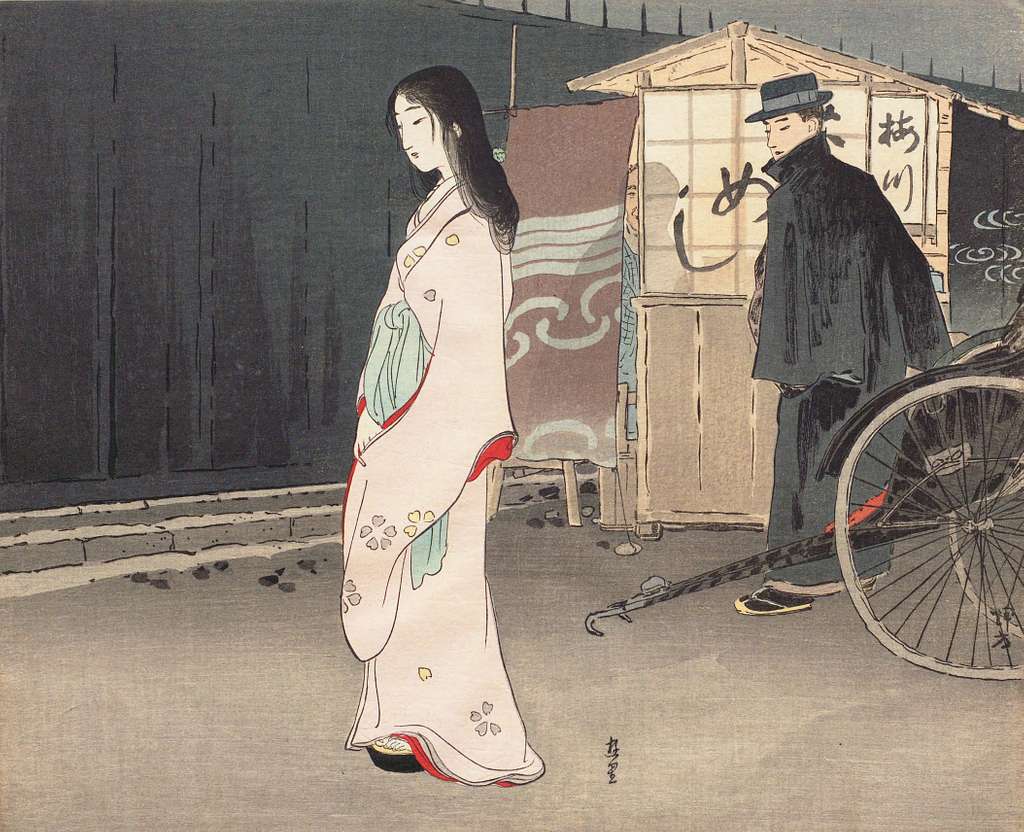
Frontispiece to “Sharing an umbrella (Ai ai gasa)” by Izumi Kyōka, frontispiece illustration, woodblock print.

Haiku by Kala Ramesh, Joanna Ashwell, and Manasa Reddy Chichili

plucked jasmine
a funeral
        on my hands


Kala Ramesh (India)
The Heron’s Nest: Volume XXIV, Number 1: March 2022

Commentary from Nicholas Klacsanzky:

Jasmine not only has a powerful scent but also has far-reaching symbolism in rites and rituals. In India, jasmine is a common flower used as garlands for the deceased. The scent of the flower is so strong that it often can linger on the hands of the person handling it. In this haiku, the poet creates emotional resonance with the contrast of death and the continuance of scent (or life) after an offering. Interestingly, due to the phrasing, the funeral mentioned could refer to a person or the flower itself.

The word “plucked” connects well to the theme of death, as after a flower is plucked, it eventually withers. The poet may be saying that like plucked jasmine, when people die, our scent is left behind in the form of memories, passed on wisdom, and life work. The phrase “on my hands” has a dual meaning of physically being on one’s hands and also a sense of responsibility. With added space in the third line, I believe Kala is illustrating the weight the funeral is having on her and the responsibility she feels in taking care of this rite. It is also a unique concept to see one’s hands as a funeral, which leads readers much to mull over.

Traditionally, jasmine is a kigo or seasonal reference for spring. In India, jasmine can blossom from spring to autumn. Overall, I propose that in the context of this haiku, Kala may have been increasing the resonating contrast of spring with the end of life.

The poem is quite efficient with only seven words. This effectiveness doubles with the usage of multiple meanings with “plucked” and “on my hands,” plus the employment of physical space in the third line. In terms of sound, the most outstanding letter is “l,” where the reader can almost feel the action of being plucked.

There are many ways for readers to imagine the haiku in existence and that is one of the strengths of this poem. Kala allows the “white space” in the haiku to speak and the result is a multi-layered poem that connects to the deeper recesses of our spiritual self.

chaffinch call
a brief burst
of sunshine


Joanna Ashwell (UK)
Autumn Moon Haiku Journal, issue 3:2, Spring/Summer 2020

Commentary from Hifsa Ashraf:

Chaffinches call for many reasons, i.e. rain, warnings, mating, or interactions with each other. The chaffinch, a little bird, is a symbol of positivity, happiness, and good tidings. The call of a chaffinch is being heard by the poet or a keen observer, which shows how nature attracts our senses in different ways. Chaffinches have a soft tune when they chirp. When a person hears their call, it is in a calm and quiet place i.e. park, forest/jungle, garden, meadow, etc. The word ‘call’ instead of ‘chirp’ indicates that it is for a purpose. Having no ellipses at the end of line one allows us to interpret it in our own way. 

The rest of the haiku defines or specifies the chaffinch’s call which may be related to a pre-rain or post-rain situation. “A brief burst” is purely a seasonal expression here with some great analogies, i.e. a brief burst of joy, hope, laughter, or related feelings after a hopeless, cloudy, hazy day, or feelings. I see it as a sudden change in weather where the sun is playing hide and seek with clouds akin to the ups and downs in life where we need a call or news that can break gloomy feelings or thoughts. 

The third line of this haiku implies positive energy and life hidden in the sunshine which soothes our senses and changes our feelings/thoughts and ultimately our mood. If it is a pre-rain or post-rain circumstance, then ‘sunshine’ could mean brightness and light that makes us calm and positive after a rough patch or harsh weather.

I love this haiku because of its simplicity and expression. It shows how deeply our lives are connected with nature and how much we depend on it both internally and externally. 

Also, the sounds of ‘ch’, ‘s’, and ‘b’ make this haiku rhythmic and allow us to enjoy reading it while imagining the chaffinch’s call.

empty bowl
so many thoughts
singing in my heart

Manasa Reddy Chichili (India)
Autumn Moon Haiku Journal, Volume 8:1 Autumn/Winter 2024

Commentary from Jacob D. Salzer:

I appreciate this haiku because, in the empty bowl, the poet’s heart and mind are full and overflowing with thoughts and images. The notion of “so many thoughts singing in my heart” gives me clear feelings of gratitude, harmony, and abundance. I appreciate how the value of the empty bowl becomes apparent in this haiku without explaining it. When each of us looks into the empty bowl, what do we see? 

This haiku could also involve a lack of food. I can see the poet holding the empty bowl, perhaps asking for food on a street. Even in this interpretation, the poet seems to be fulfilled in their spirit, even if food is scarce. In turn, I think of how food is sacred and not something to be wasted. The poet (and perhaps others) could have also just finished eating a meal and all that remains are so many thoughts of loved ones who are living and those who have passed.

I can also see a singing bowl in this haiku. This special bowl sings precisely because it is empty. 

This haiku also resonates with the well-known Buddhist saying from the Heart Sutra, “All form is emptiness. All emptiness is form.” Thoughts rise and fall, but only in what could be called a sacred silence. In a way, we could be seen as images of the invisible.

What songs can we sing to those we love in this lifetime? 

This is a moving haiku we can contemplate and experience without overly analyzing it. It is personal yet universal at the same time and accessible. We can each experience the poem in our own way. A beautiful haiku.

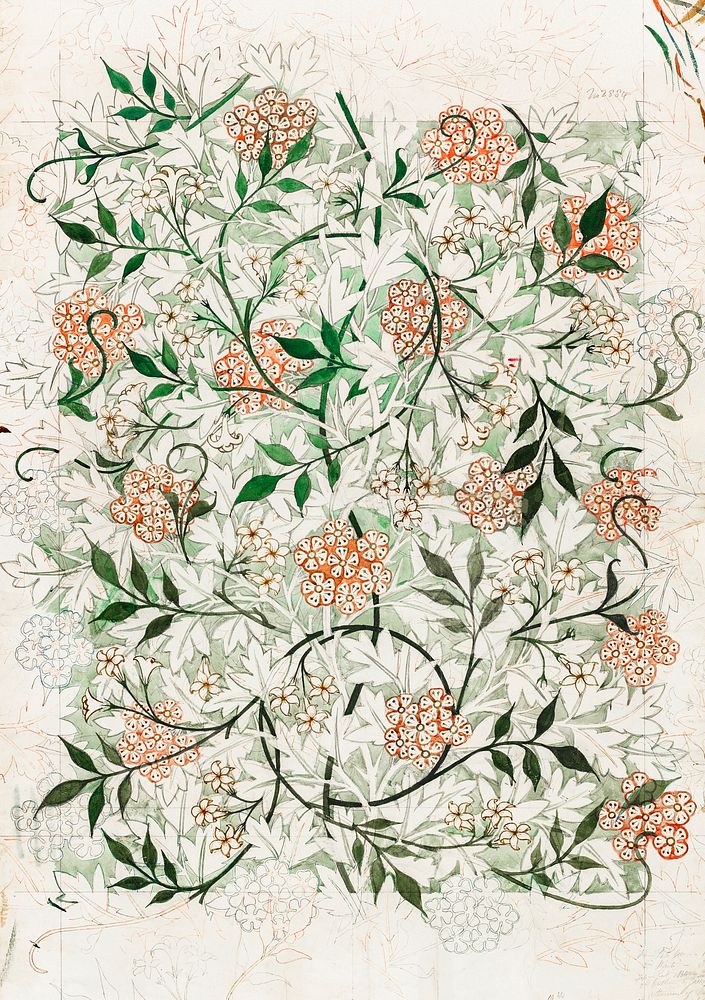
Painting by William Morris (1834-1896). Original from The Birmingham Museum.