
Haiku by Michael Dylan Welch, Elliot Diamond, and Joshua St. Claire

letting the moon
into your lung
the bullet hole


by Michael Dylan Welch (USA)
2026 Editor’s Choice Confluence Award

Commentary by Hifsa Ashraf:

When I read the opening line, letting the moon, I paused and tried to consider the different possibilities contained in this multifaceted phrase. Letting suggests an intentional act, something allowed to happen rather than something forced. The moon here can be read both literally and metaphorically. Why let the moon in? Is it an act of surrender, acceptance, exhaustion, or simply an unconscious response to something beyond one’s control? The line leaves these possibilities open. The moon also carries a long history of association with solitude, longing, beauty, silence, and the inner self. Yet the poet does not tell us what kind of moon it is. Is it full, half, waxing, waning, eclipsed, or barely visible? This uncertainty adds to the poem’s mystery and allows the reader to bring their own moon into the scene.

Then comes the striking second line, into your lung. The movement from moon to lung creates an unexpected connection between the external world and the body. The moon is no longer simply something seen in the night sky—it somehow enters the body. The line can suggest breathing, inhalation, or the absorption of a scene through the senses. I also read the lung metaphorically, as a place where something is taken deeply inside, retained, and perhaps left unspoken. What enters the lung is not necessarily expressed through words. It may remain suspended in silence.

The final line, the bullet hole, radically changes my understanding of the first two lines. Suddenly, the moon may be visible through a bullet hole, perhaps in a wall, a door, a window, or some other structure marked by violence. At the same time, it may suggest a person being shot in the chest, with the bullet piercing the lung. I find myself visualizing a war scene where the bullet has left a hole in the body, creating a haunting opening through which moonlight seems to enter. The image brings together violence, death, and the quiet beauty of the moon in a deeply unsettling way. The hole could even frame the moon, creating an unsettling juxtaposition between beauty and destruction. The reader is left wondering where the bullet was fired, what it struck, and what happened before this moment.

This is where I find the haiku particularly powerful. The poet does not explain the violence or resolve the image. Instead, the three lines allow the moon, the lung, and the bullet hole to exist together in a space of silence and uncertainty. The juxtaposition preserves yūgen, leaving enough mystery for the reader to wander through different emotional and visual interpretations.

There is also an interesting sonic quality in the poem. The repeated long oo sound in moon and your, followed by the harder sounds in lung and bullet, creates a subtle movement from softness to impact. The closing hole returns us to the open vowel sound, leaving the poem with an almost hollow resonance. Rather than directly expressing sadness or remorse, these sounds may contribute to the poem’s quiet, lingering sense of grief and aftermath.

last frost–
the mailbox lid
comes free


by Elliot Diamond (USA)
Honorable Mention, Robert Spiess Memorial Contest 2026

Brad Bennett wrote the commentary below, which was printed in the recent Modern Haiku Journal, Summer 2026:

By using a traditional kigo, this poet is participating in a centuries-old haiku community conversation and exploration of the natural, cultural, and emotional meanings of “last frost.” It’s a kigo of transition, winter into spring. The poet delightfully juxtaposes that last frost with a mailbox lid coming free. They could have used “falls off.” That would imply that the mailbox has broken, leading to feelings of frustration—now it’s gotta be fixed. “Comes free” is a much more exciting and hopeful way to end this haiku and even, dare I say, gives the mailbox lid some agency. The lid has chosen to free itself. This feels like an act of hope and freedom. And the mailbox in this haiku has great metaphoric potential. We no longer need to hide ourselves inside a metal box. We are free from the constraints of winter.

Additional commentary by Nicholas Klacsanzky:

To add to Brad Bennett’s great commentary, I would like to mention the punctuation, sound, and pacing of this haiku. The em dash in the first line not only gives the reader time to pause and feel first frost, but it also provides a sense of finality to the haiku. The “o” sounds in each line make “comes free” feel tangible and reinforce the haiku’s imagery. Finally, the short line/longer line/short line format excellently approximates the traditional Japanese haiku rhythm. The brevity of the haiku (7 words total) corresponds well with haiku tradition, as most traditional haiku are written in 6-9 words or characters. This haiku has a lovely aesthetic and feel. It’s easy to see why this placed in the Robert Spiess Memorial Contest 2026.

scintillating scotoma
a glimpse
beyond the wall

Joshua St. Claire (USA)

Commentary by Jacob D. Salzer: 

An intriguing haiku. If the eyes are, indeed, the windows of the soul, here we have a haiku that involves vision and the medical diagnosis of a scintillating scotoma.  

An online search reveals that a scintillating scotoma is a type of visual abnormality, typically a blind spot that often appears jagged or wavy. It can result in light or darkness due to a disruption of electrical signals. People can experience this when they have a migraine with aura, but scintillating scotomas usually don’t last long.

In terms of human anatomy, the retina is a layer at the back of the eye that converts light into electrical signals. The optic nerve sends those signals to the brain. A scotoma is often a spot on the retina where the nerves don’t work and therefore can’t send signals to the brain, resulting in a visual impairment or blind spot. Unsurprisingly, the word scotoma is the Greek word for darkness. We also don’t know what wall is being referred to in this haiku, which gives room for readers to imagine different scenarios. There is also the simultaneous possibility of a metaphorical wall, or an internal, mental, or imaginary wall that is being referred to in this haiku, which inspires the question: how do our internal thought processes, beliefs, or mental programs affect the way we visually see the world? What walls are created by thoughts we attach to? Do we sometimes blindly believe a thought without questioning it?

In short, this is an intriguing haiku that sheds light on the anatomy of vision. It gives us a glimpse of what it’s like to live with a visual impairment. Clear vision is a gift that many people seem to take for granted. This haiku also perhaps gives us a glimpse into the poet’s soul or someone else’s soul. An important and interesting haiku.

Sources: 

https://www.merriam-webster.com/dictionary/scintillate

https://my.clevelandclinic.org/health/diseases/24687-scotoma
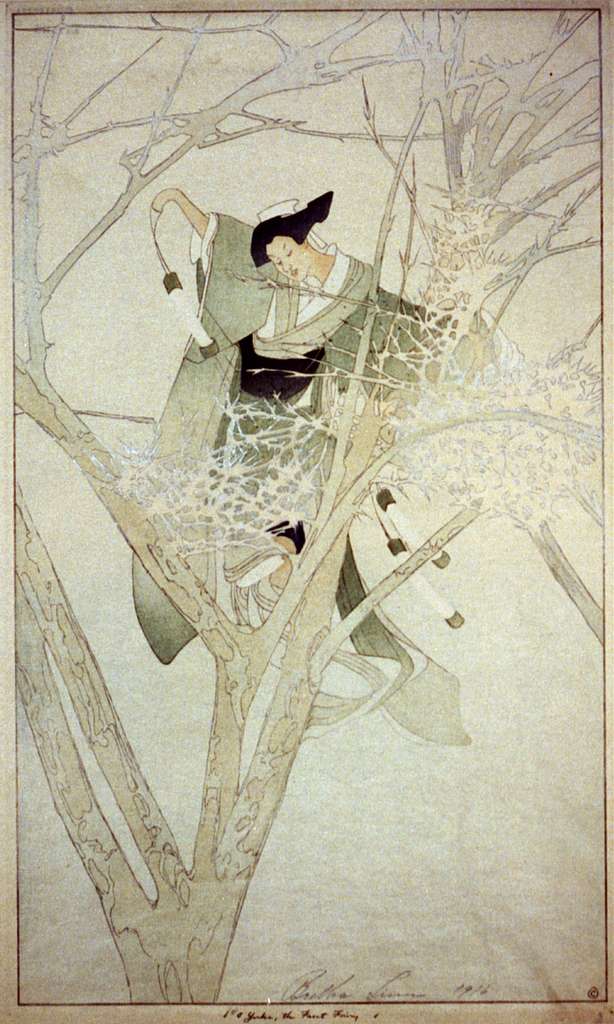
Woodblock print by Bertha Lum

Results for the Inaugural George Klacsanzky Memorial Haiku Contest

The inaugural George Klacsanzky Memorial Haiku Contest received submissions from 491 poets, totaling 1,393 haiku. This is a great honor for Haiku Commentary and for the memory of haiku pioneer George Klacsanzky. The judge of the contest, Michael Dylan Welch, was kind enough to write commentary on the winning poems. The full results are shown below.

First Place

abandoned cemetery
the dust in me
whispers a prayer

— Denisa Hanšutová, Slovakia

We are made from dust and to dust we shall return. This poem confronts us with that reality in its allusion to the book of Genesis, reminding us of our place in the cycle of life. This cemetery is abandoned, so even the cemetery is returning to dust. Yet the poet is visiting, either by chance, out of curiosity, or intentionally to see the grave of a loved one. In a moment of introspection, the poet’s awareness of mortality prompts a prayer of hope or desire, whispered in quietness, as if not to disturb the scene’s moving tranquility. Saint Augustine said, “It is no advantage to be near the light if the eyes are closed.” Perhaps visiting this cemetery has opened the poet’s eyes.

Second Place

nettle flowers—
the paramedics stop
defibrillating

— Lucas Weissenborn, Norway

It’s easy to suspect that these nettles, despite their flowers, are stinging nettles. As a result, this poem’s first line immediately introduces tension. Yet we could hardly predict where its last two lines will take us, which is a sad moment marking the end of a life. We can picture these flowers at the side of a road, noticed after an accident and the arrival of paramedics. The nettles echo that metaphorical sting. Most likely it is summer, the peak blooming time for many nettles. And although summer is usually the peak of life, here a life has ended, and we can engage with that moment of psychological realization that no more can be done to save this life.

Third Place

piecing together
a torn photograph—
winter stars

— Alvin B. Cruz, Philippines

Loss is confronted with a desire to heal, to mend, surely to piece together more than just a photograph. The stars may be particularly clear in winter, but their light is also cold. The image of the last line carries a coldness, yes, but also the idea of wishing upon a star, of desiring a return to the way things once were. A melancholy sadness pervades this poem, yet not without a touch of hope. I appreciate this poem’s deft pairing of unstated emotion with tactility.


Honorable Mentions
(in no particular order)

moonlight
the stillness
of a wrecking ball

— Ravi Kiran, India

It’s not often that we see a wrecking ball. It’s a tool of destruction, yet here it’s an object of fleeting beauty, seen at night when it’s not being employed for its intended purpose. The poet finds a new purpose for the wrecking ball and records that moment of attention for our appreciation.

glacial erratic—
a refugee traces
his lifeline

— Meera Rehm, UK

A refugee will know his or her origins and never forget them. Where does a glacial erratic come from? In some cases, the answer might be as simple as somewhere farther up the mountain, near a still-active glacier. But in many parts of North America and elsewhere, glacial erratics survive far from mountains, left over from the ice age where their origin is often much more of a mystery. Here the refugee contemplates not just the past but also the future.

summer midnight—
the traffic light changes
for no one

— Punyasloka Mohapatra, India

Perhaps we’ve been on a late-night walk and have seen traffic lights change when no cars are on the road. The irony of this poem is that the light changed for the poet, the observer, if not for a passing vehicle. Haiku poets are noticers, appreciators. Billy Collins has said that haiku are poems of existential gratitude, and we feel that gratitude in this poem.

summer fair
the merry-go-round
of glances

— Herb Tate, UK

It’s easy to imagine a parent seeing his or her child on this merry-go-round, perhaps a carousel. Every trip around brings a fresh glance, a fresh meeting of the eyes, a fresh sharing of delight. Surely the watcher appreciates the gentle joy of the person on the merry-go-round—its purpose is indeed merriment, and the watcher shares that joy vicariously.

returning soldier—
the kids ask their dad
for souvenirs

— Annette Akkerman, Netherlands

This poem points to the innocence of children, who seem to have no idea what war is, or what their dad’s job truly is. The question is, does the father explain, or let the kids think that his travel is more like a vacation? We can be grateful that the father has indeed returned, even if the children are not aware of how grateful they should be for that, their true gift on that occasion.

starless sky
opening and shutting
the same cupboard

— Christine L. Villa, USA

It’s late at night, and the poet has wandered into the kitchen, perhaps forgetting why, or changing her mind. The sky is starless outside the window, and perhaps that dullness has clouded the poet’s mind in this moment of aimlessness. This “same” cupboard may have been opened just a moment earlier, adding more depth to this moment of distractedness, and we can only wonder why.

stargazing
the baby’s cry
brings me back to earth

— Rich Schilling, USA

The stars here are so absorbing that the poet has momentarily forgotten their child. The reality of being a parent isn’t without the optimism of gazing at stars, though, and every parent will wish for the stars for their newborn baby. Up may seem to be countered with down in this poem, beauty tempered with practicality, yet those stars will surely be what this family reaches for in the years ahead.

—

Thank you to all participants of the inaugural George Klacsanzky Memorial Haiku Contest for making it a great success. We hope all of you participate next year in May. Cheers!

Michael Dylan Welch’s Scattered Petals

scattered petals . . .
the thud of my books
in the book drop

© Michael Dylan Welch (USA)

The first line most likely refers to late spring, when the petals on blossoms regularly fly off, though some petals scatter in early spring as well. Instead of “scattering” we have “scattered,” which denotes that we are seeing the petals after they have already spun through the wind and landed in a formation. The kireji or “cutting word” as the ellipsis works well to show the continuous motion of the petals. Though Welch does not specify which petals, I imagine them to be pink.

Then we have an abrupt action: the thud of books. It is important to note the use of “my.” It could mean the books the author wrote himself or simply the books he is returning to a library. The use of “my ” gives the books more weight, no pun intended.

In the third line, we get to know that the thud of books is coming from a book drop, which are located at libraries.

Though books and petals have much different physical weights and the actions described in both parts seem to be different, they have a similarity: transience and a circular nature. Through seasons, petals come and go, illustrated nicely by the ellipsis. But even if they appear to be transient, they always come back each year. On the other hand, when we get out books from the library, we eventually return them, and then someone else will take them out. Though the author’s reading of the books was temporary, there is an endless cycle of reading them from the countless readers at the library.

Another thing to get from the juxtaposition is how the two actions connect. Did the dropping off of the books, and its thud, cause the petals to scatter, or vice versa? Kind of like a trick of the mind, I find myself hearing the thud of the books as I imagine the petals scattering, possibly around the library courtyard, or parking lot. I also see how the definite thud of the books correlate to the now still petals on the ground. Though cause and effect is usually avoided in haiku between the two parts, it is not a “sin” to imply it.

The sound of the haiku works well. The “s” sound in “scattered,” “petals,” and “books” make a rustling sound akin to scattering petals. The “o” sound in “books” and “book drop” illustrate the dropping motion and maybe the sensation we feel when dropping books off.

The use of two “the” seems right, as both the sound of the books dropping and the book drop itself need to be important. If it was “a book drop” I think we would feel the impact less.

The mood the haiku is somber and introspective. For me, it instantly puts me in a state of looking for higher meaning in what I perceive in everyday life. Many haiku poets would agree that it is one their goals for readers when writing haiku: to allow people to see greater significance behind mundane existence and to see the connection between the myriad things we perceive.

If you want to learn more about Michael Dylan Welch and read his fantastic essays on haiku and related subjects, visit http://www.graceguts.com/

– Nicholas Klacsanzky (Ukraine)