
Lucky Triana’s Great Eggfly

midday heat
a great eggfly sips
my sweat

© Lucky Triana (Indonesia)

This haiku shows the classical compassion and even irrationality that is the essence of haiku. It also has a strong seasonal reference and a great sense of sound.

The poet is sweating, but the butterfly is taking away her sweat. Though this action is instinctual, there is a sense of compassion in it–which is a paradox that haiku often employs.

“Midday heat” is a common seasonal reference for summer, and summer is a relaxing and joyful time. The act of the butterfly taking away her sweat is an expression of this carefree atmosphere.

I enjoy the naming of this butterfly, as in haiku, giving exact details is often essential to creating meaning and mood.

The sound of “t” works to create the tension of the heat in “heat” “great” and “sweat.” The sweetness of the compassion can be seen through the “s” sounds: “sips” and “sweat.”

I wish I had been there to experience this. A pleasant haiku.

– Nicholas Klacsanzky (Ukraine)
Eric Lohman’s Cherry Blossoms

cherry blossoms
how a street becomes
a car-park

© Eric Lohman (USA)

Lovely! This is a time, in my opinion, that a crafty rhyme can slip in with ‘blossoms’ and ‘becomes’…the syntax leads you smoothly through cherry blossoms and how a street ‘becomes’ (smooth sounds) before abruptly stopping you at ‘car-park’.(harsh sounds)
Having ‘a car-park’ on L3 is so abrupt it forces the reader to go back to the top, re-reading and building a clearer image on every reading…love it!

– Brendon Kent (UK)

To add to this, I love the juxtaposition between the two parts. Seeing the similarity in the way cherry blossoms bloom and the way urban streets fill up with cars is a genius insight. It also makes a harmony between the natural world and human technology.

In terms of sound, “blossoms” and “becomes” has both a pleasant “b” and “o” sounds, which increases the beauty of the haiku.

Lohman could have written much more, but chose to be concise, which is key to writing haiku. Writing about small things in a large way, concisely: an essential art to practice for any haiku poet.

– Nicholas Klacsanzky (Ukraine)

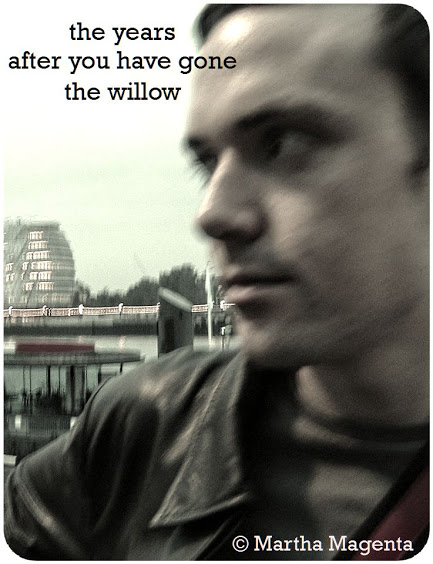
Martha Magenta’s Willow

the willow

Though simple, this haiku has a lot of weight to it. We don’t know who has gone, but the photo accompanying it might give us a clue. The weight of the loss is shown through the willow, which often symbolizes melancholy. Over the years, the willow has grown, and this might imply that the grief of the author has grown over the years as well.

I like how the haiku seems so natural, like it could be written in a matter of seconds. However, I am sure Martha took longer than that to write the poem. But this shows how a haiku should be: simple and effortless to read. Just the right words in the right place.

In addition, there is a continuation of the “o” sound that adds to the sense of sadness and continuation.

A fine example of an emotionally-weighted haiku.

– Nicholas Klacsanzky (Ukraine)