Marilyn Ward’s Glacier

2016+1

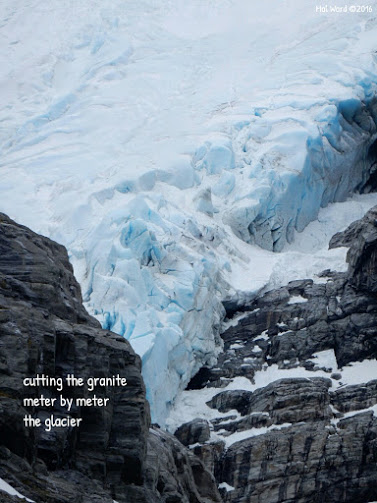
At first sight, you might read this haiku and say, “so what?” However, I believe through its statement, it helps us realize how the landscapes around us have been shaped: through a long process. This observation can apply metaphorical to our lives as well, in that what we keep frozen inside us cuts us slowly.

With the word “cutting” it is inferred that it is painful. We might even garner some compassion for the granite through its suffering, though we know in the back of our mind that granite does not feel suffering. That is one of the powers of haiku: giving us compassion for every form of life, even inanimate things.

Without punctuation, the poet makes the two parts clearly separate. The sound works well, with “I” sounds running through it, possibility showing the sound of cutting.

This haiku has a classic feel to it, with it being an observation made into a great insight.

– Nicholas Klacsanzky (Ukraine)

Eva Limbach’s Wars

all our wars
lost
blossom wind

© Eva Limbach (Germany) (2016)

Every word counts and is powerful in this haiku. The pacing is also effective. Having “lost” as the second line shocks us and makes us stop. The juxtaposition is also effective. Blossoms are beautiful, unlike wars, but both blossoms and wars get lost in the wind: blossoms in natural wind, and wars in the winds of hate, vanity, anger, and jealously.

The big difference is that blossoms are innocent, and though they are spread randomly and carried off, they give no harm. I believe this haiku is a call to be innocent and sweet like blossoms in the winds of life. It also has a distinct feeling, which is important, as haiku are about feeling, ultimately.

This haiku is a bit indescribable, as haiku should be.

– Nicholas Klacsanzky (Ukraine)

Marilyn Ward’s Shelter

 2016+-+1

Haiku is a lot about being objective, accurate, specific, and describing our senses. This is a good example of these qualities. Alan Summers, who is taking a break as a mentor, has often told others about being specific in haiku and how it can add layers and additional meaning to haiku. Marilyn is a true student of Alan. “granite fissures” and “coltsfoot” is right on the mark in terms of being specific.

She could have written:

sheltered from wind
in a hole in a rock
small leafy plant

…but as we see, not only does this lessen the beauty of the sound, it makes it harder for the reader to experience the moment that the haiku portrays. By saying it is granite, fissures, and coltsfoot, the poet gives a vivid picture of the haiku moment and allows us to immerse in the experience.

About the actual feeling of the haiku, I like how the haiku implies that nature has compassion in its seemingly random existence. The haiku is concise, well-paced, and focused.

– Nicholas Klacsanzky (Ukraine)