
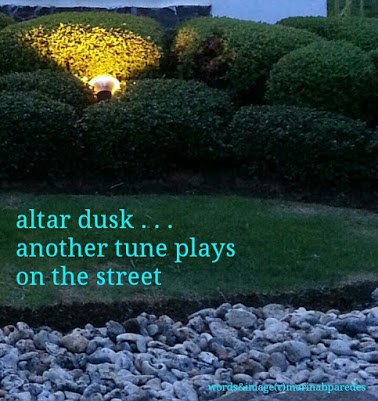
Marina Balmaceda Paredes’ Altar

16+-+

Just the right pacing and the right words. We begin with “altar dusk,” suggesting that this haiku is about a religious or spiritual activity. With dusk, that activity is ending, but we have the ellipses (…) telling us something else might happen, or that the dusk is slowly carrying on.

The second line comes as a pleasant surprise. It suggests that there was music during the religious or spiritual event, but now another form of music is being played. But where?

The third line gives us the answer. The music is coming from outside. In a sense, the poet is implying that the religious or spiritual music is being playing on through street music. This concept bridges the spiritual world with the human world, and makes it one, though the poet skillfully does not say this directly. Oneness is an often-used concept in haiku–usually from surprising counterparts.

I like the sound of the haiku as well. “altar” and “another” have a nice tune, and “dusk” and “tune” make good use of the “u” sound, which sounds musical.

The photo adds to the imagery already in our mind. We see a street lamp, which can be seen as an extension of the alter lamp, but in a suburban setting.

I enjoy how the haiku and accompanying image portrays the thought that spiritual and religious activity need not be stuffed in a box, but can be expressed in many different forms, even street music.

– Nicholas Klacsanzky (Ukraine)

Dave Read’s Morning Commute

morning commute
the horizon bright
with headlights

A Hundred Gourds March 2016
© Dave Read (Canada)

The first thing I noticed was the sound of the haiku. “morning” “commute” “horizon” are connected with an “o” sound, whereas “horizon” and “headlights” have alliteration.

The second thing that caught my eye is how the third line came as a surprise. Reading Dave’s haiku for a while, I can tell that he is a master of third lines– making turns that astonish and intrigue us.

Third lines are often the most important lines in haiku, as they can create layers and imply different things.

For me, Dave’s third line here is about how humankind is replacing the natural world with its own inventions, and kind of canceling out nature. By reading it, we get a feeling of both awe and the dryness of modern life.

On the technical side, each word is used effectively and phrased well to have an effect on the reader. Being laconic (but not to the extreme) is usually a reward of hard work or natural inspiration.

If people have not read through an issue of A Hundred Gourds, I highly recommend it:

– Nicholas Klacsanzky (Ukraine)

Gabri Rigotti’s Twilight

twilight the sky mountains its silhouettes

© Gabri Rigotti (South Africa)

This is one of those haiku that you got to read several times over to see everything in it. One liners are commonly this way, as they can be read in several ways due to having no punctuation and phrases bleeding together.

Let’s breakdown the various ways it can be read:

“twilight/the sky mountains/its silhouettes”

“twilight/the sky/mountains/its silhouettes”

“twilight the sky/mountains its silhouettes”

… and maybe more.

From the various ways of reading it, one can a sense things beyond our comprehension or usual understanding–that behind our usual perception is an entirely different world, that we might be missing out on.

“sky mountains” could be clouds, or it could mean the mountains appear to be in the sky with the lack of visibility.

If a haiku confuses or puzzles you, but makes you feel something (especially something personable), it can be said that the haiku has achieved a great deal. Haiku should not be something explained and clearcut. It should have mystery, make the reader change their state of consciousness, to break out of our usual perception of life.

I think Gabri’s haiku has achieved this.

– Nicholas Klacsanzky (Ukraine)