Martha Magenta’s Summer Silence

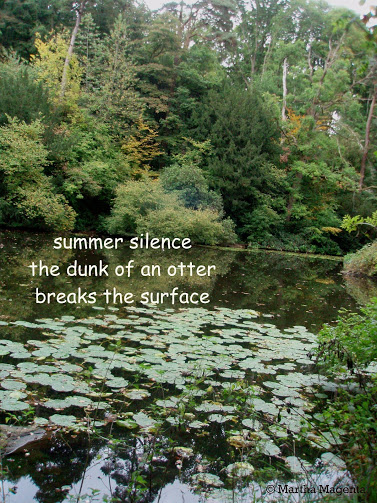
summer+silence

This is in line with classical haiku. We got a strong kigo or seasonal reference with “summer,” the passive voice of “the dunk” which expresses a sense of egolessness, and a short line-longer line-short line format.

Summer is usually associated with fun, holidays, love, among other things. But in this haiku, Martha examines the serenity of summer.

Reminiscent of the famous haiku by Basho:

old pond
a frog jumps in
the sound of water

Martha concentrates more on the surface of the water, though it is still sound oriented through the reader’s imagination.

The haiku suggests our actions are not their own and we don’t own our actions. This is especially poignant with the use of an animal, who does not have self consciousness. Through the otter, we can realize that we are the witnesses of our actions and existence, rather than being what we do.

The photo compliments the haiku by adding to the atmosphere and image of the haiku. The lily pads and variety of trees are stunning. A meditative photo.

– Nicholas Klacsanzky (Ukraine)

Tiwago’s Song

song of wet pavement
with kettledrums and cymbals

             i read between naps

© Tiwago (USA)

With the first two lines, I can imagine a parade or a march through a wet street and the splash of people walking on the street. And then the kettledrums and cymbals come, which heightens the sound, and makes it intense. This intensity makes for an interesting comparison between the second part. The two parts make a striking comparison.

Maybe the author is lying in bed, having a lazy day, while everyone is celebrating something–kind of detached from the world.

I think there is a definite feeling that sets in as one reads the last line. It is not simply a striking image for the sake of being striking.

Overall, I think it is a fascinating haiku that is engaging and maybe even a bit puzzling, but in a good way.

– Nicholas Klacsanzky (Ukraine)


Eva Limbach’s Soldiers

soldiers
took them by their hands
step by step
across the minefields
the wind

————————–

Original German:

von den Soldaten
an der Hand geführt
Schritt für Schritt
über die Minenfelder
der Wind

© Eva Limbach (Germany) (2016)

The contrast of the freedom of the wind, and the self-made dangers of war (minefields) is stark. I believe Eva is pointing towards how human nature has been separated from the natural world.

The languid pace of the tanka helps us to realize and come to the last line stronger. Though the last line is simple, it is effective and even shocks a reader.

From what I can read from this translation, the language is simple, but each word counts. I think Eva has got to the heart of an important issue without telling too much or explaining too much–which is precisely why poetry like tanka and haiku are so effective.

She truly used the “show, don’t tell” principle in this tanka. An inspiring work.

– Nicholas Klacsanzky (Ukraine)