Eva Limbach’s Wars

all our wars
lost
blossom wind

© Eva Limbach (Germany) (2016)

Every word counts and is powerful in this haiku. The pacing is also effective. Having “lost” as the second line shocks us and makes us stop. The juxtaposition is also effective. Blossoms are beautiful, unlike wars, but both blossoms and wars get lost in the wind: blossoms in natural wind, and wars in the winds of hate, vanity, anger, and jealously.

The big difference is that blossoms are innocent, and though they are spread randomly and carried off, they give no harm. I believe this haiku is a call to be innocent and sweet like blossoms in the winds of life. It also has a distinct feeling, which is important, as haiku are about feeling, ultimately.

This haiku is a bit indescribable, as haiku should be.

– Nicholas Klacsanzky (Ukraine)

Marilyn Ward’s Shelter

 2016+-+1

Haiku is a lot about being objective, accurate, specific, and describing our senses. This is a good example of these qualities. Alan Summers, who is taking a break as a mentor, has often told others about being specific in haiku and how it can add layers and additional meaning to haiku. Marilyn is a true student of Alan. “granite fissures” and “coltsfoot” is right on the mark in terms of being specific.

She could have written:

sheltered from wind
in a hole in a rock
small leafy plant

…but as we see, not only does this lessen the beauty of the sound, it makes it harder for the reader to experience the moment that the haiku portrays. By saying it is granite, fissures, and coltsfoot, the poet gives a vivid picture of the haiku moment and allows us to immerse in the experience.

About the actual feeling of the haiku, I like how the haiku implies that nature has compassion in its seemingly random existence. The haiku is concise, well-paced, and focused.

– Nicholas Klacsanzky (Ukraine)

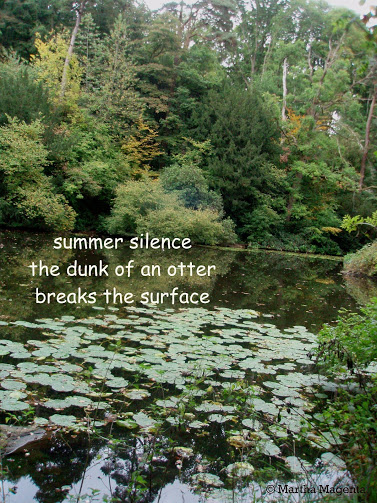
Martha Magenta’s Summer Silence

summer+silence

This is in line with classical haiku. We got a strong kigo or seasonal reference with “summer,” the passive voice of “the dunk” which expresses a sense of egolessness, and a short line-longer line-short line format.

Summer is usually associated with fun, holidays, love, among other things. But in this haiku, Martha examines the serenity of summer.

Reminiscent of the famous haiku by Basho:

old pond
a frog jumps in
the sound of water

Martha concentrates more on the surface of the water, though it is still sound oriented through the reader’s imagination.

The haiku suggests our actions are not their own and we don’t own our actions. This is especially poignant with the use of an animal, who does not have self consciousness. Through the otter, we can realize that we are the witnesses of our actions and existence, rather than being what we do.

The photo compliments the haiku by adding to the atmosphere and image of the haiku. The lily pads and variety of trees are stunning. A meditative photo.

– Nicholas Klacsanzky (Ukraine)