sunlit farm
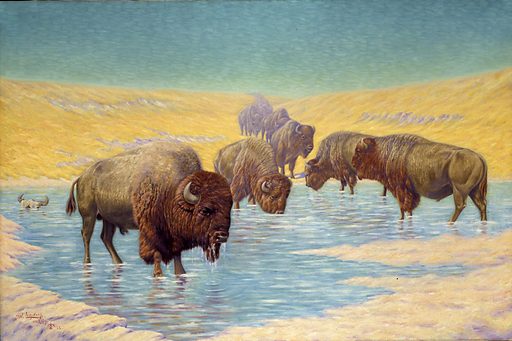
a buffalo exhales
into my palm
by Neena Singh (India)
first published in The Heron’s Nest, Volume XXVIII, Number 1: March 2026
Commentary by Jacob D. Salzer:
Buffalo were (and still are) an essential part of Indigenous tribes and their way of life. The buffalo are seen as spiritual beings who help Indigenous Peoples and their lives, both physically and spiritually.
The specificity of “exhales” in this haiku is both a vivid image and a powerful symbol of reciprocation. The buffalo gave their lives so many Indigenous Peoples can continue to live. The Indigenous Peoples used (and still use) every part of the buffalo as part of their life. As readers, we can both see and hear the exhale of such a wondrous animal. The sight of the exhale marks a cold day, which contrasts with the warmth of the sun. Also, in terms of impermanence, an exhale appears, and then disappears, as we all do. With this in mind, the buffalo exhaling is a powerful spiritual symbol of transformation as the physical appearance of their breath disappears into sunlight. Their exhale disappearing could also reference attempts at their extinction through colonization, as we’ll see below.
The last line of the haiku, “into my palm,” also carries significant spiritual weight, as the palms of our hands show a lifeline. As the Indigenous Peoples hunted buffalo, they did so in a balanced, sustainable, and reverential way. Also, the specificity of “my palm” is inherently an image of receiving, as only with open hands can we give and receive.
According to The World History Encyclopedia: “Between c. 1840-1890, with the approval and encouragement of the US government, millions of buffalo were slaughtered primarily to deprive the Plains Indians of their major resource and allow for the westward expansion of Euro-American settlements. The large herds of buffalo, and the nomadic Plains Indians, impeded initiatives such as the transcontinental railroad and so were regarded as obstacles to be eliminated. White buffalo hunters, US military, merchants, and white settlers all engaged in the systematic slaughter of the buffalo to deprive the Plains Indian nations of their livelihood and drive them, along with the buffalo, to extinction.”
Fortunately, despite the previous drastic decline in the Indigenous and buffalo populations, the Indigenous Peoples have survived, and there is some additional good news:
“Conservation efforts have proven to be successful. The 500 animals who survived extermination have multiplied to hundreds of thousands today. Estimates vary, but there are anywhere between 350,000-500,000 bison on private lands today. An additional 15,000-30,000 can be found on public land. As herds continue to thrive and grow, conservationists select animals to reintroduce into new areas, forming new herds. At best, bison have grown to only 1% of their original population. However, they are a conservation success story. After nearly becoming extinct, American bison recovered to the point that they are no longer threatened with extinction, although they remain a species of conservation concern. They are protected in state and national parks, as well as being commercially raised by ranchers for their meat, wool, and hides.” Source: The Near Extinction and Conservation of the American Bison
In short, this is a powerful haiku that honors buffalo and Indigenous Peoples, both historically and presently. I think we can all learn from Indigenous Peoples in regard to living better lives and taking better care of the Earth and ourselves. While we no longer need to kill buffalo in order to survive, they are an important symbol to consider along the path to a more sustainable and healthy future for all.
after wudu
the tap keeps dripping
into silence
by Ibrahim Abdulhakeem (Nigeria)
Commentary by Hifsa Ashraf:
This haiku captures a quiet moment after wudu (ablution), where the dripping tap becomes an extension of the ritual’s stillness. The first line evokes purification, suggesting a person who has undergone physical cleansing and is now ready to stand before the Almighty in prayer. The word after is particularly significant because it marks the transition from the physical act of purification to a state of spiritual preparedness. It suggests that the person is not merely physically clean but also experiencing a sense of calm, renewal, and readiness to connect with the Divine.
The contrast between the sound of water and the word silence in the phrase “into silence” creates a sense of solitude and contemplation. The tap continues to drip, yet its sound seems to disappear into the surrounding silence. Why does the tap keep dripping? Is it intentionally left open, or has it become faulty through repeated use? Perhaps the tap belongs to a mosque, where countless worshippers use it for ablution, or to an ordinary household or public space. The absence of a definite setting makes the scene universal, allowing the reader to imagine both domestic and sacred spaces. The dripping may also suggest confession, contemplation, and introspection, with each drop representing a thought, memory, regret, or unspoken prayer. The interval between two successive drops is equally significant, as the silence allows the person to pause and reflect on something deeper. It is as though one thought emerges with each drop, while the silence in between provides space for ma (contemplation), self-reflection, and muhasaba (self-accountability). In this sense, the dripping becomes a metaphor for an inward dialogue, where the person gradually confronts their inner self, perhaps seeking forgiveness or preparing for an unspoken conversation with the Almighty.
The absence of punctuation allows the three lines to flow into one another without interruption, keeping the reader’s attention on the visual image of the tap, the sound of dripping water, and the surrounding silence.
no ending no beginning
in the darkness of dawn
the first eagle
by Isabella Mori (Canada)
first published in The Solitary Daisy, issue 31, 2024
Commentary by Nicholas Klacsanzky:
I get epic and mythic vibes from this haiku. The first line makes me think of philosophy or the start of a creation story. The initial two lines could, if I imagine, be part of the Tao Te Ching in its poetic majesty. But the third line is where it gets more grounded. The tangible elements of the haiku begin at “dawn” and stretch out to the last line. Even though the haiku begins in grandiose fashion, I believe the main focus is the eagle. It brings about a sense of presence and attention akin to Zen meditation, with everything fading except one thing. By the end of the haiku, all I can see is the eagle in its mystical form.
“The first eagle” could be signaling to the reader that this is the first eagle of the season or year. It could also point to creation myths, where the first eagle was created, or where an eagle created the earth. Not making this clear adds to the poem, as readers can take from it what they want or will. There is no seasonal reference per se, but mentioning “dawn” and “first eagle” could place it in certain seasons or times.
A kireji (cutting word) is absent, but the poem still has a pivot. The second line, due to the lack of punctuation, pivots between the first and last line to add meaning. I think the poet made a cool artistic choice not to have punctuation to inject more flavor into the lines.
Looking at the sound, the repeated d in “darkness” and “dawn” gives the second line alliteration with a somber mood. The repetition of “no” in the first line, and more “n” in other words there, provides weight. The word “first” is the first of its kind, as there are no other “f” sounds in the poem. It makes the eagle stand out even more.
The tone of the haiku is quiet and a little uncanny. There is no verb in the poem. This lack of action creates stillness, as if the reader is standing with the poet, watching and unable to explain.
A mysterious haiku that is fairly easy to envision. I enjoy the philosophical air of the haiku and allusions to mythos.



Pingback: Haiku Commentary – Whispers of the Soul