Haiku and senryu by Lucas Weissenborn, Vaishnavi Pusapati, and Neena Singh

corporate avenue –
even the trees
follow in line


Lucas Weissenborn (Norway)
first published in Failed Haiku, Volume 10, Issue 111, August 2025

Commentary by Jacob D. Salzer:

This haiku/senryu essentially shows the consequences and limitations of corporations and a corporate mindset, which is hierarchical, with the CEO at the top of the pyramid. The CEO’s vision and values trickle down, affecting the entire corporation and all employees. The CEO and senior management usually make far more money than the rest of the employees, sometimes to an extreme extent. The straight line mentality of “business as usual” seems to have inherent limitations and psychological consequences.

The last line reminds me of a conveyor belt: the same thing is done every day, much like a machine, and the employees within certain corporations may start to feel like gears in the machine. As a result, this poem indirectly shows the beauty and importance of creativity, as it avoids the straight-lined mentality. Even the trees in this poem that were planted along the avenue may appear to be artificial, given that they were planted in a perfect straight line. Also, the word “follow” in the last line reminds me of the corporate and military culture to follow orders. In the U.S., the best-paying jobs are often found in corporations. Some corporations have made more significant contributions to humanity, while others feed materialism and a consumer-based society. Non-profit organizations, such as The Nature Conservancy, have tried working with corporations to inform them that environmental stewardship is critical, not only for the planet, but for their own business as well. I don’t know how successful they have been with this endeavor, but I think The Nature Conservancy is worthy of praise and recognition for its sincere efforts.

While some people may regard this poem as a senryu, with the focus on the corporation (and because it was published in Failed Haiku), others may see this as a haiku, capturing part of modern culture. Regardless, this is an important poem that provides a window into the world of corporations and their limitations. May more corporations see the bigger picture to take better care of the Earth, people, employees, and other species.

mist over the pond –
last year’s reeds
still whisper


Vaishnavi Pusapati (India)

Commentary by Nicholas Klacsanzky:

Living in the Pacific Northwest, I’m very familiar with mist. It gives a spiritual, mysterious mood. Sometimes it is a welcome sight, and other times, you wish you could drive more clearly. Anyway, the first line presents a classical haiku scene with a dash to allow readers to pause before considering the second half. Thinking about mist in India, the primary season for it would be winter, specifically from late November to February. Having this haiku placed in winter resonates with the stark imagery in the last two lines.

I enjoy the surprise from the second line to the third. I expected the last line to be something like “still standing.” But “still whisper” resonates much more and leaves white space for the reader to fill in. The reeds could be staying around in a dry form, with the wind making music while moving through them. Also, the reeds could now be in a different form, as all decomposed matter transfers to other beings. The whispering of last year’s reeds could be part of the flora and fauna in the area or beyond.

The pacing of the lines is a little different than usual, with a longer first line and decreasing line lengths from there on. The first line could simply be “misty pond,” but the image of the mist suspended over the pond creates a more substantial effect in comparison to the whispering of last year’s reeds.

It appears to me that the most prominent letter in this haiku is “r.” It gives a weight to the reading and mood of the poem. Also, each word is chosen well and is compact, with only nine words in the haiku. It’s a haiku that effectively captures the mood of the scene and allows our imagination to see how a passed-on being still breathes through new life.

childhood home
I reach for a hand
no longer there


Neena Singh (India)
published in THF Volunteer Haiku Anthology—Kick the Clouds, 2025

Commentary by Hifsa Ashraf:

Childhood homes, family havelis, and ancestral spaces are among my most cherished themes in haiku. I spent my school summer vacations in our family haveli in the rural side of Punjab, where I experienced nature in its purest form. Those moments remain deeply embedded in my memory and continue to be a part of my poetry.

This haiku captures the innocence of a time when relationships were simple, honest, and pure. The opening line, ‘childhood home’, invites the reader to pause and absorb its emotional weight and strength. In the subcontinent, such homes are often vibrant, shared spaces where extended families live together under one roof. They are rich with relationships, daily rituals, and collective memory. Here, the poet evokes not just a physical place, but a nurturing environment that shapes one’s social and emotional values.

The second line, ‘I reach for a hand,’ introduces an intimate and personal gesture. It suggests the presence of a loved one, perhaps a grandparent, an aunt/uncle, or a cousin, etc. The act of reaching conveys both connection and longing. It feels like a vivid recollection of childhood, where true family bonds once existed. At the same time, it hints at absence and an emotional void.

The final line, ‘no longer there’, brings a subtle shift. A gentle sense of yūgen reflects a deep, unspoken awareness of life’s transience. Maybe time has changed the landscape of the home; the people who once lived there are gone, whether through distance or death. What remains is an emptiness that contrasts beautifully with the warmth of memory. Yet, in recalling these moments, the poet brings them to life.

Having no punctuation invites the reader to linger in the space, to experience the gaps where memory fades, and absence quietly endures.

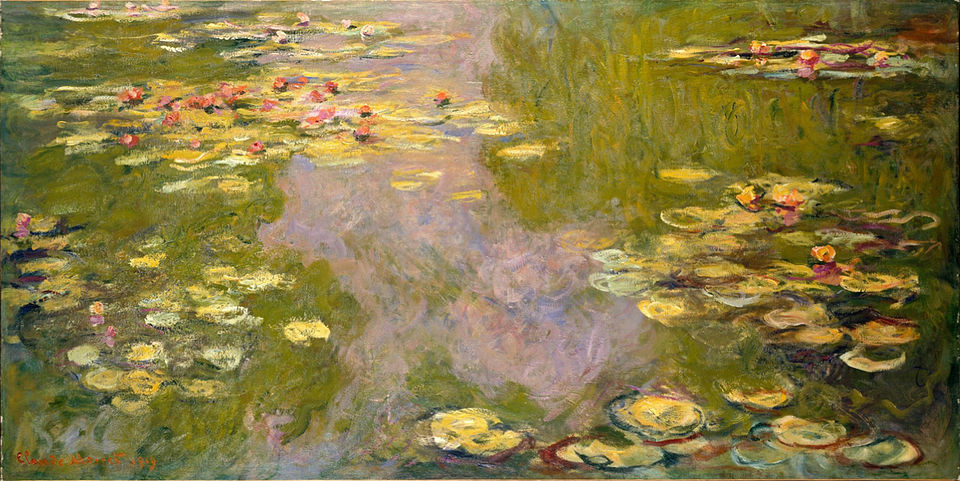
Water Lilies, a 1919 painting by impressionist Claude Monet

Haiku by Anne Kulou, Elliot Diamond, and Małgorzata Formanowska

morning fog—
a crow’s cry piercing
the layers of light


Anne Kulou (Germany)

Commentary by Nicholas Klacsanzky:

I have a soft spot for morning fogs and crows, so this haiku gravitated towards me. The ellipsis in the beginning grounds us in the scene, allowing the reader to imagine a beautiful, yet mysterious fog. “Fog” is a double entendre, lending to interpretations about the fuzziness of the mind and other psychological disturbances, such as the “fog of war.”

No matter if the fog is literal or figurative, the crow’s cry cuts through it, even in the calmness of the morning. The word “cry” is intriguing, as it humanizes the crow. We usually associate this magnificent bird with “caw” and something abrasive. But “cry” prompts us to feel sympathy, if not empathy, for the crow.

Morning fogs and crows point towards autumn. It is a time of sparseness, with just a little light coming through. Even that minuscule amount of brightness is sliced through by the cry of the crow, which highlights or intensifies the sense of autumn.

The power of this haiku centers around its vivid imagery, the play between sound and light, and the embodiment of the season. It also reads well, with open sounds in “o” and “i” strung throughout. These pleasant letters are contrasted with the stronger letters in “r” and “g,” which connect with the juxtaposition of fog and the cry of a crow that runs through it. The pacing of the lines is also measured and weighty, like walking through a fog.

This haiku brings back awe to common themes, which is a mark of knowing tradition well and utilizing our creative spirit.

siren song                                                                  
as a fire station                                                         
empty boots

Elliot Diamond (USA)
first published in The Pan Haiku Review Issue 2 (Winter 2023), Kigo Lab Special, ed. Alan Summers

Commentary by Jacob D. Salzer

This is an important haiku that gives us a glimpse into the life of firefighters. This haiku seems to have a haunting quality, as the siren song could be the silence of the fire station itself. Even in the silence, we can hear the echoes of the siren. The siren song could also be exemplified by the red color of the fire station. It is interesting to include the word song in this haiku. This seems to give the siren added dimensions. It is no longer merely a siren, but a kind of song that seems to honor those who have left the occupation or passed away. It is a sound that marks the urgency of fighting a fire. There is no time to waste.

We also don’t know why the boots are empty. A firefighter could have retired, he/she/they could have left the job for another occupation, or the firefighter could have passed away. In all three scenarios, the darkness of the empty boots allows us to step into the shoes/boots of the firefighter, even for a moment. Regardless of our interpretations, this haiku shows the inherent dangers of being a firefighter, the sheer courage and strength it takes to be on the front lines of several fires, and the consequences. Indeed, firefighters sometimes risk their lives to save others. Additionally, this haiku may inspire readers to learn more about how to prevent fires, fire safety, and what to do during wildfires.

Interestingly, Indigenous Peoples have long known the importance of controlled fires to prevent wildfires. These controlled fires also allow ashes and nutrients to supplement the soil. I think we should take the time to learn from Indigenous Peoples who are excellent caretakers of the Earth.

This haiku first appeared in The Pan Haiku Review Issue 2 (Winter 2023), edited by Alan Summers. One unique aspect of this journal is Alan’s inclusion of additional context around certain poems. For this particular haiku by Elliot Diamond, Alan adds:

“What is the life expectancy of a firefighter in the United States? Life expectancy for firefighters is 10 years less than for individuals with other occupations. The frequency of leaving the job due to health problems was 60% higher among firefighters than among individuals working in other industries.

Seasonality and Coronary Heart Disease Deaths in United States Firefighters: https://www.ncbi.nlm.nih.gov/pmc/articles/PMC3756551/

The September 11 attacks (New York City 2001) 9/11 by the numbers: 8:46 a.m. and 9:02 a.m. Time the burning towers stood: 56 minutes and 102 minutes. Time they took to fall: 12 seconds. From there, they ripple out. Number of firefighters and paramedics killed: 343 September 11 by Numbers New York Magazine Despite advancements in DNA technology, roughly 40% of the victims (1,100 people) thought to have died in the disaster, remain unidentified. CNN September 2023″

In summary, this is an important haiku that provides a window into the life of firefighters. I sincerely thank all firefighters who put their lives on the line. They have a heart of compassion and will attempt to save anyone, regardless of their race, ethnicity, gender identity, or background.

winter air
the fleeting shapes
of our breaths  

Małgorzata Formanowska (Poland)
22nd Annual UKIAH Haiku Festival: Honorable Mention for the Jane Reichhold International Award

Commentary by Hifsa Ashraf:

This haiku captures a quiet moment in cold winter, phrased in a way that makes us feel it to our core. “Winter air” may be referring to the extreme cold that may occur before or after rain or snowfall. It is something invisible but still shows its existence in mysterious ways, i.e., breath clouds. The poet showcases the moment of visibility of the air in an imaginative way, where it suddenly takes shape briefly before it disappears. The yugen and ephemeral elements of this poem make it interesting, while also being easily relatable.

“The fleeting shapes” show the transience of life. Things come and go quickly, leaving a deep impact on our lives. Fleeting shapes may allude to the possibility that there are two persons in close proximity who are not only enjoying the warmth of their breath but also the shapes that it creates in dense air, which can intermingle and overlap with each other. It may also reflect melancholic feelings, with the person being alone and enjoying the shapes of breath even in chilly weather, or being so focused on something, and then the poet gets distracted by the shapes of breath. In any case, it is a subtle awareness where breath is a symbol of life, and seeing it appear and disappear in winter air evokes the fragility and temporary nature of existence.

Looking at the sound, the frequent use of vowels in this haiku emphasizes the subtle connectivity that exists in moments but leaves strong effects behind.

Sumi-e by Carolyn Fitz

Haiku by Kashiana Singh, Goran Gatalica, and David Josephsohn

my epitaph
again and again
the weeds


Kashiana Singh (USA)

Commentary by Nicholas Klacsanzky:

Writing one’s epitaph has various connotations. It could mean the poet is near death or was near death at some point. Another reason is that the poet is already reflecting on her life and writing an epitaph, even though she is not close to passing away. Epitaphs are usually short and compact, and comprising a whole life in one statement is difficult.

The second line acts as a pivot, which could add content for either the first or third line. It is also a contrast of the finality of the first line. “again and again” could be pointing towards reincarnation or revising an epitaph over and over. There is another reading that suggests that the weeds keep coming up over the epitaph not matter how many times you get rid of them. Both ways of looking at the poem are interesting and make readers ponder. Overall, the poem makes me introspect about our insignificance and how nature cannot be truly disrupted, despite our push to control our environment. In addition, I think of how difficult it is to encapsulate a life in one sentence, as each of us is a multitude.

When I read “weeds,” I feel the weeds might be us. Also, the poet might be hinting that the weeds might be the true epitaph of the poet, and perhaps of us all. A weed also flowers and is often misunderstood. We label them as “weeds” when they are simply following their essential nature.

Peering at the more formal elements, the language mirrors the minimalism of an epitaph. Yet, the final image expands outward, suggesting seasons, neglect, and time passing after the poet is gone. It is difficult to pin down a kigo or seasonal reference here, as different types of weeds are more prominent at certain times of the year. In traditional Japanese haiku, common examples are ukikusa (duckweed) for summer, mugura (cleavers/creepers) for spring, dandelion for early spring, and tsuwabuki (rock butterbur) in winter. In this haiku, though, I don’t feel the poet is putting emphasis on the season. Rather, the poet is focusing on the link between permanence and impermanence.

In terms of sound, it seems the lightness of the e and a letters contrasts well with the heaviness of the g letters. This brings transience and mortality into focus again.

It’s quite a simple haiku at first glance, but the more you look at it, the more layers you discover.

starry night—
the generations of women
who did needlework

Goran Gatalica (Croatia) 
Awarded First Place in the 3rd John Bird Dreaming Award for Haiku, Australia, 2025

Commentary by Jacob D. Salzer:

This is a beautiful haiku that honors generations of women, giving them the respect and reverence they deserve. The relationships that women made with each other and with others resonate powerfully with the invisible constellations that connect the stars. I believe these relationships continue, spiritually, and also form new relationships when women continue the craft. When someone engages in an age-old tradition, I feel they are inherently connecting with their ancestors.

On that note, this haiku also makes me think of Indigenous culture. I’ve read that Indigenous Peoples believe each person’s spirit travels across the Milky Way at the end of their human life to meet their ancestors and the Great Mystery. Indigenous Peoples understand that everything is connected, which leads to reciprocity and community, as our lives are interwoven in a myriad of ways. This view shows that our lives are woven with our ancestors as well, which comes through this haiku.

In a broad sense, needlework is a crafting technique that often involves yarn, thread, and fabric to create clothing and other works of art. There are actually at least 14 different kinds of needlework: (1) embroidery, (2) appliqué, (3) knitting, (4) crocheting, (5) quilting, (6) sewing, (7) bead weaving, (8) cross-stitch, (9) ribbon embroidery, (10), crewel embroidery, (11) needlepoint, (12) needle lace, (13) tapestry, and (14) patchwork. These needlework approaches can result in delicate and textured works of art, quilts, clothing, home décor, scarves, intricate lace, blankets, toys, bags, and curtains. For more information on needlework, I recommend this article: 14 Types of Needlework. This article includes this quote: “These 14 needlework crafts, each with its distinctive techniques and histories, offer not just a means to create but also a way to connect with traditions, communities, and our creative selves.”

In summary, this is a powerful haiku that honors our ancestors, the women who did needlework, and the women who continue needlework today. It also shows the power of relationships. This haiku is spiritually charged with love and reverence, and tangibly shows how the threads of our lives are interwoven with each other and other forms of life in both obvious and mysterious ways.

busker’s song

coins rattle

in a minor key


David Josephsohn (USA)
Winner, the Haiku International Association 2023 Contest

Commentary by Hifsa Ashraf:

The opening line, “busker’s song,” recalls for me a performance I once heard along the River Thames in London. The phrase does not specify the melody, but the kind of songs buskers often choose i.e. sentimental, powerful, or quietly melancholic pieces that stir emotions. The apostrophe in the opening line suggests that it’s something very personal and emotional.  

The second line, “coins rattle,” introduces a sharp, sudden sound. The quick succession of coins in a bowl makes it a parallel rhythmic music that echoes a bit loud and also gets the attention of the audience. To me, it gives me a sense of sadness as personal feelings are being transformed into something materialistic. The rattling coins suggest that the song has touched many listeners, yet there is a subtle irony here: while the audience may feel deeply moved, their response is reduced to the simple gesture of tossing a coin. The sound becomes both appreciation and limitation in terms of a public token for private feelings that perhaps cannot be openly expressed.

The concluding line, “in a minor key,” gives an emotional touch to the poem. A minor key implies sadness, depth, and introspection. It’s a minor key with the strongest impact. The melancholy of the melody leaves some reflection where listeners can feel their profound emotions. Whether deliberate or instinctive, the busker’s choice of tone draws out a collective response that makes the minor key more significant.

The absence of punctuation encourages the readers to experience the moment freely. The repetition of the r sound (busker’s, rattle, minor) adds a subtle rhythm to the ears by integrating all the elements together: music, metal, and deep feelings.