
milky way …
the city’s debris choking
what is left of its river
— Kala Ramesh (India)
first published in Acorn, fall issue, 2025
Commentary by Jacob D. Salzer:
This is a revealing haiku that speaks volumes about the amount of waste produced in cities. This haiku also shows how poorly waste is often managed, leading to polluted water, soil, and air. The first line provides a much broader perspective on the Milky Way galaxy that shows how ignorant much of humanity is, creating a narrow-minded economic system based on scarcity, supply-and-demand, competition, and a refusal to take care of the Earth. The Milky Way and the Earth have been revered for thousands of years, especially by Indigenous Peoples, environmentalists, and spiritual people. Indigenous Peoples also often live near rivers, lakes, and oceans. Indeed, where there is water, there is life. If a city’s debris is choking a river, that’s a clear sign that we have built too much, too fast, and now we are all taking the consequences. In the end, we all share our brief human lives on this small Earth, and we are all temporary visitors here. What will we do with our limited time here?
This haiku sparks conversations about ways we can protect the Earth and reduce the sheer amount of waste we produce on a daily basis. This haiku also inspires questions about where products come from, and how they are sourced and created. Hopefully, this will lead to more mindful and informed consumers who are not fooled by clever or misleading marketing campaigns.
Finally, in a much broader sense, this haiku urges us to think about our values and how we want to live on Earth with our limited time here.
According to the Global Waste Index 2025 by Sensoneo, “After a comprehensive analysis of waste management in 38 countries, Israel has emerged as the country with the highest per capita waste generation, producing up to 650 kg of municipal waste per person annually. Of this amount, 524 kg is landfilled, representing 80% of the country’s total waste – the highest landfill share among all analyzed nations. Consistent with data from 2019 and 2022, Chile and the United States continue to rank among the world’s most significant waste polluters.
On the other end of the spectrum are two Asian countries. Japan jumped to first place from seventh in 2022, thanks to low rates of waste generation and landfilling. South Korea secured second place with the highest recycling rate among all nations – 54%. Surprisingly, Estonia joined the top three with almost no waste sent to landfills. Positive rankings were also achieved by Scandinavian countries such as Sweden and Finland, as well as by DACH region countries, Germany and Austria.”
Source: https://www.sensoneo.com/global-waste-index/2025/
An important haiku.
winter breath
floats through chilled air-
child tries to catch it
— Jas Asencio Ramirez (USA)
first published in Brussels Sprout, Volume XII:3, 1995
Commentary by Nicholas Klacsanzky:
The season the haiku is placed in is shown in the first line with “winter.” It is reinforced with “chilled.” The cold and sparseness of winter is contrasted by the third line. A child tries, in its innocence and playfulness, to catch the visible, floating breath. But, like the breath, a child’s carefree nature eventually dissipates. Sometimes, it seems to parents that their children grow up too fast. Classic haiku often focus on a fleeting moment, and this one is built around impermanence. The attempt by the child to catch the breath is doomed from the start. The imagery is hopeful at the same time, capturing a child’s innocent belief that something visible must also be graspable.
In the second line, there is an approximation of kireji, or a cut marker, to delineate the two parts of the haiku, with the introduction of the dash. The line break after “floats through chilled air—” creates a small pause, mirroring the way breath hangs in cold air before scattering.
The letter “r” in this haiku seems the most prominent to me, which brings a sense of heaviness. This provides more weight to the visible breath. Light letters like “t” and “i” also provide tenderness to the musicality of the haiku.
In terms of pacing, the haiku follows the short/long/short line lengths. This reflects the traditional Japanese haiku rhythm. Though this haiku is not so focused on absolute brevity, the word choice by the poet unfolds an emotional response from the reader. The poet captures a poignant moment with clarity to allow readers to ponder the relationship between innocence and experience, transience and staying power, and hope and realism.
as the heatwave settles a swell of cicada songs
— Royal Baysinger (Canada)
first published in Frogpond, 46.3, 2023
Commentary by Hifsa Ashraf:
This monoku reflects a moment of seasonal transition, where one phase of summer gradually transforms into another. The opening phrase, as the heatwave settles, suggests that the speaker has been enduring and observing an extended period of oppressive heat, waiting for the moment when its intensity finally begins to ease. The word settles becomes the hinge of the poem, marking not only a shift in the weather but also a quiet change in the speaker’s emotional state. As the heat subsides, so too does the inner tension, creating a sense of relief and anticipation.
The phrase a swell of cicada songs evokes both a rising chorus and a wave of renewed life. The word swell carries a double meaning: it suggests an increase in sound while also recalling the movement of a wave, reinforcing the poem’s sense of transformation. The cicadas seem to celebrate this subtle change in the season, their chorus becoming a natural announcement of renewal. Their songs may also foreshadow the coming rains, or express the instinctive joy of a landscape awakening after oppressive heat.
Beyond the seasonal scene, the haiku resonates as a metaphor for human experience. Just as the heatwave eventually settles, periods of hardship also come to an end. The swelling chorus of cicadas becomes a symbol of hope, resilience, and inner renewal—a reminder that difficult times can give way to fresh understanding, joy, and transformation.
The poem’s music further deepens its effect. The repeated s sounds in as, settles, swell, songs, and cicada create a soft, whispering rhythm that mirrors the gradual easing of the heat, while the w sound in heatwave and swell suggests the motion of a wave carrying the poem from stillness toward renewal.
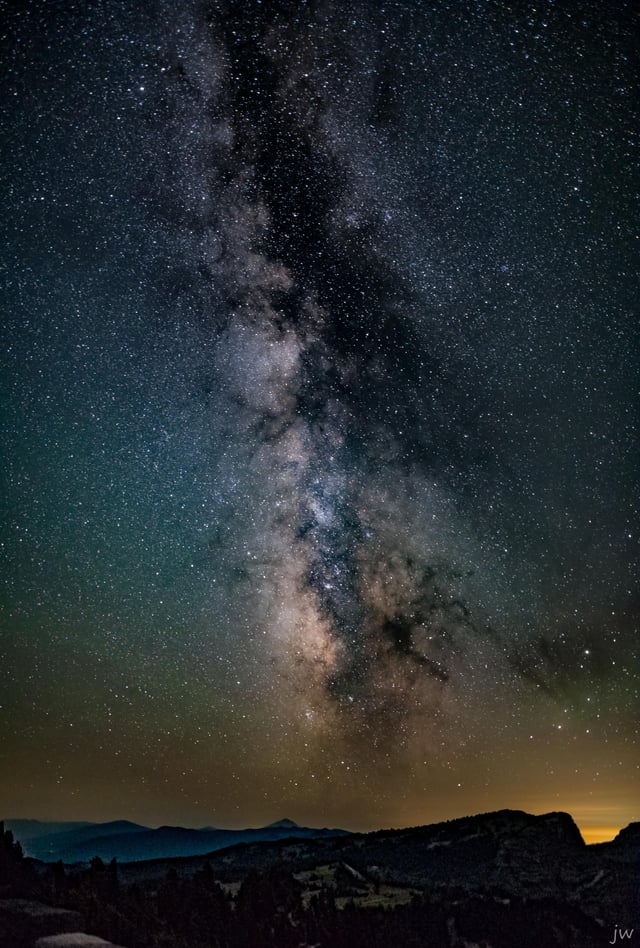
Photo by Jon Washburne

