just off the plane
humidity fogs
my glasses
— Stephen Curro (USA)
I like how this haiku let’s the reader step into another world. It conjures up a memory of visiting family in Alabama years ago. The humidity there was so thick. I would step outside for five or ten minutes and be sweating, just from standing! It seems “humidity fogs my glasses” could also represent the hazy feeling of visiting a foreign country filled with unknowns on the journey. It seems to mark a degree of uncertainty, which can be beautiful, accompanied by unexpected turns and surprises on the adventure. At the same time, the mental haze/foggy glasses could represent stepping onto land that might be intimidating (or at least appear to be). I also interpreted the foggy glasses as the psychological haze from jet lag, adjusting to a new time zone. It seems the physical fog could also represent mental fog. i.e. if we cling and identify with certain thoughts or ideas, they seem to shape how we physically see the world. Another literal interpretation is the author’s own breath could create fog on their glasses. I have experienced this while wearing a COVID-19 mask. My warm breath rises from inside the mask and fogs my glasses.
While we don’t know where the poet has landed, or exactly why they are there, I feel his courage in this haiku and all the emotions (and culture shock) that comes with the adventure. I get a clear sense that he has stepped outside of his comfort zone. If opportunities arise, I think it’s important to experience the diversity of life and embrace different cultures. A deceptively simple and powerful haiku.
— Jacob Salzer (USA)
It’s difficult sometimes to get rid of certain memories that usually jump in during the journey, especially when someone lands in another place. This haiku depicts how memories, departure, separation, and leaving the past behind can dilute one’s thoughts, vision, and future. The expression ‘humidity fogs’ is beautifully used here as it is a phenomenon that rarely catches the attention of poets. Foggy glasses simply show that the person passes from one illusion of life to another with no clarity of his/her vision, and the future as well.
— Hifsa Ashraf (Pakistan)
This haiku caught my attention because of the idea that the poet enters a new environment and cannot enjoy it/perceive it properly. It resonates with me in that, no matter where we go, our biases and individual perceptions cloud our awareness. Even though we go to a new place on our travels, we carry our personal baggage with us everywhere we go. It may not be possible to experience anything without the interruption of our ego and mental conditioning. It seems that only by being in the state of pure awareness can we witness a new environment without hindrance.
In terms of kigo, there may not seem to be a seasonal reference at first glance. However, “humidity” can refer to summer indirectly. I think the relation between summer humidity and not being able to perceive a place properly makes sense to me. With the fogging of the poet’s glasses, the poet could feel overwhelmed, annoyed, or disturbed, like being in intense humidity. For the kireji, the line break in the first line is sufficient.
Looking at the structure of the haiku, we can see it is a bit different than the usual English-language format of three lines short/long/short. For this haiku, I don’t think this variation matters much for the content and reading of it.
Sound plays a big role in this haiku, too. The “o”s seem to bring about the feeling of frustration of having fogged glasses. The “l”s bring a softness to the reading and the “f”s could be said to accentuate the starkness of the moment.
Overall, I believe this haiku at once portrays a mood and also a spiritual fact about perception and ego.
— Nicholas Klacsanzky (USA)

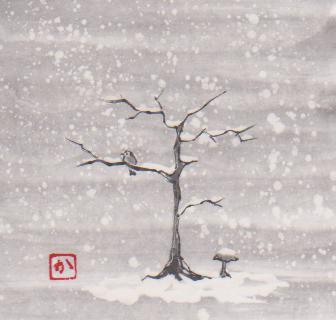
Sumi-e by David Moeljadi