Haiku and senryu by Lucas Weissenborn, Vaishnavi Pusapati, and Neena Singh

corporate avenue –
even the trees
follow in line


Lucas Weissenborn (Norway)
first published in Failed Haiku, Volume 10, Issue 111, August 2025

Commentary by Jacob D. Salzer:

This haiku/senryu essentially shows the consequences and limitations of corporations and a corporate mindset, which is hierarchical, with the CEO at the top of the pyramid. The CEO’s vision and values trickle down, affecting the entire corporation and all employees. The CEO and senior management usually make far more money than the rest of the employees, sometimes to an extreme extent. The straight line mentality of “business as usual” seems to have inherent limitations and psychological consequences.

The last line reminds me of a conveyor belt: the same thing is done every day, much like a machine, and the employees within certain corporations may start to feel like gears in the machine. As a result, this poem indirectly shows the beauty and importance of creativity, as it avoids the straight-lined mentality. Even the trees in this poem that were planted along the avenue may appear to be artificial, given that they were planted in a perfect straight line. Also, the word “follow” in the last line reminds me of the corporate and military culture to follow orders. In the U.S., the best-paying jobs are often found in corporations. Some corporations have made more significant contributions to humanity, while others feed materialism and a consumer-based society. Non-profit organizations, such as The Nature Conservancy, have tried working with corporations to inform them that environmental stewardship is critical, not only for the planet, but for their own business as well. I don’t know how successful they have been with this endeavor, but I think The Nature Conservancy is worthy of praise and recognition for its sincere efforts.

While some people may regard this poem as a senryu, with the focus on the corporation (and because it was published in Failed Haiku), others may see this as a haiku, capturing part of modern culture. Regardless, this is an important poem that provides a window into the world of corporations and their limitations. May more corporations see the bigger picture to take better care of the Earth, people, employees, and other species.

mist over the pond –
last year’s reeds
still whisper


Vaishnavi Pusapati (India)

Commentary by Nicholas Klacsanzky:

Living in the Pacific Northwest, I’m very familiar with mist. It gives a spiritual, mysterious mood. Sometimes it is a welcome sight, and other times, you wish you could drive more clearly. Anyway, the first line presents a classical haiku scene with a dash to allow readers to pause before considering the second half. Thinking about mist in India, the primary season for it would be winter, specifically from late November to February. Having this haiku placed in winter resonates with the stark imagery in the last two lines.

I enjoy the surprise from the second line to the third. I expected the last line to be something like “still standing.” But “still whisper” resonates much more and leaves white space for the reader to fill in. The reeds could be staying around in a dry form, with the wind making music while moving through them. Also, the reeds could now be in a different form, as all decomposed matter transfers to other beings. The whispering of last year’s reeds could be part of the flora and fauna in the area or beyond.

The pacing of the lines is a little different than usual, with a longer first line and decreasing line lengths from there on. The first line could simply be “misty pond,” but the image of the mist suspended over the pond creates a more substantial effect in comparison to the whispering of last year’s reeds.

It appears to me that the most prominent letter in this haiku is “r.” It gives a weight to the reading and mood of the poem. Also, each word is chosen well and is compact, with only nine words in the haiku. It’s a haiku that effectively captures the mood of the scene and allows our imagination to see how a passed-on being still breathes through new life.

childhood home
I reach for a hand
no longer there


Neena Singh (India)
published in THF Volunteer Haiku Anthology—Kick the Clouds, 2025

Commentary by Hifsa Ashraf:

Childhood homes, family havelis, and ancestral spaces are among my most cherished themes in haiku. I spent my school summer vacations in our family haveli in the rural side of Punjab, where I experienced nature in its purest form. Those moments remain deeply embedded in my memory and continue to be a part of my poetry.

This haiku captures the innocence of a time when relationships were simple, honest, and pure. The opening line, ‘childhood home’, invites the reader to pause and absorb its emotional weight and strength. In the subcontinent, such homes are often vibrant, shared spaces where extended families live together under one roof. They are rich with relationships, daily rituals, and collective memory. Here, the poet evokes not just a physical place, but a nurturing environment that shapes one’s social and emotional values.

The second line, ‘I reach for a hand,’ introduces an intimate and personal gesture. It suggests the presence of a loved one, perhaps a grandparent, an aunt/uncle, or a cousin, etc. The act of reaching conveys both connection and longing. It feels like a vivid recollection of childhood, where true family bonds once existed. At the same time, it hints at absence and an emotional void.

The final line, ‘no longer there’, brings a subtle shift. A gentle sense of yūgen reflects a deep, unspoken awareness of life’s transience. Maybe time has changed the landscape of the home; the people who once lived there are gone, whether through distance or death. What remains is an emptiness that contrasts beautifully with the warmth of memory. Yet, in recalling these moments, the poet brings them to life.

Having no punctuation invites the reader to linger in the space, to experience the gaps where memory fades, and absence quietly endures.

Water Lilies, a 1919 painting by impressionist Claude Monet

Haiku by Samo Kreutz, Tuyet Van Do, and Bonnie J Scherer

meditation music …
a kitten’s purr slips
into incense


Samo Kreutz (Slovenia)
THF Haiku Dialogue, November 2025

Commentary from Hifsa Ashraf:

This haiku resonates deeply with me, especially since my recent collaborative book, Beyond Emptiness, explores themes of mysticism and spiritual transformation.

The opening line, “meditation music,” immediately evokes a serene, introspective space. For me, it echoes the tones of Sufi music or soft instrumental melodies—sounds that captivate the senses and guide the soul toward mindfulness. Such music plays a vital role in calming the nerves and synchronizing one’s rhythm with the stillness within.

The second line, “a kitten’s purr,” introduces a gentle, intimate sound—subtle yet profound. I interpret the kitten’s presence as symbolic of a beginner in meditation: quiet, curious, and softly aligned with the spiritual energy. Purring suggests delight, warmth, and safety—a sensory harmony that seamlessly blends with the meditative ambiance. It reminds us that the healing power of sound affects not just humans but all sentient beings.

The poet concludes it beautifully with “slips into incense,” which is both poetic and mystical. There’s a beautiful synesthetic quality here, a merging of sound, scent, and motion. The phrase “slips into” suggests a gentle transformation, a shift from the tangible into the ethereal. It reflects that moment in meditation when physical sensations dissolve, and one is immersed in the intangible. The incense symbolizes this spiritual diffusion where worldly concerns fade, and one melts into a deeper, more satisfying stillness.

Altogether, the haiku captures a sacred moment where the boundaries between body, mind, and spirit gently blur.

queueing for coffee
an elderly man
counting his change

Tuyet Van Do (Australia)
Kokako 43, 2025

Commentary from Jacob D. Salzer

This is an important haiku for a variety of reasons. 

Firstly, this haiku shows a fast-paced lifestyle that coffee is often associated with, and the sheer demand for coffee. While there is non-caffeinated coffee available, most coffee has caffeine, which is known as an addictive drug. Not all people who drink coffee are addicted, but many people are. This could transfer to the interpretation that some people seem to be addicted to a fast-paced lifestyle, thinking that faster is always better. However, some people also seem to move faster as a survival mechanism due to low-wage jobs and rising costs of living. By moving faster and sometimes working multiple jobs, there is an opportunity to make more money. 

While drinking coffee in moderation has health benefits, the added sugar to specialty coffee beverages, such as lattes, can have serious health consequences when consumed regularly over time, and can lead to diabetes mellitus, inflammation, and cardiovascular diseases, which can be fatal. According to the World Health Organization, in 2021, ischemic heart disease was the #1 cause of death worldwide, and diabetes mellitus was the 8th leading cause of death (source: https://www.who.int/news-room/fact-sheets/detail/the-top-10-causes-of-death). There are also often negative health consequences that come with a fast-paced lifestyle, including increased stress, and not activating our parasympathetic nervous system enough to rest, digest, and relax.

The sheer demand for coffee is marked by the “queueing for coffee” in this haiku, which means there’s a long line of people waiting. Ironically, depending on the size of the business and the number of workers, people may have to wait for quite some time to buy their coffee. The fast-paced lifestyle is starkly contrasted with the elderly man, who is slowly counting his change and has to move at a much slower pace due to his age. This elderly man could be addicted to coffee, but he is not moving as fast as he used to. Alternatively, he could not be addicted to coffee at all. He may also be living in poverty due to counting his change. It seems people are waiting in line longer, partly because he is counting his change. Unfortunately, he may not have enough money to buy the coffee he ordered. I feel compassion for this elderly man and appreciate that he’s showing a slower pace of life. Also, the word “change” can refer to how the elderly man has transformed over his lifetime. The double entendre in haiku is a common device that is used to great effect.

According to Coffee Industry: Size, Growth, and Economic Impact Analysis, “The coffee industry is one of the largest and most influential sectors in the world, with an economic impact that extends far beyond just a daily beverage. As of 2025, the global coffee market accounted for $256.29 billion, and will register a CAGR of 4.52% from 2025 to 2034. This consistent growth reflects coffee’s enduring popularity, driven by changing consumer preferences, increasing disposable incomes, and the expanding coffee culture in emerging markets. According to a recent study, U.S. coffee consumption has grown by 5% since 2015, illustrating the increasing demand for this beloved beverage. This includes the shift toward premium and specialty coffee, which is boosting the value of global coffee beans, expected to reach $174.25 billion by 2030. Despite these hurdles, the coffee industry remains a crucial economic force, providing over 2.2 million jobs and generating more than $100 billion annually in wages across the U.S.”

According to Coffee’s Economic Impact:

Two-thirds of American adults drink coffee each day and more than 70% of American adults drink coffee each week.”

Highlights of coffee’s economic impact in the United States include:

  • The total economic impact of the coffee industry in the United States in 2022 was $343.2 billion, up 52.4% since 2015.
  • The coffee industry is responsible for more than 2.2 million U.S. jobs and generates more than $100 billion in wages per year.
  • Coffee can only be grown in tropical climates. It cannot be grown in most of the United States and is sourced from countries with tropical climates. Every $1 in coffee imported to the United States ends up creating an estimated $43 in value here at home. Learn more about coffee and trade.
  • Consumers spend more than $300 million on coffee products every day—nearly $110 billion per year.

For more information on coffee, including the roots of coffee in Ethiopia, fair-trade, global coffee markets, and the consequences of colonization and enslavement associated with growing coffee in certain countries, I recommend this interview with Phyllis Johnson, published in The Sun Magazinehttps://www.thesunmagazine.org/articles/601-crop-to-cup

In short, this is an important haiku that sheds light on coffee, the consequences of a fast-paced lifestyle, and also inspires compassion as we age. 

a story
cut short
earthworm

Bonnie J Scherer (USA)
Modern Haiku 56.3

Commentary from Nicholas Klacsanzky:

I believe this poem hovers between being a haiku or senryu—not that it matters too much. Ultimately, what is important is that it expresses violence and empathy via brevity, with its emotionality implied rather than stated.

Opening with “a story” is unique. As an editor, I don’t think I’ve ever seen that as a first line in a haiku/senryu. The phrase invites expectation and makes the reader curious about what is going to happen next in the poem.

“cut short” functions as both a poetic turn and a literal act. It interrupts the promise of “story” and physically refers to severing something. So, you got a balance between abstraction and the mundane.

With the mention of “earthworm,” we get the conclusion and also the opening up of the story. It grounds the poem in reality. This toriawase—story versus earthworm—creates resonance between human meaning-making and a small, often-overlooked being. The poet doesn’t dive into sentimentality; the earthworm is not anthropomorphized, yet the simplicity of the verse allows us to recognize that even the humblest organism contains a “story.” The violence is understated, yet it is heavy through sparseness.

I think the poem plays with the idea of impermanence and permanence. It is commonly known that if you cut off the body of an earthworm and the head remains, many times earthworms can grow their tails back and be whole once again. In this sense, the poet may be saying that even if a story is cut short, there is a strong chance that the narrative will continue with time.

Even though the poem is very short (five words in all), the sense of sound is strong. The elongated “o” sounds make the reading slower and more meditative. The “r” sounds perhaps bring extra weight.

I am a sucker for haiku and senryu that deal with the small things and beings around us, and this poem called out to me for that reason. The hidden meanings in the poem also made me more invested in it and allowed my mind to wander in introspection. A fine, sparse ku that does a lot with only five words.

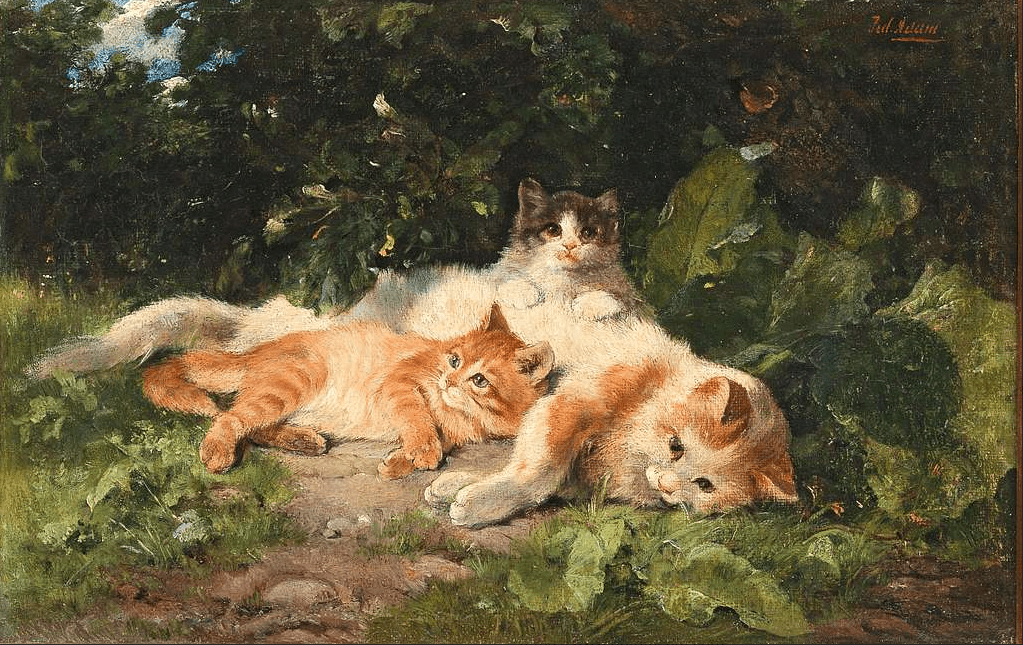
Painting by Julius Adam (1852 – 1913), “Cat with her Kittens”

Haiku by Elliot Diamond, Hifsa Ashraf, and R.C. Thomas

oil spill fish blowing bazooka bubbles

Elliot Diamond (USA)
Failed Haiku, issue 98.1, 2024

Commentary from Jacob D. Salzer:

I appreciate this one-line haiku for revealing one of the severe consequences of oil spills. In a broader sense, this haiku is also showing the inherent economical and environmental dangers of oil dependency in modern civilization.

The word “bazooka” can refer to chewing Bazooka gum. The bazooka bubbles could visually resemble the bubbles created by fish. However, a bazooka is also a military weapon. In this monoku, the bazooka seems to signify not only a war between humans, but a war between humans and the Earth. More specifically, limited human viewpoints and ideologies (that see Nature as only resources to be extracted) leads to harm and war, which also harms ourselves, in many ways. If we want to lead healthier lives, I think we need to protect the Earth and call on Indigenous wisdom.

The strong “b” sound echoes in this monoku with the sonic impact of the oil spill and the bazooka. Even so, because sound is muffled underwater, I also feel a kind of deathly quiet in this poem.

In short, this is an important monoku that shows the dangers of oil. However, it is more than a poem as it can also inspire a social call to action.

old snow
unfolding mom’s
bridal gown


Hifsa Ashraf (Pakistan)
ESUJ-H, September, 2025

Commentary from Nicholas Klacsanzky:

The contrast between “old snow” and “bridal gown” jumped out at me. Both are white, but with “old” and “mom’s,” we understand that both the bridal gown and snow are tainted in some way. From the poem, I get the feeling that either the poet’s mother has passed away, or is simply passing on her bridal gown as a form of heritage. Both images point to transience and create a sense of harmony between nature and human life (toriawase).

With the mention of “old snow,” I feel the seasonal reference, or kigo, is late winter. With the time being on the cusp of spring, it relates to a new beginning, such as a wedding—especially with the reference to being “mom’s bridal gown,” showing the passage of time leading to a new future.

The act of unfolding suggests a form of reverence. It also makes readers ponder questions about the haiku: why is the gown being unfolded now? Is this an act of remembrance or preparation? Finally, “unfolding” also mirrors the melting of now.

Though there is no punctuation in this haiku besides the possessive marker, the kireji, or cut, is felt in the line break in line one. However, with the lack of punctuation, the haiku can be read either as two parts or as one flowing part. Both readings are valid, and perhaps the poet wanted to leave more interpretations open for the reader through the lack of punctuation.

The pacing, however, is quite traditional. With a short first line, longer second line, and shorter third line, this haiku aligns with the traditional Japanese haiku rhythm of 5-7-5 sound units (not syllables). Following this rhythm usually allows the poet to make the haiku brief and colloquial in language.

Overall, this haiku embodies the qualities of seasons, subtle emotion, and the revelation that arises from an unforced contrast/comparison that lends to multi-layered reading.

hard-boiled summer
a busboy’s smile
begins to crack


R.C. Thomas (UK)
Frogpond, 46.1, Winter 2023

Commentary from Hifsa Ashraf:

The opening line, “hard-boiled summer,” presents a rich, multi-layered metaphor. At one level, it conveys the intensity of extreme heat—affecting both mind and body. On another level, it could be describing a person who is emotionally hardened or indifferent. There is also a clever allusion to hard-boiled eggs—thoroughly cooked, contained, and under pressure—suggesting both physical heat and psychological tension. The poet skillfully invites the reader to navigate these interpretations without losing the poem’s emotional depth.

The second line, “a busboy’s smile,” operates both literally and symbolically. It may express a fleeting moment of joy, perhaps the result of brisk business during the summer heat, or act as a mask worn over exhaustion. Extending the egg metaphor, the smile becomes the uncracked surface of a hard-boiled egg—calm, polished, but under pressure. One might also associate egg yolk with the golden light of summer.

The concluding line, “begins to crack,” conveys a subtle shift. It suggests the gradual collapse of composure, whether the smile breaking under heat and fatigue, or the beginning of an emotional unraveling. The metaphor completes itself with the image of an egg’s shell cracking, revealing vulnerability beneath the surface.

This haiku masterfully intertwines climate, emotion, hardship, and human resilience, using layered imagery to reflect on the strain of daily labor in harsh conditions. Finally, the repetition of the letter ‘b’ in this haiku evokes a gentle, calming rhythm, subtly reflecting the sense of ease that follows the unfolding of a mystery.

Isolation Peak, Lawren Harris (Canadian, 1885–1970), oil on canvas, © Family of Lawren S. Harris