Haiku by Quamrul Hassan, Tom Bierovic, and Martina Matijević

all her feelings for him coming back first snow

Quamrul Hassan (USA) 
published in the Wales Haiku Journal, Winter ’25/26 edition

Commentary by Jacob D. Salzer:

An interesting haiku about a past relationship that has not fully faded away.  The many qualities of snow really come alive in this one-line haiku (monoku) in relation to the complexity of a past relationship, partly because the poet has used very few words. Perhaps the poet met a previous partner in late spring or early winter as the first snow was falling. Perhaps the man in this poem is relatively quiet and soft-spoken with a kind heart. Perhaps there is also something that was suppressed or hidden beneath the layers of snow in the man’s and/or woman’s mind.

Snow is soft, quiet, and often magical, yet it can also carry connotations of melancholy, distance, danger, and emotional coldness. In places that experience all four seasons, the snow comes and goes, and then melts away.  However, even when the snow melts, the scent of snow remains in our memory, just as the memories of this man seem to remain in the woman’s heart and mind, even if it’s only traces of him. It seems the woman in this poem could be feeling a combination of feelings all at once. Whether the breakup was last year or several years ago, it seems it was complex and not an easy decision.

In addition, the common phrase, “falling in love,” could be implied in this monoku as the first snow is falling. Why did this couple go their separate ways? How often do couples reunite? What brings people together? What tears people apart? The cycles of the seasons create a complex dynamic in this poem, as the memory of this man returns. In the end, how long will our memories remain in a personal and collective sphere? Does the snow itself also carry memories as it melts into rivers and streams? This is a powerful monoku that juxtaposes human relationships with the many qualities of snow.

her goodbye
too soft to hear
autumn rain


Tom Bierovic (USA)
published in The Heron’s Nest, Volume XXVII, Number 1: March 2026

Commentary by Hifsa Ashraf:

The haiku begins with the pronoun ‘her’, which immediately personalizes the experience. The phrase ‘her goodbye’ carries a particular emotional weight. Had the poet written simply goodbye, the effect would have been more general, but the addition of her suggests someone who has a special place in someone’s life. It conveys a sense of disbelief, as though the speaker cannot quite accept that this particular person is leaving.

The line ‘too soft to hear ‘is especially striking because goodbyes are often associated with sadness, bitterness, or rage. However, in this haiku, the goodbye is soft, suggesting tenderness. Perhaps the separation has been discussed and mutually accepted, making the departure gentler, though no less painful. The repetition of the long o sound in too and to subtly deepens the emotional intensity of the moment.

The word ‘hear’ is equally important. It may imply that the speaker does not fully register the goodbye, either because it is spoken so softly or because the reality of the parting is too difficult to accept. There is something intriguing here; who heard it? The intended person, or perhaps others who witnessed the scene?

The ending image, ‘autumn rain’, beautifully anchors the poem. Autumn is normally associated with decline, endings, and melancholy, while rain often evokes quiet sorrow and introspection. The seasonal image deepens the emotional resonance of the farewell, allowing readers to connect their experiences of loss and separation to the poem.

What I particularly appreciate is the mystery of this haiku. The word ‘her’ remains open-ended. She could be a beloved, a family member, or a friend. Likewise, the goodbye may signify a breakup, a departure, an illness, or even death. This openness invites readers to enter the poem with their own memories and emotions, giving the haiku a universal and enduring quality.

remaining snow —
my eulogy rests
in the closet

Martina Matijević (Croatia)

Commentary by Nicholas Klacsanzky:

The poem opens with a seasonal reference (kigo) that indicates late winter, when the snow has refused to melt. The em dash (cut marker or kireji) at the end of the first line allows readers to pause and consider the image presented. The run of “n” sounds in this line also brings a sense of heaviness.

The second line, “my eulogy rests,” creates a turn in the haiku. However, the word “remaining” relates well to “rests.” It makes a connection between the snow and the eulogy. As a written tribute to someone who has passed, it is intriguing that the poet’s eulogy is already composed—either by the poet herself or by someone else. The word “rests” also personifies the eulogy, or the piece of paper it is written on. It gives the eulogy a life of its own. There is a mix of soft and hard sounds in this line, with “o” and “r” continued from the first line. These letters reflect the mixture of emotion someone might have when writing a eulogy.

“in the closet” as a third line brings the haiku back to the mundane from the flight of the previous line. The expression “in the closet” has many connotations and interpretations. A closet is often a repository of postponed things, our winter coats, our old lives, the objects we can’t quite throw away and can’t quite use. Having one’s eulogy in the closet could mean you were close to death once and have now recovered. Furthermore, it could be interpreted as the eulogy being less important than previously thought from the poet’s perspective. Perhaps the poet feels that words cannot adequately describe a life. Finally, “in the closet” can mean keeping a key aspect of your identity, such as sexual orientation or gender identity, a secret from others. It stems from the phrase “skeleton in the closet,” highlighting a time when hiding your true self was seen as a shameful secret. Leaving these mysteries in the haiku provides space (ma) for the reader to find meaning that is their own.

There are a lot of soft sounds in the last line, with “o,” “l,” and ‘i.” But the “t” at the end subtly closes the matter and makes us feel that perhaps the eulogy will remain in the closet for some time more.

The resonance from “remaining snow” deepens after reading the whole haiku. Both the snow and the eulogy belong to a colder season, a season of dying, and yet both persist.

In form, the haiku hits the sweet spot with only eight words. The diction is simple, though poetic enough to have flavor. Each word is needed and adds to the sentiments and scene. This haiku is a grand, layered association between nature and human mortality.

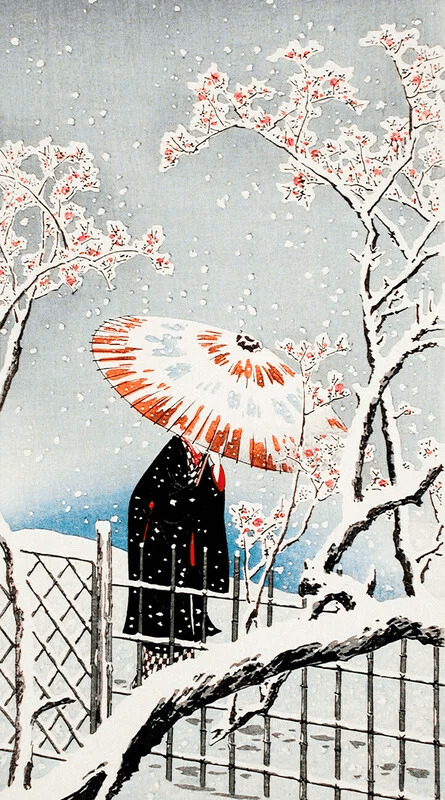
 Painting by Hiroaki Takahashi

Haiku by Martina Matijević, Anthony Lusardi, and Paul Callus

dusty teddy bear   
brushing off   
my childhood 


Martina Matijević (Croatia)  

Commentary from Hifsa Ashraf:

This haiku evokes a tender yet bittersweet moment of reconnection with the past. The “dusty teddy bear” serves as a symbol of childhood, once cherished, now forgotten, or stored away. Dust here is not just physical but metaphorical, suggesting the passage of time and emotional distance where one may have fading memories of childhood.

The middle line, “brushing off,” is beautifully ambiguous, yet letting the person find some clarity into their childhood. It implies a physical act where cleaning the toy hints at revisiting or even confronting long-buried memories. There’s a subtle emotional movement in this line: care, nostalgia, and perhaps a trace of reluctance. This is how one reverts back to their past life with a little bit of effort and time.

The final line, “my childhood,” brings a sense of closure. The teddy bear becomes a gateway to personal history, and the speaker, by brushing it off, also dusts off a part of themselves. The haiku captures a universal experience, how a small object can unlock an entire era of feeling. It’s delicate, reflective, and deeply human.

Lastly, the sound of consonants b and d in this haiku strikes deep yet strong feelings that might have brought back some vivid memories of childhood.

blind date
a wildflower                           
my app can’t identify

Anthony Lusardi (USA)
Prune Juice, August issue, 2025

Commentary from Nicholas Klacsanzky:

The senryu opens with “blind date,” situating the poem in the modern social world. It’s also a circumstance that many of us can identify with. Usually, “blind date” senryu have elements of humor. So, as a reader, I immediately expected a comical twist.

The second line introduces “a wildflower”—a counterpoint to the digital world referred to in the third line. The wildflower symbolizes something growing outside expected boundaries and a sense of freedom. In traditional haiku aesthetics, a wildflower often embodies sabi (rustic beauty), yet here in this senryu, it is employed in a playful way where the poet’s date is implied to be a “wildflower,” and notes how romance or love is often indescribable.

The closing line captures the tension between technology’s attempt to categorize the world and the irreducible mystery of human connection. There’s an irony in our dependence on apps to “know” what’s what—even as what truly matters (the person on the blind date) resists such identification.

Overall, the humor is understated—a hallmark of senryu—but carries emotional resonance. Beneath the joke about the app’s failure is a quiet longing for authenticity, for something not optimized or labeled.

Checking in on the sense of sound, the w and f sounds give both emphasis and a wispy feeling to the poem. With the format, the last line is long, yet it is not an issue since not only is this a senryu (which doesn’t focus on format much), but the line breaks seem natural.

Ultimately, I chose to comment on this senryu because of its mixing of technology, romance, and playful use of nature. I was happy to see it appear in the prestigious journal, Prune Juice.

monsoon rain
over the paddy fields
a flight of dragonflies


Paul Callus (Malta)

Commentary from Jacob D. Salzer:

This is an interesting haiku that shows the after-effects of a monsoon in the paddy fields where rice is grown. According to the National Environmental Satellite, Data, and Information Service: “A monsoon is a shift in winds that often causes a very rainy season or a very dry season. Although monsoons are usually associated with parts of Asia, they can happen in many tropical and subtropical regions – including several locations in the United States. Monsoons are caused by a change in the direction of the wind that happens when the seasons change. In fact, even the word monsoon comes from the Arabic word mausim, which means ‘season.’ At the beginning of summer, the land warms up faster than bodies of water. Monsoon winds always blow from cold to warm. In the summer, warm air rising off the land creates conditions that reverse the direction of the wind.”

In this haiku, the extreme weather of heavy monsoon rains is contrasted with the silent and delicate flight of dragonflies. Traditionally, dragonflies are an autumn kigo (seasonal reference). The flight of dragonflies could symbolize a human migration, i.e., perhaps the farmers in the paddy fields are also temporarily migrating due to the heavy rains, as summer fades into autumn.

On the other hand, according to the World Population Review: “The most common method of cultivating rice involves flooding the field, a practice typically carried out in what’s known as a rice paddy. This helps water and protect the plant from vermin and disease.” Therefore, the monsoon rains can help cultivate rice, though it’s more difficult to work in the paddy fields during the downpour.

Despite the potential melancholy interpretation relating to the autumn kigo, I can’t help but feel hope, courage, and resilience in this haiku: even in the heavy monsoon rains, the dragonflies are flying together. I think the plural form of “dragonflies” is special because I normally only see one dragonfly at any given moment. While there are likely two dragonflies in this haiku, it could also be enjoyable to imagine several dragonflies flying together.

In short, this is a significant haiku that shows resilience, a seasonal shift, and offers a portal into the lives of farmers who work tirelessly in the paddy fields to grow and cultivate rice. More interesting facts about rice can be found on the World Population Review website.

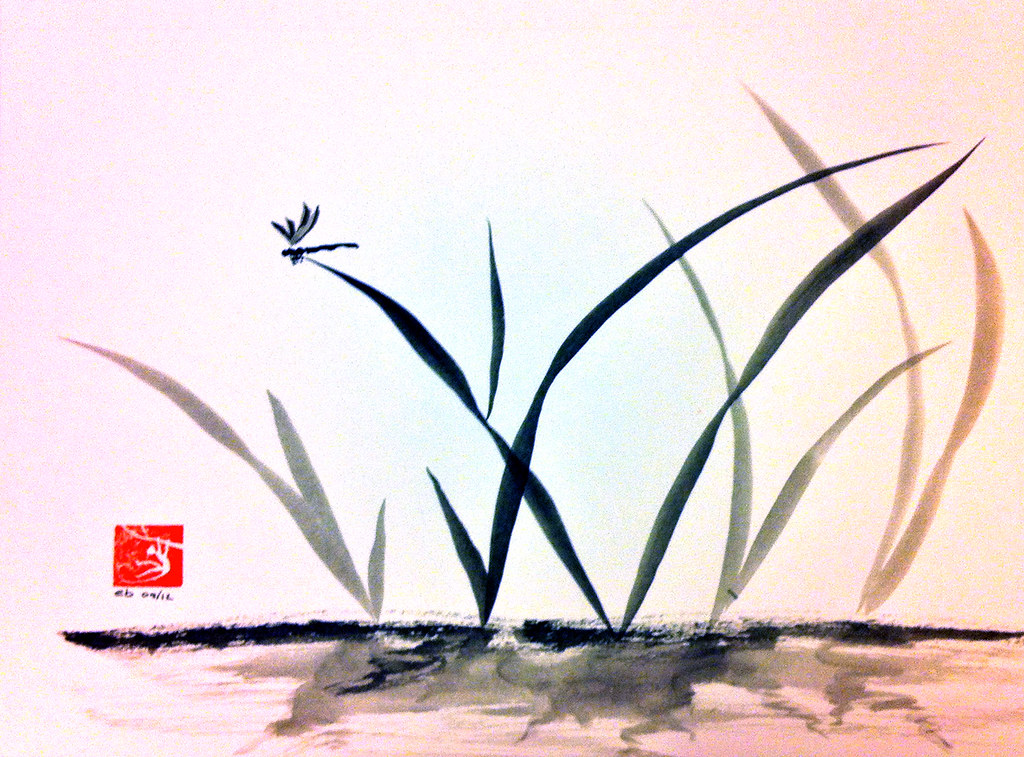
Painting by Ernest Barbaric

Haiku by Pat Davis, Anthony Lusardi, and Martina Matijević

beach stone
some of the worry
already gone

Pat Davis (USA)
The Heron’s Nest, #44, December 2024

Commentary from Jacob D. Salzer: 

I appreciate how the image of a beach stone can be a metaphor for letting go. In this haiku, we don’t know what the poet is worried about, but the beach is a place where worries seem to disappear and fade into the background. I can feel the weight of the beach stone and hear the pulse of ocean waves. Along these lines, the beach and the vast ocean can create a relaxing atmosphere where we can embrace the space between thoughts. At the same time, the ocean can allow us to see “the big picture” where our worries can be seen from a deeper and different perspective. I think this is very important to do because we can step outside our small sense of ego and see our place on Earth and within the larger cosmos. I also appreciate how this haiku is relatable from reader to reader. It seems most people have their own worries that come and go. I deeply appreciate how the Earth herself can calm the mind and help us reflect. This haiku shows us this power. 

In short, this haiku shows the inherent healing power of Nature without overly explaining it. It includes a balance between concrete imagery and mystery. While this haiku is personal, it is also relatable to many readers with different backgrounds and circumstances. In the end, I think we can all benefit from learning how to let go. A powerful haiku.

dry summer
a spider web full                   
of fireweed seeds

Anthony Lusardi (USA)
Frogpond, 48:1, winter 2025

Commentary from Hifsa Ashraf:

The haiku speaks for itself in terms of its theme and imagery. Climate change is a topic that should be highlighted time and again through any platform or medium as a reminder to the world that it is a serious issue.
 
The kigo in the first line ‘dry summer’ gives a vivid image of both time and season. I see it as if there is a drought with a drastic impact on nature. It seems the poet talks about a rainless time when the rain is needed the most. But, it still doesn’t give us a clue of the time period i.e. is it rainless for long or short? But, I like the way the poet uses an aesthetic sense to observe the beauty of nature even in hard times. 

A spider web can represent mystery, confusion, hopelessness, or abandonment where probably no access is given to any being. I wonder if the spider web is inside or outside a building, in an open field, or in a garden/farm, etc. There is no such clue of the location which makes this haiku open for interpretation. 

Fireweed seeds in the last line add to the interest in this haiku as seeds may stick to the spider web as a result of pollination, wind, storm, or any other source. But, in any case, these seeds have no chance to germinate as they may not be on the ground or in a favourable condition. At first look, the spider web full of fireweed seeds may sound like a period of hopelessness, drought, or lifelessness. However, fireweed can symbolize rebirth, resilience, and hope. But, the word ‘full’ instead of ‘stuck’ or ‘cling’ gives me some hope that maybe, one day these seeds may survive and fall on the ground or a suitable place to grow. The article ‘a’ and the word ‘full’ make it simple to interpret without digging more into the various aspects of this imagery. So, I see both hopelessness and hopefulness in this haiku. I see the resilience of nature in extreme or unfavourable seasons. I see life in a lifeless situation. I see the impact of climate change on nature and the way nature responds to it by trying to survive and preserve its elements. 

grandma’s old vineyard 
amid dense branches 
an abandoned chick

Martina Matijević (Croatia)

Commentary from Nicholas Klacsanzky:

The contrast between the chick and the old vineyard is striking. The word “abandoned,” though, can pertain to both the vineyard and the chick. From the first line, I assume the poet’s grandma has passed away and has essentially been abandoned. Looking at the second line, it is a pivot which connects to the first and third lines. If the first two lines are read as one whole, it could be saying that the grandma’s old vineyard is “hiding” or obscured amid dense branches. If the last two lines are read as one part, the chick appears amidst the branches. It’s always a plus when you can read a haiku in multiple ways.

A kigo or seasonal reference is not quite apparent. However, the mood of the haiku is at once bleak and hopeful. There is sadness in the deserted nature of the vineyard but an optimism in the new life that has inhabited a derelict space. It feels like the baby bird is a reincarnation of the grandma or a continuation of her life.

Looking at the format, it is interesting that each line is an equal five syllables each. I am not usually a syllable counter in haiku, but I noticed how each line was about the same length. Commonly, the haiku rhythm in English is a short line, a long line, and a short line. There is nothing wrong with changing up that rhythm, though. Each haiku is organic and requires a different pacing.

Sonically, the strongest letter in this haiku is perhaps “d.” In my opinion, it provides weight to the poem and the scene itself. The other letter that interests me in this haiku is “b,” which also creates accents of strength or gravity

To wrap up, this haiku connects the poet’s experience to the animal/natural world seamlessly. The haiku also features a fine sense of sound, a unique rhythm, and multilayered imagery.

Photo credit: Martina Matijević