
Andrea Cecon’s Summer Evening

rise and fall
of my navel —
summer evening

© Andrea Cecon (Italy)
(appeared previously in Paper Wasp, spring, 2010)

This is a fine example of a haiku that goes from details to generalities. In the first two lines, we have an extremely focused subject: the navel of the author, and its rise and fall (maybe from running). Then we move onto “summer evening,” which shows us the kigo, or seasonal reference.

Though the first two lines can be taken literally, and is an interesting image on its own, we can ponder the symbolic consequences of the image as well. A navel can be a symbol for innocence, for beginnings, or something cut away and what remains of it.

“Summer evening” can be either a contrast or a comparison of the first two lines, depending on how you take the symbolism. Also, if you take the first part only as the observation of the author’s navel rising and falling, it might be suggesting that summer is coming to a close or that despite it being summer, the seasons always continue to change and are fleeting.

As a side interpretation, it could be said that the haiku shows that despite it being an evening in summer, the up and down motion of the navel matches the motion of a heatwave. Thus, it demonstrates an aesthetic of continuation.

As you can see, there can be many interpretations of this haiku, and almost any haiku, if it is written well. But let’s take the mood into consideration. By reading it out loud, we can feel a sense of melancholy and introspection. Haiku do not need to present intellectual ideas. Instead, they usually aim to show a feeling or atmosphere. In the attentiveness of the author to such an essential and even mysterious thing as his navel and in viewing a summer evening, there is a sense of looking back and reflecting on what he has become.

The use of the ellipsis works well to separate the two parts and give a pause for the reader to consider the moment presented. It may be a moment without exact meaning, but in the now, we can find peace and deep introspection, even in the most trivial of happenings.

It seems the stress in each line is at the end of each line. This creates a rhythm of something pressing or demanding, or at least something we should take seriously. The sound of “e” in “navel” and “evening” make it clear that the author is putting these side by side.

I can see this haiku as a one-liner, or monoku:

rise and fall of my navel summer evening

However, even though this version might have more interpretations possible for readers, the rhythm and somber mood of the original might be lost.

I think the power behind this haiku is not only the focused topic, but the juxtaposition as well. It seems simple and classical, yet it has its own originality and implications that make this haiku multi-layered and subtly introspective.

– Nicholas Klacsanzky (Ukraine)
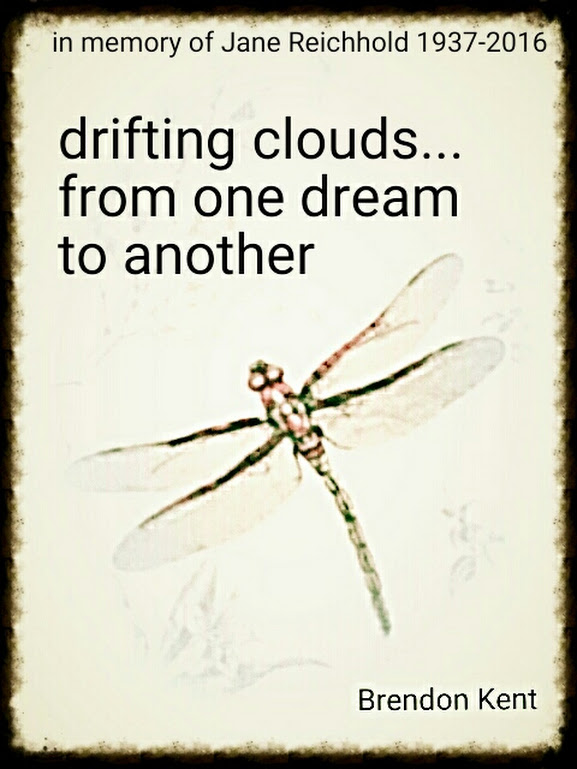
Brendon Kent’s Clouds

2016 - 1

Words and image © Brendon Kent (UK)

For the context of this haiga, or haiku and art combined, I should tell who Jane Reichhold was.

Jane Reichhold was a popular and key member of the haiku community. She was the editor of Lynx journal of haiku, tanka, and renga, and the owner of the site Aha Poetry, where a great amount of reading materials on haiku and related forms are held online. She wrote many famous books on haiku, such as Basho: The Complete Haiku, Writing and Enjoying Haiku: A Hands-on Guide, A Dictionary of Haiku, and many more influential books. She also was the recipient of the Museum of Haiku Literature Award [Tokyo] twice and the Merit Book Award twice.

It was announced that she passed away on August 5th, 2016. Many tribute haiku and articles were written for her, as she trained and influenced so many people through her essays and poetry. This haiku by Brendon Kent is a fine example of a tribute haiku for Jane.

This haiku has a clear juxtaposition and is written in a more traditional style, which I think is a prudent choice for the tone of a tribute. The poet is comparing drifting clouds to traveling from one dream to another. This juxtaposition is complemented by the image of the slightly blurred dragonfly in flight. In haiga, the image and text usually are not directly connected, but hint at each other. Brendon has done a superb job making this connection indirectly, creating a defined mood.

The use of the ellipsis shows a carrying on and delineates the two parts clearly. I think without the ellipsis, the meaning could change, and maybe Brendon wanted a more focused reading of his haiku.

I don’t know why exactly, but I feel emotional reading this haiku. It looks straightforward, but there is a definite emotion behind the words. Maybe it is the context or the solemnity with which the pacing of lines are written, but it charges me with emotion and maybe a sense of awe.

Let’s great back to the clouds. Clouds are high in the heavens, as you can say, and are an apt metaphor for Jane. She was a selfless person and committed to write poetry that uplifted people. The drifting, I believe, is a metaphor for passing into another life. The wind making the clouds drift could be a symbol for the universal spirit that is often expressed as wind in spiritual doctrines. Maybe the cloud is a symbol for Jane in the afterlife, soon to rain and bring about a new life of her own in a distant place.

The dream could be the illusion of life. Most spiritual traditions agree that we are not this body, emotions, or mind, but a pure spirit. It seems these lines are a kind of reassurance and a kind of detachment as well. This process of life and death are only transitions of the mundane, and maybe we all wake up to our spirit in between (though some say it is better to realize the spirit while living).

Or, the poet could be simply stating what happened to him. Maybe he took a nap on a forest walk, or on his backyard, and woke up to seeing drifting clouds after experiencing transitions to and from different dreams.

Haiku are usually objective reporting of what is happening, but can be seen as metaphors and symbols for much more. And knowing Brendon Kent’s work, he enjoys creating layers of meaning in his work, so it is probable that he wanted to portray both the spiritual and mundane.

On the level of sound, the “o” sound in “clouds,” “from,” “one,” “to,” and “another” create a wispy feeling for the reader, akin to clouds. It is great when the reading of a poem accurately reflects its content. The words without”o” are “drifting” and “dream,” which have alliteration and are both key words in the context of this haiku. Leaving these words as the only ones without an “o” sound makes them stand out more, which draws our attention to them more.

Though many fine tributes for Jane Reichhold have been written since her passing, this is one of the finest I have read. Wherever Jane may be now, I hope she is reading this tribute, and many others.

– Nicholas Klacsanzky (Ukraine)


Eva Limbach’s Gods

all those Gods
I lost and found
dandelion fluff

Sonic Boom Journal, 2016
© Eva Limbach (Germany)

The first thing that struck me about this haiku was the capitalization of “Gods” instead of “gods.” Grammatically, “gods” is preferred in most cases, but in this haiku, I believe the author is giving respect to each god she has encountered, loved, and may have freed herself of.

What also made me turn my head was the striking juxtaposition between gods and dandelion fluff. So much can be implied:

1) All gods are same, essentially.

2) All gods share the same purpose.

3) Which god we choose to worship may not be that important after all.

4) Like dandelion fluff, gods drift in and out favor.

… and maybe much more.

Another part of the haiku that got me interested in it is the use of “I’ instead of just keeping it as “all those gods/lost and found.” Bringing in a personal side to the issue adds weight, and allows readers to identify with the experience of the haiku, rather than see it purely as something philosophical or historical.

A strong part of this haiku is its sound. The “o” sound flows through “those,” “Gods,” “lost,” “found,” and “dandelion.” I believe this sound aims for euphony, or a harmonious and beautiful connection of sound. This could be another way the haiku shows how gods are one.

Maybe in our modern times, gods have become like dandelion fluff: revered and memorable, but somehow not worth much in these times of technological and scientific progress. Or maybe gods are numerous but one, and in these times of fast-paced developments in human progress, we have so many resources and chances to get connected with one of them. There is no right answer, but this haiku for sure makes us introspect on the state of religion and what we ourselves have experienced on our own spiritual journeys.

– Nicholas Klacsanzky (Ukraine)