Several one-line haiku by Alan Summers

We have a special feature this time around. Here are several commentaries on one-line haiku from Alan Summers’ new book, modŏ – new & selected.

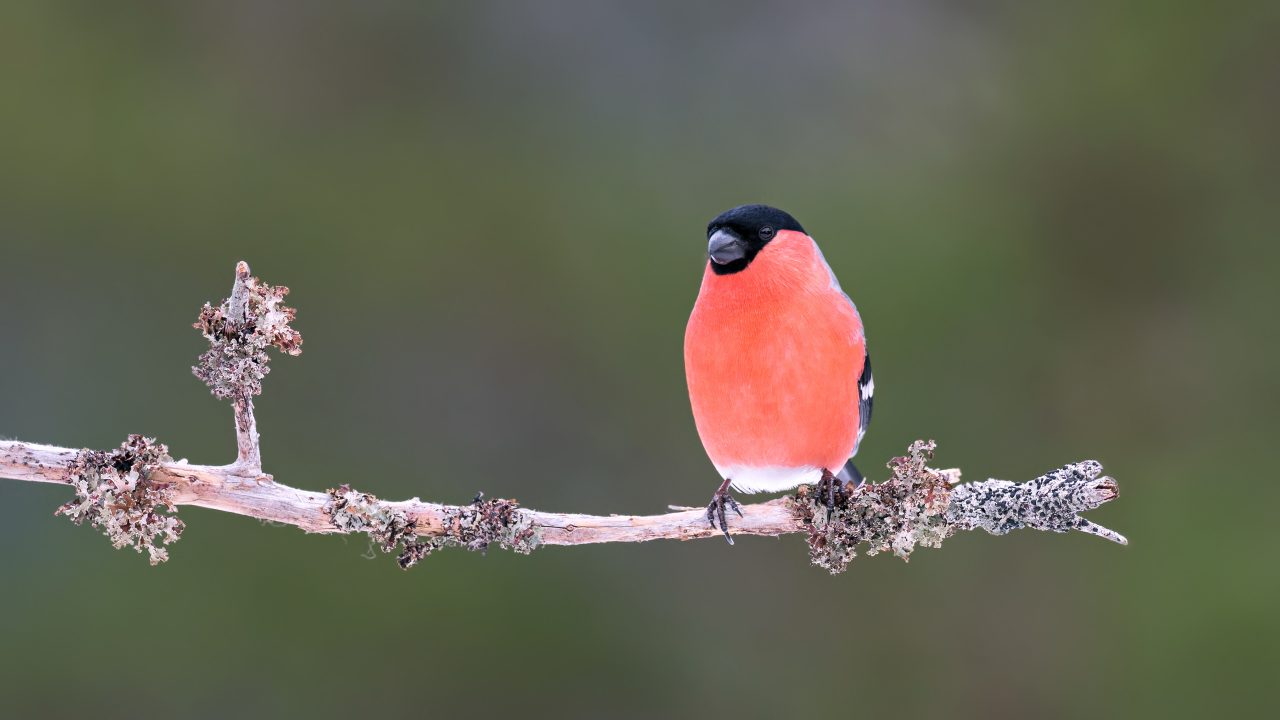
the robin and the snow and the robin’s song again underscored


Commentary by Hifsa Ashraf:

When I read this poem in one go, I feel as if an old vinyl record is playing on a loop, with slight pauses between the music that are almost imperceptible. It is a profound monoku in which the poet sketches a winter scene for us—a season of deep silence, where snow and cold weather often keep people indoors. Yet, winter is also a season of reflection, allowing us to connect more deeply with our inner selves and with nature. Since snow is a familiar part of winter in many regions of the world, connecting one’s emotions with it feels both natural and profound.

The opening word, ‘the’, makes me think of a particular robin. It may be a bird enjoying itself in the snow, or perhaps its song carries a note of sadness or loneliness. Symbolically, I also see the robin as a person seeking solace in nature in whatever way they can. Is the robin connected to deeply personal feelings that resurface each winter? Is it an old longing or desire that has quietly endured over the years and now emerges again in this season? The snow in the background plays an important role in highlighting these thoughts, emotions, moods, and desires. It also evokes a sense of nostalgia—something that keeps returning with the arrival of winter.

‘The snow’, likewise, may represent the familiar qualities associated with winter: silence, loneliness, emptiness, and stillness. Yet, I also see it as a kind of white noise, something vast and difficult to fully grasp. In this sense, the robin and the snow create a yin-yang relationship, complementing and defining one another.

The repetition of and in italics, though less emphasized, together with the recurring presence of the robin and the snow, creates an interesting rhythmic effect in the background. It emphasizes both elements and encourages readers to view them not as separate images but as parts of a unified experience.

The real cut, for me, occurs at ‘again’. The word suggests continuity—something returning time and again, whether through the cycle of the seasons or through recurring personal memories. It is as though the robin’s song repeatedly resurfaces within the snowy landscape. Perhaps it is something a solitary person longs for in winter: a sound that breaks the silence and resonates with their feelings. The song inspires one to join nature’s chorus and find comfort within it. It becomes something impossible to ignore amid the quiet fall of snow.

The haiku concludes with the word ‘underscored’, which shifts our attention from the surface imagery to the deeper music beneath it. Besides the robin’s song and the silence of the snow, there is a hidden harmony created by their interaction. The robin gives voice to the snow, while the snow, in turn, amplifies the robin’s song. The ending carries a subtle melancholy that invites us to reflect on our relationship with nature regardless of the season. At the same time, it offers hope, showing us how silence itself can become a symphony, even when no one else is there to hear it.

The repeated sounds of r, s, o, and n further enhance the musical quality of the monoku, creating a melody that readers can almost hear as they move through the poem.


wintergreen that time spent as Christmas alone


Commentary by Jacob D. Salzer:

It is remarkable how certain scents can transport us back in time to a specific memory (or a collection of memories), in a specific place and circumstance.  In this monoku, the word “alone” could have at least two different interpretations: 1) it could mean that the wintergreen scent is only smelled on Christmas Day with family and/or friends, or 2) Christmas Day was spent alone without the company of family and/or friends. This monoku makes me think of elderly people who live in assisted living homes, memory care facilities, or hospice facilities who may not have family nearby. Although the person referenced in this monoku could also be young and alone for many different reasons. Did the person get stranded in a snowstorm?  Did they experience a tragedy or a flight delay? Did they want to spend Christmas with family but their family members passed away? Does this scent bring back memories when the person celebrated Christmas with family but can no longer do this anymore?  

I also think of a beautiful forest. Perhaps the person spent Christmas in the woods for the first time.

I also appreciate how this monoku shows a disruption in our day-to-day lives, where the Christmas holiday is celebrated (hopefully beyond the capitalist mindset of gifts and money exchange), and where actual relationships are made and nourished beyond the idea of money.

Regardless of our interpretations, it is the wintergreen scent that is remembered, viscerally felt, and re-experienced in this monoku. Perhaps this scent brings a mix of emotions all at once (melancholy, joy, nostalgia, etc.). The wintergreen scent is also strong and powerful (and therefore hard to forget), which (in my mind) translates to strong emotional correlations. What other scents do we recognize, and where do they take us? What mental impressions (samskaras) remain in the subconscious mind from this lifetime (and even past lives) that are associated with various scents? This is a powerful monoku to experience and contemplate.


a single gate faces the forest snow-hinting sky


Commentary by Ron Scully:

Why “a single gate” rather than a double, or another, open or closed? Alan Summers shows deftly the doors, read gate, are one way, one off, and we are stopped by the stand of thick forest, rather than forest bathing, we are on the brink of snow bathing. Quite the piquant piece by a master. Several readings would yield richer reactions.


self-penned obituary again the snow


Commentary by Nicholas Klacsanzky:

Though this monoku is extremely concise, there are at least three ways of reading it. My first interpretation was that the poet, or another person in the poet’s life, is writing an obituary for themselves again, and this act is represented in, or connected to, the snow falling outside. The second look made me think that snow itself might be the obituary that is penned, and that the poet feels (or felt) one with snow; the snow could be falling after the obituary has been read, signifying that nature continues without indifference or reverence. Finally, on the third reading, I saw that a self-penned obituary is perhaps being compared to snowflakes, where variety is present at a focused level, but from far away, it might appear the same.

In any way you read this one-line haiku, the kigo, or seasonal reference, of snow is important. It expresses the mood, the cold, and sometimes the beauty of impending death. Snow can also be a metaphor for the blank page, or erasure. It also adds a layer of sound with “s” that matches the beginning with “self.” Perhaps it is representative of the cycle of life and death. In addition, the “o” sounds in “obituary” and “snow” provide an open feeling as if the person in the poem is welcoming death and ready for it.

The cut to form the two parts of the haiku is felt naturally after either “obituary” or “again.” The word “again” acts as a pivot that can give meaning to both the first and second parts of the haiku.

There is a lot of feeling behind the words and phrasing in this monoku. Not a word or image is out of place. An impactful haiku that calls us to pause and introspect about our relationship with nature, death, and identity.

Publications:

“the robin” previously published in whiptail: journal of the single-line poem, ed. Kat Lehmann & Robin Smith (November 2025)
“a single gate” previously published in haikuKATHA 52 (January 2026) Founder/Managing Editor: Kala Ramesh

“self-penned obituary” previously published in whiptail: journal of the single-line poem, ed. Kat Lehmann & Robin Smith (November 2025)

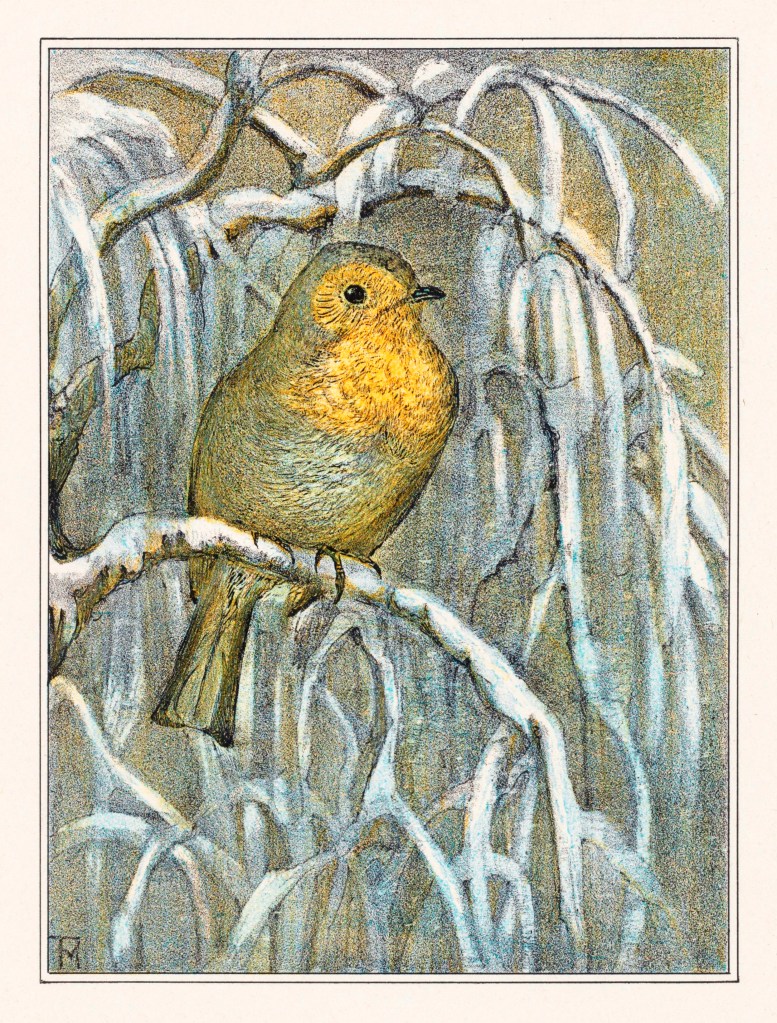
Roodborstje op besneeuwde boomtak (1878–1910) print in high resolution by Theo van Hoytema. Original from The Rijksmuseum. Digitally enhanced by rawpixel.

Haiku by Alan Summers, Royal Baysinger, and Nisha Raviprasad

the last one melting
in the snow-jerk’s grip 
cola float 

Alan Summers (UK)
The Pan Haiku Review Issue 2, New Year’s Eve/Winter 2023 
A Kigo Lab, Special ed. Alan Summers

Commentary from Nicholas Klacsanzky:

What initially drove my interest in this haiku is its unique kigo, or seasonal reference. In the poet’s own words: “After “Soda jerk” a term used for a person who operated the soda fountain in a drugstore, preparing/serving soda drinks & ice cream sodas. A snowjerk is a snow chaser, as the snow decreases in some geographical areas, and increases in other areas. Snow will soon be like diamond dust.” This reflects the effects of climate change.

The first two lines could be interpreted in at least two ways. It may connect to the cola float mentioned in the third line, or an unnamed iceberg or ball of snow. I believe this haiku points to the irony or sadness of a snowjerk melting ice, snow, or a float with their hands. This melancholy is contrasted with the sweetness of the cola float.

There is a fine euphony occurring in the haiku with the “l” and “o” sounds. Also, the pacing of the haiku aligns well with the original Japanese rhythm of this art form. Lastly, though the kigo is unique, the language itself is accessible. Overall, it’s a haiku you have definitely never seen before with pressing topics built in, which makes us pause and ponder.

a dog
gnawing its bone
— re-reading her letter

Royal Baysinger (Canada)
Modern Haiku, 54.2 (Summer 2023)

Commentary from Jacob D. Salzer:

As with many powerful haiku, complex emotions are implied in the first two lines through the “show not tell” method. In addition to re-reading the letter, there is repetition in the act of gnawing. The em-dash also provides a weighted pause, which adds emotional weight. The fact that the poet is re-reading this letter also tells us that it has heavy emotions within it. As readers, we can likely relate to this experience or enter our imagination in this haiku in our own way. 

Using simple words, this haiku has a powerful juxtaposition that balances concrete imagery with mystery. It has room for the reader and is relatable. In short, this is an effective haiku that focuses on the layered complexity of relationships.

ragwort sprouts…
mother pats her wrinkles
with a gentle sigh

Nisha Raviprasad (India)
Under the Basho, June 1, 2024

Commentary from Hifsa Ashraf:

We all try to compare and contrast many things in our surroundings to justify or satisfy ourselves. In this haiku, the poet relates ageing with the leaf structure of ragwort sprouts which are wavy and wrinkled.

Mother, who is patting her wrinkles with a gentle sigh, is perhaps indicating her feelings of satisfaction that she is not alone. Though her skin is changing, other things in nature pass through similar transformations right from the beginning. The words ‘pat’ and ‘sigh’, though, perhaps show signs of satisfaction and motivation that she gets after seeing ragwort sprouts. There may also be a comparison between the poisonous nature of ragwort and changes in mood, thoughts, and feelings due to ageing that become more cynical or bitter. As ragwort causes skin allergies, I can see an element of fear here where the mother makes herself content by assuring herself that her skin is still healthy despite dangerous risks in her vicinity. She may be trying to accept ageing and adjust to it positively. 

Looking at the sound, the letter ‘w’ could indicate the continuous thought process of ageing that can be satisfactory or dissatisfactory.

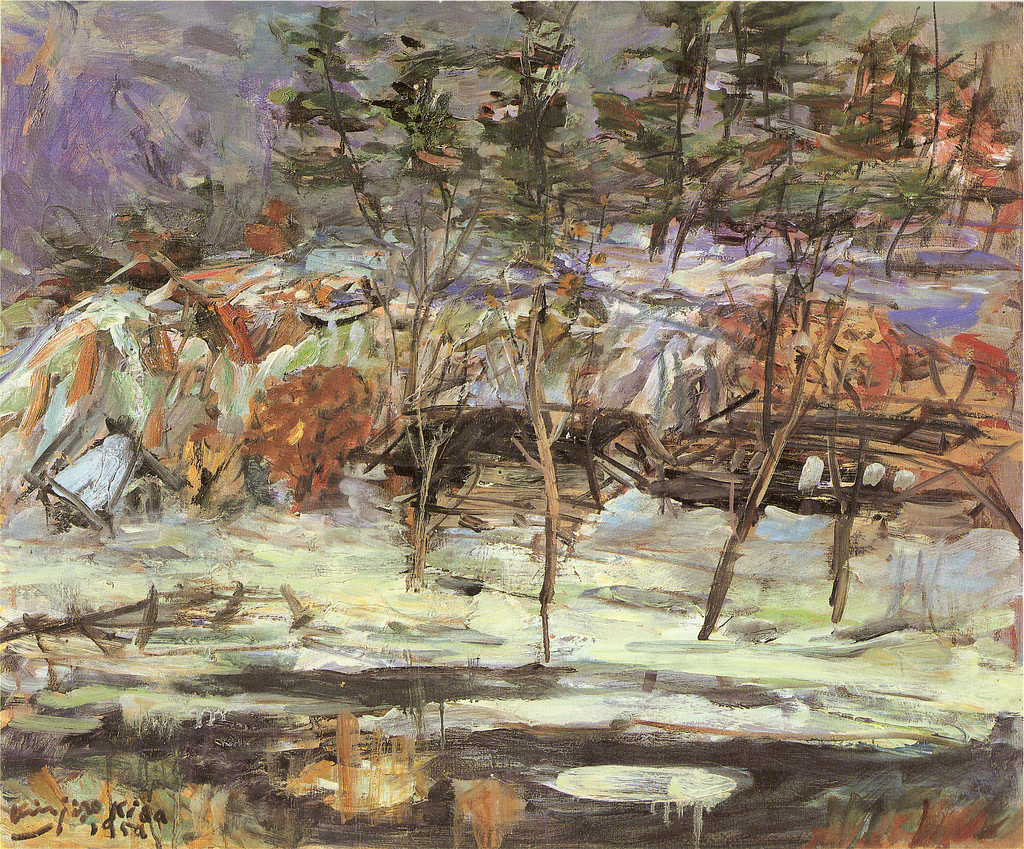
Kida Kinjiro, 1959, “Melting of Snow in Thinned Copse”

Alan Summers’ nightfall

nightfall the key turns into a blackbird

Alan Summers (England, UK)

Publication credit:

First published: Blithe Spirit 31.4 (November 2021)

Article: 

The Unseen Go-Between in Haiku by Alan Summers
Haiku Society of America Haiku Spotlight (January 2022)

Award Credit

Runner up: Museum of Haiku Literature
Blithe Spirit vol. 32 no. 1 (February 2022)

Commentary

I appreciate the mystery (yugen) in this haiku and the possible interpretations. I initially felt a kind of fantasy-surrealism in this monoku. “The key” could be to a door, and if so, a door to what? Is the key a door that leads inside a physical building or room? Is it a key to a door that leads outside a building? Or, is this a key to a psychological door in the poet’s mind or within someone else’s psyche? In one interpretation, I get the feeling the key is turning and opening a locked door in the poet’s house leading outside. I like how the door does not need to be said in the monoku for me to imagine it.

I think “nightfall” effectively sets the tone and a mysterious atmosphere. I also think the double meaning of “turns” adds more depth to the monoku. Did the key physically turn into a blackbird? Or, did the poet open the locked door and simply saw a blackbird at night? Is the poet dreaming or daydreaming? Is this a monoku about the poet reading a fantasy novel? Did the door release a blackbird from a confined physical and/or mental space? Perhaps a limited physical room could symbolize a confined, limited mind or mental concept. When I see the key turn, I feel a door opening and the blackbird is released and disappears into the night. In that sense, perhaps the spirit of the blackbird is a key that opens the door to the Great Mystery/unseen dimensions of life and simultaneously opens the poet’s mind to a different way of seeing. 

If taken literally, I see the key transforming into a blackbird could symbolize how something that appears to be a concrete image (in this case, the key and the blackbird) is actually full of depth and mystery. It’s interesting how a single key can unlock possibilities and also lock a door and protect us from danger. I also get a sense that the blackbird is being honored and respected in this monoku, especially in relation to the night and the Great Mystery. I appreciate how this interpretation resonates with Indigenous spirituality. There are many Indigenous myths and legends about various birds. I also appreciate how this monoku expresses the beauty and importance of having an open mind. The poem encourages us to have the courage to see the world from different perspectives versus staying in our comfort zone and familiar ways of seeing and labeling. An intriguing and powerful monoku. 

 — Jacob Salzer

Nightfall is a shift in the day which brings mysteries with it. Symbolically, it unfolds a different world that manifests our true state of mind and heart. A time when we rarely see things through the lens of others and try to unfold our own stories. A time when we can fully concentrate on what matters the most in our lives. A time when certain realities are revealed to us through introspection or pondering.

Nightfall in this one-line haiku shows the vastness and significance of time, which motivates us to pause and imagine the scene that may look more inspirational and persuasive in this particular poem. The shift in the poem is the ‘key’ which reveals the mystery or unfolds the story; it can be the cognitive process that productively grasps the whole situation and gives flashbacks; it can be the meditative state of mind that unwinds the day’s fatigue by opening the doors of imagination or mysticism and brings some peace; it can be the solution to a problem when a person finds a creative solution and is able to find a way through critical thinking; or, it can be simply daydreaming when a person seeks solace in imagination and manifests their imagination in the most creative and surprising way, which looks magical in the end.

A blackbird symbolizes mystery, death, and magic but it is also significantly considered a sign of spiritualism or transformation. In this poem, nightfall transforms a person’s life where they can turn the key into something that looks more blissful and peaceful.

Overall, the poet challenges our senses to imagine and capture the vivid image of this poem and lets our creative faculties run wild and find how nightfall can spellbound us to see what we want to see or to see beyond seeing.

Hifsa Ashraf

The blackbird in England can be seen year-round. However, their mating season stretches from March up until July. So, perhaps this is a spring haiku. This relates well to the key possibly turning into a blackbird, as spring is a time of transformation. 

There is no kireji or cutting word in this monoku, which is common in English-language haiku that run as one line. There is a clear grammatical break after “nightfall,” though. 

However, you could say the haiku could be read as one flowing phrase, with “nightfall” being a verb that acts upon “the key.” Then, “turns” would be the second part of the haiku. 

“nightfall” also goes well with transformation as many things change during the night. Because of the darkness, things can be perceived differently. A person might imagine a key turning into a blackbird. A person might also imagine turning a key and going into an apartment or house and seeing a blackbird in the darkness. In this respect, the haiku might be speaking about human perception and its possible manipulation or trickery. I feel that the night, the key, and the blackbird are ultimately the same. 

This haiku is succinct with no word out of place. Also, the lovely soft sounds of the letter L contrasting with the sharp tick of the letter T make this haiku musical and layered.

A haiku that begs to be read over and over, it presents an abstract idea in a concrete sense.

Nicholas Klacsanzky

Copyright: © Arte Ivanna