Haiku about “dust”

Haiku Commentary had a prompt challenge on Twitter that revolved around the theme of “dust.” Here are our favorite submissions and commentary on them. 

rising dust . . .
the old argument
resettled

— Marion Clarke (Ireland)

The opening line of this haiku alludes to the visibility, progress, and movement of something very intangible and subtle. ‘Dust’ may reflect resilience, hope, positivity, strength, or life. When a person moves on in life with all these characteristics, they find it easier to understand certain realities of life and their underlying meanings.

When we look back into the past, old arguments look vague and meaningless. We hold fast to our points of view over the years and ruin relationships because our state of mind doesn’t accept them or see through them for a better reflection of the causes of those arguments.

The resettling of arguments means a new perspective on past disagreements or the reasons behind those arguments that bring more understanding of life.

— Hifsa Ashraf (Pakistan)

Haiku often showcase two slices of life that contrast in a unique and meaningful way. Here we have the action of rising and resettling juxtaposed, written in a way that can be taken both mundanely and metaphorically.  We can easily imagine by reading this haiku that an argument has settled on an imaginary ground and dust rising from its impact of touching the earth.

Nicholas Klacsanzky (USA)


my childhood memories
a cloud
of chalk dust

— Paul David Mena (USA)

Childhood memories always remain with us no matter how old we are or how hard it is to get through our lives. We always cherish those memories no matter how bittersweet they are. Those flashbacks of the past look like a cloud of chalk dust that we enjoy for a moment and then get back to our routine lives. This also means that vivid memories are fading away either due to life experiences of both childhood or present or due to ageing. In any case, if words have been erased, only chalk dust remains for a short while. A cloud also shows fading memories or forgetting, where a person loses the details of childhood memories and has only short glimpses of their childhood.

The word ‘my’ depicts the personal experiences of the poet where he finds it hard to remember those memories. The letter ‘c’ in this haiku displays the half circle of those memories that result in mere images or glimpses from childhood without having any significant details.

— Hifsa Ashraf (Pakistan)

I have written plenty of haiku on childhood memories and can say that it is quite difficult to do so. Mena has composed one with power and brevity in a seemingly effortless fashion (the trick is to make it look effortless when it is not). “Chalk dust” has many implications, as it pertains to education, writing, purity, innocence, and possibly more.

Nicholas Klacsanzky (USA)


dust on your photos
the last fragments of you
that remain

— Shane Pruett (USA)

While the poet is looking at photos of a beloved of his, there remain parts of this person that are still technically alive on the pictures: the individual’s dust. This brings about an extra layer of sadness because even though a part of this person is still with the poet, it is a part that is non sentient and cannot interact with him. This haiku might reflect the Japanese aesthetic of mono no aware (物の哀れ), which is about the pathos and transience of things, and that sometimes brings about beauty in melancholy.

Nicholas Klacsanzky (USA)

There are certain memories in life that we want to forget but cannot as they leave deep imprints on our minds and hearts. But still, time is considered as the best healer. So, the memories of loved ones remain as mere dust.

Specks of dust on photos, metaphorical flashbacks, or vivid memories are fading away or not getting the importance they deserve. This may be due to a change in priorities or other perspectives of life or ageing when someone cannot remember certain things of the past or ignore them.

In this haiku, ‘last fragments’ show the loosening of memories that the narrator once held dear. These fragments are dust, which also shows the annihilation of memories.
Ultimately, this haiku speaks about the transformation of a relationship from a tangible personal touch to the intangible thoughts and memories that later fizzle out in the dust of time.

Hifsa Ashraf (Pakistan)


an attic window sill
a wasp curls
into its own dust

— Alan Summers (England)
Haiku of Merit: Ginko & Kukai event with Professor Hoshino Tsunehiko (1997)
Pub. Yomiuri Shimbun Go-Shichi-Go On-Line Language Lab (Japan, 2005)

An attic window sill is a place where many creatures yearn for their dreams and rest for a moment or two and then fly away. An attic window may be a reflection of memories where a person finds themselves close to their inner self and feel protected.

The analogy of a wasp who curls into its dust may indicate the protection that we acquire after time. When we relate this to human life, our experiences reshape our potential and abilities where we can transcend and transform with time. The connection between ‘attic’ and ‘dust’ shows the stages of maturity that we gain phase by phase and eventually gain the maturity level where the outcomes of those experiences become our strength and protect us from an unseen future. ‘Dust’ may also reflect the annihilation where a person bends down due to either ageing or the brunt of the past that they bury under the dust of time or death.

The articles ‘an’ and ‘a’ project the individual experiences of a person that are more subtle but profound. The letter ‘w’, I feel, gives a sense of the ups and downs in life that reshape our intellect and bring ultimate maturity until death.

Hifsa Ashraf (Pakistan)

To me, the act of the wasp curling into its own dust is representative of an attic itself: self-contained, enclosed, and a place of possible loneliness. The wasp being at the windowsill adds more to the pathos of this haiku, as it indicates that the wasp wished to leave the stuffy attic for its free life outside. It brings into question humanity’s relationship with nature and makes us think about how we can live in more synchronicity with the natural world.

Nicholas Klacsanzky (USA)

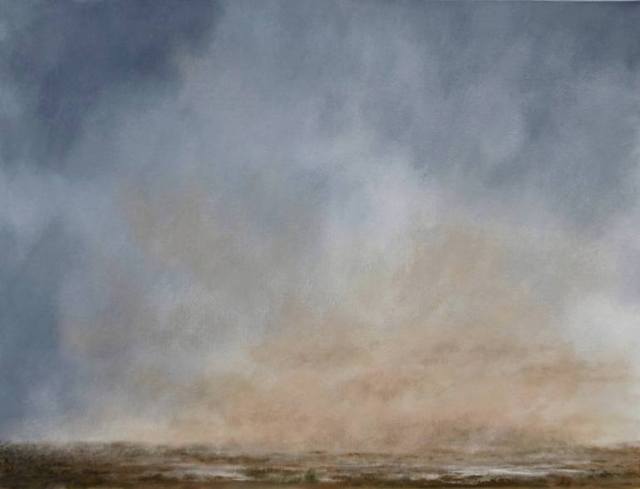
5982985-KTKJFJFX-7

— “Dust Haze” by Steffie Wallace

Alan Summers’ duskfall

duskfall…
the moon bumps
into a paperboat

Alan Summers (UK)
(Published previously in The Heron’s Nest vol. XXI no. 4, 2019)

It’s difficult sometimes to summarize a whole story into the shortest possible amount of words, but when someone does it, it becomes a masterpiece. This haiku is one of those masterpieces that shows why haiku is considered as one of the finest forms of creative writing.

‘Duskfall’ with an ellipsis gives the imagery of a silent yet sad evening where there are no activities. The word itself shows the ending of life when dusk has fallen and is followed by darkness. But, the ending of life can also mean a new beginning that is deeper in nature. It looks like the locus of control is shifting from the outer world to the inner one where subtle aspects of nature get active and replace worldly life.

In this haiku, I can see both outer and inner aspects of life where outer life activities gradually enter into the night and let night complete the rest of the story. The moon bumping into a paper boat shows how things delicately work out of realities, especially when they enter into the night where a moon gradually comes close to Earth and touches the temporary or fragile part of life, which is a paper boat in this case.

Hifsa Ashraf (Pakistan)

Mr. Summers is often experimental and inventive in his choice of words and phrasing. In this haiku, “duskfall” is one such example. It is not a recognized word by the majority of dictionaries but it is intuitively understood. It has a potent imagistic sense to it, with the motion of dusk falling either into place or dropping away. I prefer to think it is the former. As Hifsa pointed out, the ellipsis helps to create movement as well.

The next two lines provide a startling but calming image of the moon bumping into a paper boat. However, we can discern that the moon is not actually hitting the paper boat, but its reflection is.

A fun part of reading this haiku is figuring out the connection between the first line and the next two lines. The haiku seems to say: “the coming of dusk is like the moon’s reflection bumping into a paper boat.” A lot could be interpreted from this, but I feel that the image gives rise to mystery and magic.

What is also curious is that Mr. Summers plays with color with the two parts: dusk being black and the moon and paper boat being white. In a way, the coming of the blackness accentuates the white. I get a sense that the poem could be speaking of yin and yang: the sky and the earth, the night and day, are intertwined and balance each out.

Besides all this thought, witnessing the moment described would be joyous and spectacular, especially in the quiet of dusk. Like in any poetry, haiku have a layer of mental interpretation and a layer of mood/atmosphere. Understanding both can give us a comprehensive picture of a poem.

Another feeling I get from this haiku is the beauty of the “o” sounds in “moon,” “into,” and “paperboat.” These long syllables slow down the poem and create the scene of dusk potently.

It’s difficult to write an original haiku about the moon after 100s of years of tradition of doing so. Mr. Summers has done it through his unique juxtaposition, word choice, and imagery.

Nicholas Klacsanzky (USA)

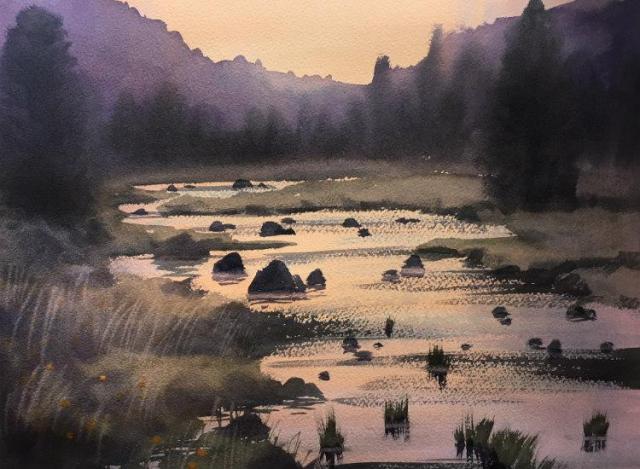
rhoucfpca7r01

– Painting by Gareth Naylor.

Alan Summers’ Riverlight

riverlight
the sewing pins
of rainfall

Alan Summers (UK)
Modern Haiku volume 48.3 Autumn 2017

Commenting on a master’s haiku is always a gamble, but fundamentally … fortuna adiuvat audaces. At first, I wondered what the light of the river was: the brightness of the river’s surface or the lights on its shore … then I realized that it didn’t really matter and that I didn’t have to rationalize too much. The image that reaches me is immediate: dark, a light that reflects on the river and on falling raindrops. The raindrops, if illuminated by an intense light in the dark, can highlight and hypnotically catalyze the eye. Enlightenment that reveals what would otherwise escape us. And here, they are clearly evident: these thin needles that sew the river with the sky, the darkness with darkness, in a single landscape.

This haiku, masterfully expressed in a few words, has enchanted someone like me who loves brevity very much. I also enjoy its harmonious fluidity, which cleverly breaks into a stark tone only in the second line. It harmonizes well with an Italian who is accustomed to the harmonious sounds of their own language. Chapeau.

Margherita Petriccione (Italy)

This is a very visual haiku where I can immediately see a scene of a night of rain ripples but one might ask how can there be light at night if it’s raining? To answer that, another immediate scene came to my mind, which was an urban or suburban area lit by city lights around the river. Manhattan or the other side Brooklyn is a perfect atmosphere for this haiku. This haiku also conjures images of rain needles during the day too.

Another question to ask is why would someone be in the rain to view such a sight? Perhaps an unexpected downpour occurred while someone was by the river or was inside a boat/ferry to capture this moment. There’s a lot going on in this seven-word haiku.

Although this haiku can be seen as a shasei “sketch of life” poem, one can note the juxtaposition between the fragment (riverlight) and the phrase (rain) and the space the reader has to fill in to see the ripples without it being told. Ex. If this haiku was written as:

riverlight
the sewing pins
of rainfall ripples

That to me would be too telling and boring and would definitely classify as shasei.

Another interesting thing about this haiku is that riverlight on the spellchecker sees it as a typo. I’m not sure if it was intended or not and I could not find a direct definition of the word but found that’s it’s a name of a property in London. Perhaps leaving the word not in caps made it personal to the author yet open to the reader. Either way, it doesn’t hurt the essence of this haiku, which to me is quite masterfully written.

Fractled (USA)

Riverlight, with its great mystery, is used as the starting note of this beautiful orchestral haiku, where the subtlety of life lies in the light that makes no difference to the flowing water but to the falling rain. It’s a deep expression of having everything but still nothing in life. The riverlight may be soft, subtle, mysterious, and vague for the rhythmic movement of water but it has a great impact on the things that are intangible.

Sewing pins not only help in setting clothes but also fixing mending issues by providing adherence. The analogy of sewing pins with rainfall makes this haiku poignant and profound. Again, the riverlight gives a great colour to the rain but metaphorically doesn’t change the vagueness and purposeless life of it.

In life, we may experience a lot of things that look different when uncovered or unveiled by rational thinking. We may find them piercing our life and wish to not face them or encounter them again. Glimpses of adversity in life may be painful but it brings ease with them.

The synthesis of sight, touch, and feel in this haiku makes it more profound and mystical in nature, where the light turns rain into painful experiences or trials of life that eventually lead to eternal peace.

Hifsa Ashraf (Pakistan)

One of the great qualities of Alan’s work is that it is always unique and often imaginative/abstract. However, this imagination is grounded in the perception of reality. “riverlight” is a good example of this. The invented word in the first line and the image of rainfall being like sewing pins can be easily understood. In some instances, rain does appear to be sharp and could be mistaken for sewing pins.

Though sewing pins can be seen as something sharp, they can also be perceived as something that mends the broken. This may be why “riverlight” is used: the rain has merged the river and sunlight/moonlight. Also, Alan might be saying that riverlight is akin to the magic of rain appearing as sewing pins.

In terms of sound, the “i” jumps out in almost every word in this haiku. They are in the shape of sharp rain and even have a sonic comparison to them. I also like the format, with the second line setting up a surprise in the third line.

Overall, I believe this poem is unique, fascinating, and economically written.

Nicholas Klacsanzky (USA)

Did you enjoy the haiku and commentary? If so, please leave us a comment. 

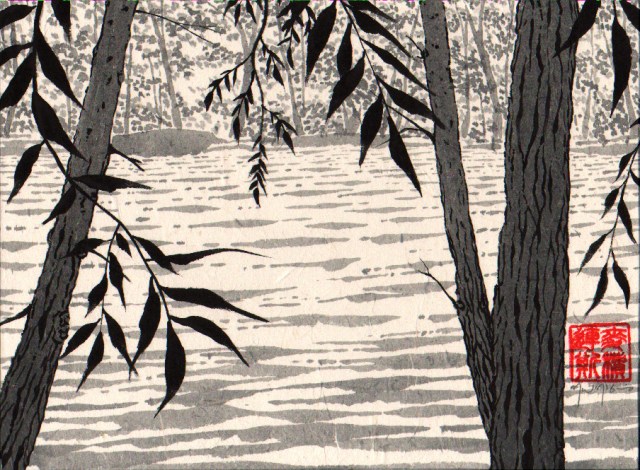
willows-boise-river-2

– Sumi-e painting by Mark W. McGinnis