Haiku by Pat Davis, Anthony Lusardi, and Martina Matijević

beach stone
some of the worry
already gone

Pat Davis (USA)
The Heron’s Nest, #44, December 2024

Commentary from Jacob D. Salzer: 

I appreciate how the image of a beach stone can be a metaphor for letting go. In this haiku, we don’t know what the poet is worried about, but the beach is a place where worries seem to disappear and fade into the background. I can feel the weight of the beach stone and hear the pulse of ocean waves. Along these lines, the beach and the vast ocean can create a relaxing atmosphere where we can embrace the space between thoughts. At the same time, the ocean can allow us to see “the big picture” where our worries can be seen from a deeper and different perspective. I think this is very important to do because we can step outside our small sense of ego and see our place on Earth and within the larger cosmos. I also appreciate how this haiku is relatable from reader to reader. It seems most people have their own worries that come and go. I deeply appreciate how the Earth herself can calm the mind and help us reflect. This haiku shows us this power. 

In short, this haiku shows the inherent healing power of Nature without overly explaining it. It includes a balance between concrete imagery and mystery. While this haiku is personal, it is also relatable to many readers with different backgrounds and circumstances. In the end, I think we can all benefit from learning how to let go. A powerful haiku.

dry summer
a spider web full                   
of fireweed seeds

Anthony Lusardi (USA)
Frogpond, 48:1, winter 2025

Commentary from Hifsa Ashraf:

The haiku speaks for itself in terms of its theme and imagery. Climate change is a topic that should be highlighted time and again through any platform or medium as a reminder to the world that it is a serious issue.
 
The kigo in the first line ‘dry summer’ gives a vivid image of both time and season. I see it as if there is a drought with a drastic impact on nature. It seems the poet talks about a rainless time when the rain is needed the most. But, it still doesn’t give us a clue of the time period i.e. is it rainless for long or short? But, I like the way the poet uses an aesthetic sense to observe the beauty of nature even in hard times. 

A spider web can represent mystery, confusion, hopelessness, or abandonment where probably no access is given to any being. I wonder if the spider web is inside or outside a building, in an open field, or in a garden/farm, etc. There is no such clue of the location which makes this haiku open for interpretation. 

Fireweed seeds in the last line add to the interest in this haiku as seeds may stick to the spider web as a result of pollination, wind, storm, or any other source. But, in any case, these seeds have no chance to germinate as they may not be on the ground or in a favourable condition. At first look, the spider web full of fireweed seeds may sound like a period of hopelessness, drought, or lifelessness. However, fireweed can symbolize rebirth, resilience, and hope. But, the word ‘full’ instead of ‘stuck’ or ‘cling’ gives me some hope that maybe, one day these seeds may survive and fall on the ground or a suitable place to grow. The article ‘a’ and the word ‘full’ make it simple to interpret without digging more into the various aspects of this imagery. So, I see both hopelessness and hopefulness in this haiku. I see the resilience of nature in extreme or unfavourable seasons. I see life in a lifeless situation. I see the impact of climate change on nature and the way nature responds to it by trying to survive and preserve its elements. 

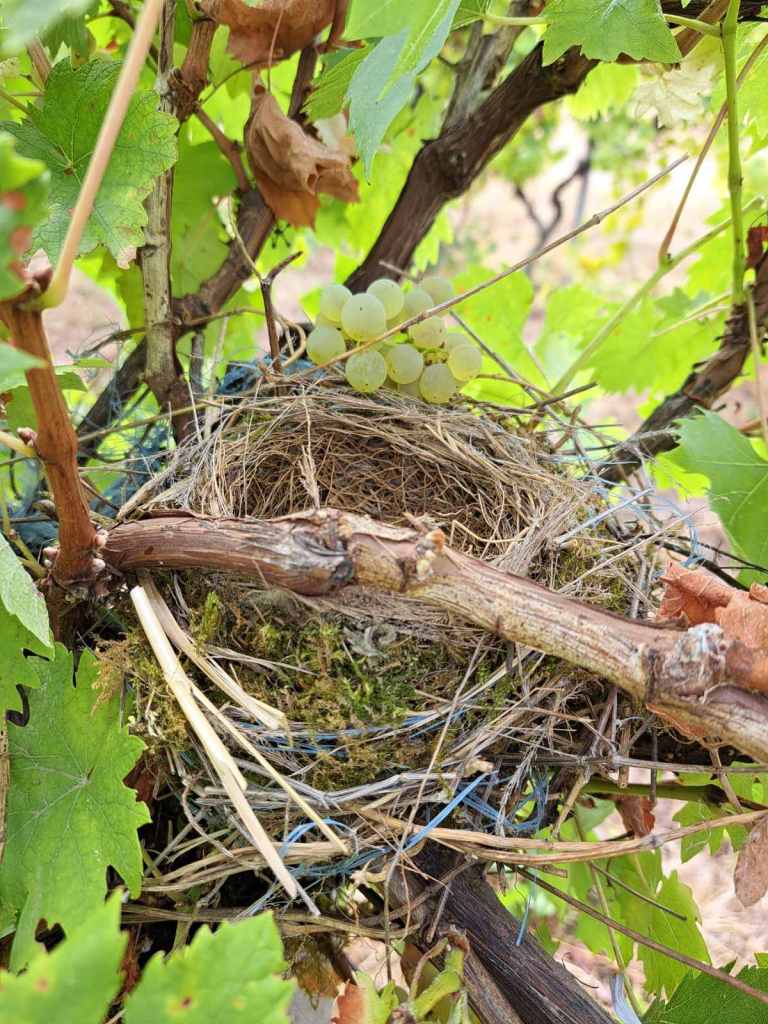
grandma’s old vineyard 
amid dense branches 
an abandoned chick

Martina Matijević (Croatia)

Commentary from Nicholas Klacsanzky:

The contrast between the chick and the old vineyard is striking. The word “abandoned,” though, can pertain to both the vineyard and the chick. From the first line, I assume the poet’s grandma has passed away and has essentially been abandoned. Looking at the second line, it is a pivot which connects to the first and third lines. If the first two lines are read as one whole, it could be saying that the grandma’s old vineyard is “hiding” or obscured amid dense branches. If the last two lines are read as one part, the chick appears amidst the branches. It’s always a plus when you can read a haiku in multiple ways.

A kigo or seasonal reference is not quite apparent. However, the mood of the haiku is at once bleak and hopeful. There is sadness in the deserted nature of the vineyard but an optimism in the new life that has inhabited a derelict space. It feels like the baby bird is a reincarnation of the grandma or a continuation of her life.

Looking at the format, it is interesting that each line is an equal five syllables each. I am not usually a syllable counter in haiku, but I noticed how each line was about the same length. Commonly, the haiku rhythm in English is a short line, a long line, and a short line. There is nothing wrong with changing up that rhythm, though. Each haiku is organic and requires a different pacing.

Sonically, the strongest letter in this haiku is perhaps “d.” In my opinion, it provides weight to the poem and the scene itself. The other letter that interests me in this haiku is “b,” which also creates accents of strength or gravity

To wrap up, this haiku connects the poet’s experience to the animal/natural world seamlessly. The haiku also features a fine sense of sound, a unique rhythm, and multilayered imagery.

Photo credit: Martina Matijević

Haiku by Anthony Lusardi, Douglas J. Lanzo, and Minh-Triêt Pham 

soft orange leaves—
how weightless she feels
in my arms

Anthony Lusardi (USA)
Dedicated to Remi June
Presence, issue #79, July 2024

Commentary from Hifsa Ashraf:

The open line allows me to pause for a while as it reflects a unique yet subtle side of autumn. Soft orange leaves make me think of not only the texture of leaves but also the time as well which raises some questions i.e. are the leaves soft because they are wet either due to dewdrops or raindrops? Are they on the ground or half-buried? Are they still hanging from the tree or stuck in the branches? What orange colour is it? The em dash makes the leaves significant in this poem but there is still a mystery about the details. 

The second line is a shift from nature to personal sentiments, where the poet creates a unique bond between the transformation of nature and personal thoughts and feelings. ‘How weightless she feels’ could reflect weakness, withdrawal, hopelessness, prolonged illness, near-death experiences, or a lack of interest. It seems the person is not feeling well and is ready to depart like soft orange leaves that are open to be annihilated or buried. The word ‘feels’ perhaps alludes to the poet not being sure about their feelings or the real state of mind of the person. The poet is sharing emotions or anticipating the future of this relationship that may be guessed from nature where orange leaves are destined to die. It is sheer hopelessness and readiness to accept the bitter reality of detachment and departure of a loved one. 

The last line shows the significance of the poet’s association with the person being mentioned where he tries to be protective and supportive, providing comfort to the person at this stage. 

This haiku is a beautiful example of a strong and subtle bond between nature and humanity. I liked the way the poet used a specific colour of leaf to project his thoughts and feelings and also left room for others to relate their life experiences with such examples from nature. 

call to prayers
the vastness
of domed desert

Douglas J. Lanzo (USA)

Commentary from Jacob D. Salzer:

An interesting juxtaposition between sound and silence, and between the limited body & mind and the vast desert. This haiku could perhaps have a kind of haunting quality. How many of our prayers are answered? Perhaps the deep silence of meditation is the highest form of prayer. From one editor’s view, my only suggestion would be to consider adding “a” before “domed.” An interesting haiku that leads us into contemplation and a deeper silence.

frosty dawn —
the metallic taste
of her lipstick

Minh-Triêt Pham (France)

Commentary from Nicholas Klacsanzky:

The first line sets the kigo in either winter or late autumn. Frost commonly looks lovely at dawn, with the sun slightly touching it and making it glitter in soft light. Yet, it can also be a reminder of a harsh reality.

This dual tone in the first line is juxtaposed with the irony of lipstick having a metallic taste. Though the last two lines are romantically inclined, there is also a touch of alarm. A lipstick with a metallic taste could indicate the presence of metal-based pigments that might not be healthy. The metallic taste could also be a sign of myriad medical issues, such as diabetes, liver issues, cancer, and more. So, the juxtaposition could be saying that a frosty dawn could be the same or similar to kissing your partner and having a metallic taste to something usually regarded as romantic. All this makes for an intriguing toriawase.

Looking at the more technical side of this haiku, the poet uses a dash as an approximation of a kireji. For me, it solidifies the seriousness and starkness of the moment. The euphony of this haiku is also important, in my opinion, with the letter “t” making a crackling sound and the letter “l” projecting strength. The haiku is also written in a rhythm corresponding to traditional Japanese standards with its short/long/short structure. Finally, the simplicity of language and brevity displayed matches the tradition of the genre.

Overall, I enjoy how the poet takes two “ordinary” events and compares them to create a “third part” of the haiku, where our imagination conjures myriad meanings that are personal yet connected to nature.

Royalty-free art without artist name


Haiku by Michael Shoemaker, Anthony Lusardi, and Richard L. Matta

morning campfire smoke
curls and rises above pines
meadowlark’s sing-song

Michael Shoemaker (USA)
Under the Bashō, June 24, 2024

Commentary from Hifsa Ashraf:

The first line of this 5/7/5 haiku tells us the time and space where one can directly imagine the whole scene before going into the details. A morning campfire can be used for warming the ambience, a get-together, cooking, etc. In any case, a campfire usually is a sign of lively activities. Adding smoke makes this haiku a bit more profound and mystical. Is it just smoke and no fire? Does it happen before or after the fire? 

The second line is more focused on the details of the smoke, curling and rising above the pines. This leaves our imagination to run wild and to think of the shape, structure, intensity, and smell of smoke. The second line could be about how smoke overshadows nature. It may be a sign of air pollution adding toxicity to the pines, which is a symbol of purity.

The meadowlark’s sing-song could be a sign of alertness depending on the pitch. For me, it may be more like a complaint or a reaction to smoke/pollution—probably in the form of a sad melody we commonly ignore. The other aspect to consider is how nature responds to our acts of toxicity with sweet melodies. The meadowlark’s song demonstrates resistance and determination in the form of music and voice.

This haiku, in its simplicity, describes a story of our actions to spread pollution and toxicants and nature’s response to it.

gloaming . . .
a spider clings to                
her egg sac

Anthony Lusardi (USA)
tsuri-doro, issue #19, Jan/Feb 2024

Commentary from Jacob D. Salzer

“Gloaming” means twilight or dusk, but it can also mean sullenness and melancholy. I appreciate how this haiku shows a mother’s love and protection with the verb “clings” and the egg sac. The mother spider is protecting her eggs from something or perhaps many things. We don’t know what dangers might be present for the spider and her eggs, which opens the door to our imagination. Dusk or twilight effectively sets the mood and atmosphere of the poem, as light fades into darkness. With that in mind, this haiku might have a somewhat haunting atmosphere as what is visible becomes invisible, yet there is still enough light for the poet to capture this moment. As the night deepens, we enter the Great Mystery. In short, this is an effective haiku that gives us a glimpse of a mother’s love for her soon-to-be children, which can apply to other creatures, insects, and mammals as well.

pinewood derby
still missing the weight 
of dad’s touch

Richard L. Matta (USA)
1st Place Senryu, Kaji Aso Studio, 35th International Haiku Contest 2024

Commentary from Nicholas Klacsanzky:

This senryu tapped into my memories, as I participated in pinewood derbies when I was a young lad with my father. More than that, this senryu uses the word “weight” effectively to have a double meaning of the physical weight of the cars and the emotional/spiritual weight of a father’s presence. “Missing” could imply that the poet’s father has either passed away or is out of contact—leaving that justly up to the reader to interpret.

I also enjoyed the sound in this senryu, with the letters “o” and “w” prominently featured. The instances of “o” contribute to the senryu being slowed down and savored, whereas “w” manifests an airy feeling to the poem. In my opinion, both of these attributes complement the context in which the senryu is written. Lastly, the senryu is efficiently written with only nine words, simple language, and excellent pacing in the line breaks. It is clear why this senryu won an award: it not only resonates with readers effortlessly but also demonstrates a keen understanding of the technical aspects of senryu.

Illustration by Louis Agassiz Fuertes of an Eastern Meadowlark (Sturnella magna), from The Burgess Bird Book for Children (1919)