Haiku and haibun by Gareth Nurden, Sathya Venkatesh, and Anthony Lusardi

civil twilight
around the old parish
the halogen glow of snow

Gareth Nurden (Wales)

Commentary by Nicholas Klacsanzky:

What initially got me interested in this haiku was the first line, “civil twilight.” I had to look it up, and found out that it means “the brightest of the three twilight phases, occurring when the sun is between the horizon and 6° below the horizon. It provides enough natural light for most outdoor activities, often making artificial lighting unnecessary. It begins in the morning before sunrise and ends in the evening after sunset” (National Weather Service). I never saw this kigo being used, and I was impressed by its sense of sound. The running of “i” and “l” through the line makes it sing.

The second line further sets the scene and serves as a pivot between the first and third lines. The lack of punctuation helps this pivot succeed. The word “parish” is wonderful in its specificity, while “old” adds to the “l” sound in the first line and creates a contrast of times.

Though the first line introduced the time of day, the last line features the season: winter. This supplies a direct comparison between the state of the parish and the stark season it now inhabits. The word “halogen” is a brilliant touch, not just from an imagistic standpoint but also from a mood perspective. The radioactive glow of halogen is reminiscent of war, industry, science, and more. However, the take that stuck with me is the relation to the aftermath of war. The old parish is most likely in ruin (physically or metaphorically), and the halogen of snow magnifies this fact. The snow and twilight did not intend to illustrate the old parish’s wrecked state, but it did in the poet’s eyes, and maybe in the eyes of others around. On another note, the third line keeps with “l” and “o” sounds that blend musically with the second line, and some of the first line.

The relationship between civil twilight and the halogen glow of snow creates toriawase, or a skillful combination of different elements. Though both of these parts are of nature, the old parish brings in a human and spiritual element. This adds another layer to the toriawase.

This haiku is understated and unfolds with meaning with each line and word. It brings in time, seasons, and the connection between human architecture and spirituality with the natural world. It is a contemplative work that delivers through excellent diction, imagery, and phrasing.

red alert
the umbrella seller sits back
to enjoy his tea


Sathya Venkatesh (India)
published in haikuKATHA, issue #44, 2025

Commentary by Hifsa Ashraf:

The haiku presents a striking shift in mood, moving from danger or urgency to quiet ease. The opening line, “red alert,” signals danger or impending disruption, immediately creating tension and uncertainty. Without punctuation, it allows readers to imagine various interpretations, the most common ones maybe a storm, heavy rain, or another natural calamity.

The second line introduces an umbrella seller that subtly hinting at the nature of the alert. Umbrellas suggest rain or rain related disasters. Yet instead of reacting with alarm, the seller seems to be relaxed, creating a contrast between the urgency and the utter relaxation.

In the final line, “to enjoy his tea,” there is a quiet sense of ease, even a hint of enjoyment. The umbrella seller appears untroubled, suggesting that what brings concern to some may offer opportunity or simply remain an ordinary moment to others.

The overall imagery can be read as revealing a colder, more self-interested side of human nature, where one benefits from circumstances that may trouble many. At the same time, the haiku remains open to multiple interpretations and invites the reader to consider both its subtle implications and its silences.

A haibun:

while reading ryokan’s poetry

i thought about the annual christmas parade in boonton, new jersey. held right after black friday on main street with fire trucks and floats for every local business. the high school marching band, the politicians, the VFWs, the church choirs, the boy and girl scouts and all the neighbors lining up and down the road, taking selfies and tossing confetti with the first falling snow. and if i was his pupil, i would try to convince ryokan to join me in the festivities . . . yet i would imagine, he would convince me to join him near the rockaway river, right near its small falls, far away from all activities and ask me to just listen.

                        late autumn moon;
                        eventually the town sleeps
                        but never the river

Anthony Lusardi (USA)
first published in failed haiku, issue #111, September 2025

Commentary by Jacob D. Salzer

This is an intriguing haibun where modern culture collides with Nature. The parade and modern culture also contrast with the monastic life of a Japanese poet, calligrapher, and Zen Buddhist priest, Ryōkan, who lived in the 18th and 19th centuries. The annual Christmas parade is loud and full of bright colors, sounds, and music, flashing phone cameras, confetti, etc. The parade is happening after Black Friday, when people buy things that day at discounted prices, but it can also involve physical violence and be dangerous. This kind of stimulation at the parade and during Black Friday can easily activate the human sympathetic nervous system (fight, flight, or freeze).

By contrast, the life of Ryōkan is strongly aligned with the beauty of Nature, without loud sounds or other excessive multisensory stimulation. The atmosphere of his life in Nature easily activates our parasympathetic nervous system (rest and digest), where we can relax, while being fully alert and present.

In this haibun, a powerful example of the collision between two worlds is “tossing confetti with the first falling snow.” With Ryōkan’s life and perspective in mind, perhaps the poet is ultimately starting to see modern culture as a kind of distraction that has established traditions, but are ultimately short-lived, while our true home is found in Nature and a quiet mind.

According to Britannica: “Ryōkan (born 1758, Izumozaki, Japan—died Feb. 18, 1831, Echigo province) was a Zen Buddhist priest of the late Tokugawa period (1603–1867) who was renowned as a poet and calligrapher. The eldest son of a village headman, he became a Buddhist priest at about the age of 17 under the religious name of Taigu Ryōkan. When he was 21 he met an itinerant monk, Kokusen, and followed him to his temple, Entsū-ji, at Tamashima, Bitchū province. He followed a life of monastic discipline there for 12 years. After Kokusen’s death he traveled to various parts of Japan as a mendicant priest. In old age he returned to his native Echigo province, where he studied the Man’yōshū and ancient calligraphy. He developed a strong master-pupil relationship with a young nun, Teishin, who after his death compiled Hachisu no tsuyu (1835; “Dew on the Lotus”), a collection of his haiku and waka poems. He also executed many pieces of calligraphy that are esteemed for their elegant beauty.”

Interestingly, there is no capitalization found in this haibun, aside from VFW’s (which I learned means Veterans of Foreign Wars, which is an organization representing U.S. veterans who have served in overseas conflicts). The lowercase words in this haibun seem to create a tone of humility.

In short, this is an intriguing haibun that offers social commentary on modern culture and the importance of being in Nature. It also provides a small window into the life of Ryōkan and Zen Buddhism. Despite our technological advances, cities will rise and fall with time, but Nature will remain. A powerful haibun.

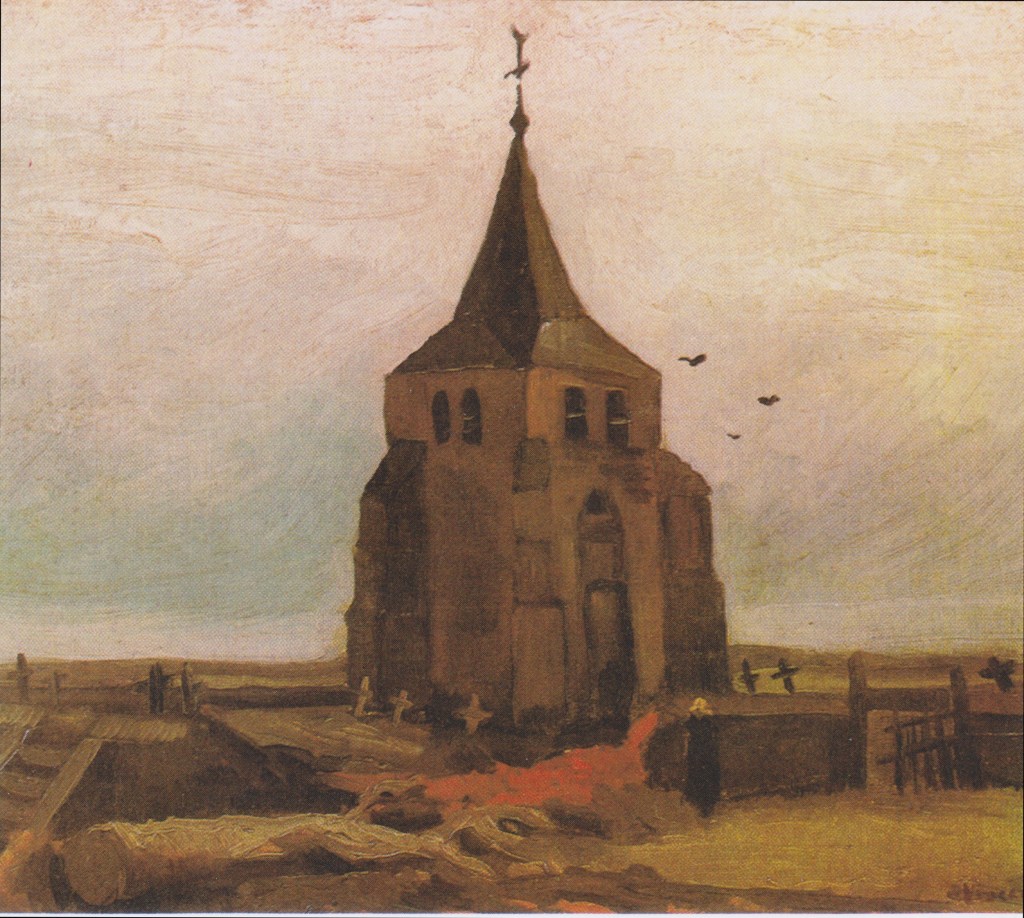
Old Church Tower at Nuenen, 1884, Vincent van Gogh

Haiku by Anthony Lusardi, Cezar Ciobîcă, and Jacek Margolak

weather forecast
neighbors discussing             
which tree might fall where

Anthony Lusardi (USA)
previously in Hedgerow, issue #151, 2025

Commentary by Jacob D. Salzer

I appreciate how down-to-earth this haiku is. This haiku features a moment where Nature and civilization collide. A fallen tree can, indeed, cause a lot of damage to houses and cars. Fallen trees can result in expensive home repairs and have, unfortunately, taken some people’s lives. On the other hand, it is true that the very construction of our neighborhoods and houses has caused a lot of environmental harm. I appreciate how this haiku encourages us to deeply contemplate how we truly want to live and encourages us to think deeply about our relationship with the Earth.

This haiku also makes me think of ways that we can build houses and buildings that protect us from storms and natural disasters. I think of earthquake-resistant buildings found in Japan, where earthquakes are common. Most houses, apartments, and duplexes are at least partially made from trees. Even where I live, I recently called the public utility company to request them to trim a tree back due to its obstructing a power line to the house.

The first line clearly alludes to a storm approaching, likely a windstorm. I have always been fascinated by the phenomenon of wind: how something invisible can be so powerful.

Aside from the philosophical conversation around Nature, storms, and architecture, I appreciate that there is community and conversation in this haiku. It demonstrates how an oncoming storm can bring people together, regardless of our many differences.

In summary, this is a down-to-earth and relatable haiku that focuses on storms, Nature, civilization, community, and the architecture of houses and neighborhoods. Perhaps most of all, I appreciate how this haiku encourages deep and meaningful conversation.

train from Ukraine
her nesting dolls
full of scars


Cezar Ciobîcă (Romania)
previously in Mayfly #78, 2025

Commentary by Nicholas Klacsanzky:

As someone who has lived in Ukraine for six years and is interested in Ukrainian culture, this haiku stood out to me. I also thought the mention of nesting dolls or “matryoshkas” was a stark cultural and political allusion. The poet doesn’t explain what he thinks about the nesting doll or its significance but allows the reader come to their own conclusion.

Though nesting dolls, or “matryoshkas,” are commonly associated with Russia and prominently featured in this haiku in a political sense, these dolls have been around in China since the Song Dynasty, which dates back to around 1000 AD. However, the Russian variant became popular in recent history (late 1800s) and has been a symbol of being Russian ever since. While in Ukraine, I saw murals of these dolls being shot at or brutalized in other ways. Attacking matryoshka dolls in Ukraine became a metaphor for resistance since the occupation of Crimea in 2014.

In association with this haiku, the image of the matryoshka doll is complex. As a reader, I want to sympathize with the toy and artwork, while at the same time feel a level of disgust at the russification of Ukrainian culture, with the Ukrainian girl or woman having a nesting doll by way of cultural occupation, oppression, and assimilation. It seems the nesting doll has gone through war too, despite being Russian itself on Ukrainian land. All of this can be summed up in the word “trauma.”

The first line could suggest that the person mentioned in the haiku is leaving Ukraine because of the current war. She has brought the nesting dolls with her, possibly as a keepsake, representing her family’s generations and the continuity of life. These values are more key in times of distress, and the person in the haiku is maybe holding onto the nesting dolls as a sign of hope. But, the third line throws in a twist, allowing the reader to ponder the context of “scars.”

Structurally, the poem mirrors the nesting motif. Each line gets smaller and smaller, yet expanding in meaning. With the absence of verbs (“nesting” acts as a noun, a gerund), the scene feels suspended. That tension between movement and stasis deepens the poignancy. The mix of hard (n and r) and soft (l and 0) sounds adds to the dual nature of the imagery.

Overall, the haiku succeeds through understatement. It doesn’t mention references to war, violence, or grief. Instead, it trusts the reader to recognize how a small, culturally resonant object can hold the weight of a nation’s wounds and oppression. A single object can carry a great mix of emotions and histories, and this haiku illustrates this with grace.

scraping fish
a few scales fall back
into the river


Jacek Margolak (Poland)

Commentary by Hifsa Ashraf:

I was deeply moved by this haiku because of its vivid imagery and profound meaning. The opening line, “scraping fish,” is a bit scary. It’s almost dreadful to imagine such a situation.  The word “scraping” is harsh and brutal as it evokes the physical act of removing scales and fins, and with it, the cruelty embedded deep down. It is not a pleasant image, and perhaps that discomfort is unavoidable, keeping the sensitivity of the image.  

Scraping a fish is part of preparing food, a very ordinary act of survival within the food chain. Yet psychologically, it may reflect the cold and ruthless side of human behavior. The fish’s scales and fins, which once served as protection against harsh water currents, are stripped away. This shows how life can fall into complete disarray when there is no one around to protect us physically and emotionally.

The second line, “a few scales fall back,” introduces a subtle movement within an otherwise quiet setting. The falling scales create a gentle motion, almost delicate in contrast to the violence of scraping. Their return to the water suggests going back to the origin. Yet this return is insignificant as the poet deliberately mentions ‘a few scales’. It makes little difference in the larger ecosystem, emphasizing how easily things disappear once annihilated. At the same time, the drifting scales blending into the river may suggest that nothing is completely erased; some traces remain behind as an example for the rest.  

The final line, “into the river,” completes the image with resonance and depth. Besides all harshness and cruelty, something returns to where it once belonged. Whether it’s a residue or restoration, the act shows the cyclical nature of existence. Life feeds on life. There are no moral safeguards within this natural order, only transience. The haiku quietly reflects this interplay between survival, loss, and return, leaving the readers to feel it deeply.

The lack of punctuation deepens the silence the poem carries, naturally slowing the reader and opening space for contemplation on life’s transience.

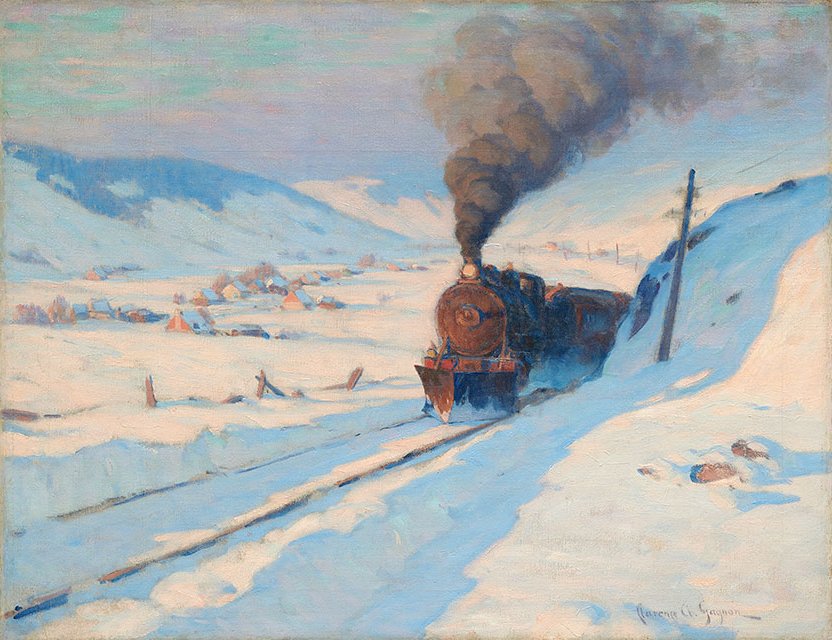
Le train en hiver by Clarence Gagnon, c. 1913-14, oil on canvas

Haiku by Martina Matijević, Anthony Lusardi, and Paul Callus

dusty teddy bear   
brushing off   
my childhood 


Martina Matijević (Croatia)  

Commentary from Hifsa Ashraf:

This haiku evokes a tender yet bittersweet moment of reconnection with the past. The “dusty teddy bear” serves as a symbol of childhood, once cherished, now forgotten, or stored away. Dust here is not just physical but metaphorical, suggesting the passage of time and emotional distance where one may have fading memories of childhood.

The middle line, “brushing off,” is beautifully ambiguous, yet letting the person find some clarity into their childhood. It implies a physical act where cleaning the toy hints at revisiting or even confronting long-buried memories. There’s a subtle emotional movement in this line: care, nostalgia, and perhaps a trace of reluctance. This is how one reverts back to their past life with a little bit of effort and time.

The final line, “my childhood,” brings a sense of closure. The teddy bear becomes a gateway to personal history, and the speaker, by brushing it off, also dusts off a part of themselves. The haiku captures a universal experience, how a small object can unlock an entire era of feeling. It’s delicate, reflective, and deeply human.

Lastly, the sound of consonants b and d in this haiku strikes deep yet strong feelings that might have brought back some vivid memories of childhood.

blind date
a wildflower                           
my app can’t identify

Anthony Lusardi (USA)
Prune Juice, August issue, 2025

Commentary from Nicholas Klacsanzky:

The senryu opens with “blind date,” situating the poem in the modern social world. It’s also a circumstance that many of us can identify with. Usually, “blind date” senryu have elements of humor. So, as a reader, I immediately expected a comical twist.

The second line introduces “a wildflower”—a counterpoint to the digital world referred to in the third line. The wildflower symbolizes something growing outside expected boundaries and a sense of freedom. In traditional haiku aesthetics, a wildflower often embodies sabi (rustic beauty), yet here in this senryu, it is employed in a playful way where the poet’s date is implied to be a “wildflower,” and notes how romance or love is often indescribable.

The closing line captures the tension between technology’s attempt to categorize the world and the irreducible mystery of human connection. There’s an irony in our dependence on apps to “know” what’s what—even as what truly matters (the person on the blind date) resists such identification.

Overall, the humor is understated—a hallmark of senryu—but carries emotional resonance. Beneath the joke about the app’s failure is a quiet longing for authenticity, for something not optimized or labeled.

Checking in on the sense of sound, the w and f sounds give both emphasis and a wispy feeling to the poem. With the format, the last line is long, yet it is not an issue since not only is this a senryu (which doesn’t focus on format much), but the line breaks seem natural.

Ultimately, I chose to comment on this senryu because of its mixing of technology, romance, and playful use of nature. I was happy to see it appear in the prestigious journal, Prune Juice.

monsoon rain
over the paddy fields
a flight of dragonflies


Paul Callus (Malta)

Commentary from Jacob D. Salzer:

This is an interesting haiku that shows the after-effects of a monsoon in the paddy fields where rice is grown. According to the National Environmental Satellite, Data, and Information Service: “A monsoon is a shift in winds that often causes a very rainy season or a very dry season. Although monsoons are usually associated with parts of Asia, they can happen in many tropical and subtropical regions – including several locations in the United States. Monsoons are caused by a change in the direction of the wind that happens when the seasons change. In fact, even the word monsoon comes from the Arabic word mausim, which means ‘season.’ At the beginning of summer, the land warms up faster than bodies of water. Monsoon winds always blow from cold to warm. In the summer, warm air rising off the land creates conditions that reverse the direction of the wind.”

In this haiku, the extreme weather of heavy monsoon rains is contrasted with the silent and delicate flight of dragonflies. Traditionally, dragonflies are an autumn kigo (seasonal reference). The flight of dragonflies could symbolize a human migration, i.e., perhaps the farmers in the paddy fields are also temporarily migrating due to the heavy rains, as summer fades into autumn.

On the other hand, according to the World Population Review: “The most common method of cultivating rice involves flooding the field, a practice typically carried out in what’s known as a rice paddy. This helps water and protect the plant from vermin and disease.” Therefore, the monsoon rains can help cultivate rice, though it’s more difficult to work in the paddy fields during the downpour.

Despite the potential melancholy interpretation relating to the autumn kigo, I can’t help but feel hope, courage, and resilience in this haiku: even in the heavy monsoon rains, the dragonflies are flying together. I think the plural form of “dragonflies” is special because I normally only see one dragonfly at any given moment. While there are likely two dragonflies in this haiku, it could also be enjoyable to imagine several dragonflies flying together.

In short, this is a significant haiku that shows resilience, a seasonal shift, and offers a portal into the lives of farmers who work tirelessly in the paddy fields to grow and cultivate rice. More interesting facts about rice can be found on the World Population Review website.

Painting by Ernest Barbaric