
Results for the Inaugural George Klacsanzky Memorial Haiku Contest

The inaugural George Klacsanzky Memorial Haiku Contest received submissions from 491 poets, totaling 1,393 haiku. This is a great honor for Haiku Commentary and for the memory of haiku pioneer George Klacsanzky. The judge of the contest, Michael Dylan Welch, was kind enough to write commentary on the winning poems. The full results are shown below.

First Place

abandoned cemetery
the dust in me
whispers a prayer

— Denisa Hanšutová, Slovakia

We are made from dust and to dust we shall return. This poem confronts us with that reality in its allusion to the book of Genesis, reminding us of our place in the cycle of life. This cemetery is abandoned, so even the cemetery is returning to dust. Yet the poet is visiting, either by chance, out of curiosity, or intentionally to see the grave of a loved one. In a moment of introspection, the poet’s awareness of mortality prompts a prayer of hope or desire, whispered in quietness, as if not to disturb the scene’s moving tranquility. Saint Augustine said, “It is no advantage to be near the light if the eyes are closed.” Perhaps visiting this cemetery has opened the poet’s eyes.

Second Place

nettle flowers—
the paramedics stop
defibrillating

— Lucas Weissenborn, Norway

It’s easy to suspect that these nettles, despite their flowers, are stinging nettles. As a result, this poem’s first line immediately introduces tension. Yet we could hardly predict where its last two lines will take us, which is a sad moment marking the end of a life. We can picture these flowers at the side of a road, noticed after an accident and the arrival of paramedics. The nettles echo that metaphorical sting. Most likely it is summer, the peak blooming time for many nettles. And although summer is usually the peak of life, here a life has ended, and we can engage with that moment of psychological realization that no more can be done to save this life.

Third Place

piecing together
a torn photograph—
winter stars

— Alvin B. Cruz, Philippines

Loss is confronted with a desire to heal, to mend, surely to piece together more than just a photograph. The stars may be particularly clear in winter, but their light is also cold. The image of the last line carries a coldness, yes, but also the idea of wishing upon a star, of desiring a return to the way things once were. A melancholy sadness pervades this poem, yet not without a touch of hope. I appreciate this poem’s deft pairing of unstated emotion with tactility.


Honorable Mentions
(in no particular order)

moonlight
the stillness
of a wrecking ball

— Ravi Kiran, India

It’s not often that we see a wrecking ball. It’s a tool of destruction, yet here it’s an object of fleeting beauty, seen at night when it’s not being employed for its intended purpose. The poet finds a new purpose for the wrecking ball and records that moment of attention for our appreciation.

glacial erratic—
a refugee traces
his lifeline

— Meera Rehm, UK

A refugee will know his or her origins and never forget them. Where does a glacial erratic come from? In some cases, the answer might be as simple as somewhere farther up the mountain, near a still-active glacier. But in many parts of North America and elsewhere, glacial erratics survive far from mountains, left over from the ice age where their origin is often much more of a mystery. Here the refugee contemplates not just the past but also the future.

summer midnight—
the traffic light changes
for no one

— Punyasloka Mohapatra, India

Perhaps we’ve been on a late-night walk and have seen traffic lights change when no cars are on the road. The irony of this poem is that the light changed for the poet, the observer, if not for a passing vehicle. Haiku poets are noticers, appreciators. Billy Collins has said that haiku are poems of existential gratitude, and we feel that gratitude in this poem.

summer fair
the merry-go-round
of glances

— Herb Tate, UK

It’s easy to imagine a parent seeing his or her child on this merry-go-round, perhaps a carousel. Every trip around brings a fresh glance, a fresh meeting of the eyes, a fresh sharing of delight. Surely the watcher appreciates the gentle joy of the person on the merry-go-round—its purpose is indeed merriment, and the watcher shares that joy vicariously.

returning soldier—
the kids ask their dad
for souvenirs

— Annette Akkerman, Netherlands

This poem points to the innocence of children, who seem to have no idea what war is, or what their dad’s job truly is. The question is, does the father explain, or let the kids think that his travel is more like a vacation? We can be grateful that the father has indeed returned, even if the children are not aware of how grateful they should be for that, their true gift on that occasion.

starless sky
opening and shutting
the same cupboard

— Christine L. Villa, USA

It’s late at night, and the poet has wandered into the kitchen, perhaps forgetting why, or changing her mind. The sky is starless outside the window, and perhaps that dullness has clouded the poet’s mind in this moment of aimlessness. This “same” cupboard may have been opened just a moment earlier, adding more depth to this moment of distractedness, and we can only wonder why.

stargazing
the baby’s cry
brings me back to earth

— Rich Schilling, USA

The stars here are so absorbing that the poet has momentarily forgotten their child. The reality of being a parent isn’t without the optimism of gazing at stars, though, and every parent will wish for the stars for their newborn baby. Up may seem to be countered with down in this poem, beauty tempered with practicality, yet those stars will surely be what this family reaches for in the years ahead.

—

Thank you to all participants of the inaugural George Klacsanzky Memorial Haiku Contest for making it a great success. We hope all of you participate next year in May. Cheers!
Haiku by Quamrul Hassan, Tom Bierovic, and Martina Matijević

all her feelings for him coming back first snow

— Quamrul Hassan (USA) 
published in the Wales Haiku Journal, Winter ’25/26 edition

Commentary by Jacob D. Salzer:

An interesting haiku about a past relationship that has not fully faded away.  The many qualities of snow really come alive in this one-line haiku (monoku) in relation to the complexity of a past relationship, partly because the poet has used very few words. Perhaps the poet met a previous partner in late spring or early winter as the first snow was falling. Perhaps the man in this poem is relatively quiet and soft-spoken with a kind heart. Perhaps there is also something that was suppressed or hidden beneath the layers of snow in the man’s and/or woman’s mind.

Snow is soft, quiet, and often magical, yet it can also carry connotations of melancholy, distance, danger, and emotional coldness. In places that experience all four seasons, the snow comes and goes, and then melts away.  However, even when the snow melts, the scent of snow remains in our memory, just as the memories of this man seem to remain in the woman’s heart and mind, even if it’s only traces of him. It seems the woman in this poem could be feeling a combination of feelings all at once. Whether the breakup was last year or several years ago, it seems it was complex and not an easy decision.

In addition, the common phrase, “falling in love,” could be implied in this monoku as the first snow is falling. Why did this couple go their separate ways? How often do couples reunite? What brings people together? What tears people apart? The cycles of the seasons create a complex dynamic in this poem, as the memory of this man returns. In the end, how long will our memories remain in a personal and collective sphere? Does the snow itself also carry memories as it melts into rivers and streams? This is a powerful monoku that juxtaposes human relationships with the many qualities of snow.

her goodbye
too soft to hear
autumn rain


— Tom Bierovic (USA)
published in The Heron’s Nest, Volume XXVII, Number 1: March 2026

Commentary by Hifsa Ashraf:

The haiku begins with the pronoun ‘her’, which immediately personalizes the experience. The phrase ‘her goodbye’ carries a particular emotional weight. Had the poet written simply goodbye, the effect would have been more general, but the addition of her suggests someone who has a special place in someone’s life. It conveys a sense of disbelief, as though the speaker cannot quite accept that this particular person is leaving.

The line ‘too soft to hear ‘is especially striking because goodbyes are often associated with sadness, bitterness, or rage. However, in this haiku, the goodbye is soft, suggesting tenderness. Perhaps the separation has been discussed and mutually accepted, making the departure gentler, though no less painful. The repetition of the long o sound in too and to subtly deepens the emotional intensity of the moment.

The word ‘hear’ is equally important. It may imply that the speaker does not fully register the goodbye, either because it is spoken so softly or because the reality of the parting is too difficult to accept. There is something intriguing here; who heard it? The intended person, or perhaps others who witnessed the scene?

The ending image, ‘autumn rain’, beautifully anchors the poem. Autumn is normally associated with decline, endings, and melancholy, while rain often evokes quiet sorrow and introspection. The seasonal image deepens the emotional resonance of the farewell, allowing readers to connect their experiences of loss and separation to the poem.

What I particularly appreciate is the mystery of this haiku. The word ‘her’ remains open-ended. She could be a beloved, a family member, or a friend. Likewise, the goodbye may signify a breakup, a departure, an illness, or even death. This openness invites readers to enter the poem with their own memories and emotions, giving the haiku a universal and enduring quality.

remaining snow —
my eulogy rests
in the closet

— Martina Matijević (Croatia)

Commentary by Nicholas Klacsanzky:

The poem opens with a seasonal reference (kigo) that indicates late winter, when the snow has refused to melt. The em dash (cut marker or kireji) at the end of the first line allows readers to pause and consider the image presented. The run of “n” sounds in this line also brings a sense of heaviness.

The second line, “my eulogy rests,” creates a turn in the haiku. However, the word “remaining” relates well to “rests.” It makes a connection between the snow and the eulogy. As a written tribute to someone who has passed, it is intriguing that the poet’s eulogy is already composed—either by the poet herself or by someone else. The word “rests” also personifies the eulogy, or the piece of paper it is written on. It gives the eulogy a life of its own. There is a mix of soft and hard sounds in this line, with “o” and “r” continued from the first line. These letters reflect the mixture of emotion someone might have when writing a eulogy.

“in the closet” as a third line brings the haiku back to the mundane from the flight of the previous line. The expression “in the closet” has many connotations and interpretations. A closet is often a repository of postponed things, our winter coats, our old lives, the objects we can’t quite throw away and can’t quite use. Having one’s eulogy in the closet could mean you were close to death once and have now recovered. Furthermore, it could be interpreted as the eulogy being less important than previously thought from the poet’s perspective. Perhaps the poet feels that words cannot adequately describe a life. Finally, “in the closet” can mean keeping a key aspect of your identity, such as sexual orientation or gender identity, a secret from others. It stems from the phrase “skeleton in the closet,” highlighting a time when hiding your true self was seen as a shameful secret. Leaving these mysteries in the haiku provides space (ma) for the reader to find meaning that is their own.

There are a lot of soft sounds in the last line, with “o,” “l,” and ‘i.” But the “t” at the end subtly closes the matter and makes us feel that perhaps the eulogy will remain in the closet for some time more.

The resonance from “remaining snow” deepens after reading the whole haiku. Both the snow and the eulogy belong to a colder season, a season of dying, and yet both persist.

In form, the haiku hits the sweet spot with only eight words. The diction is simple, though poetic enough to have flavor. Each word is needed and adds to the sentiments and scene. This haiku is a grand, layered association between nature and human mortality.

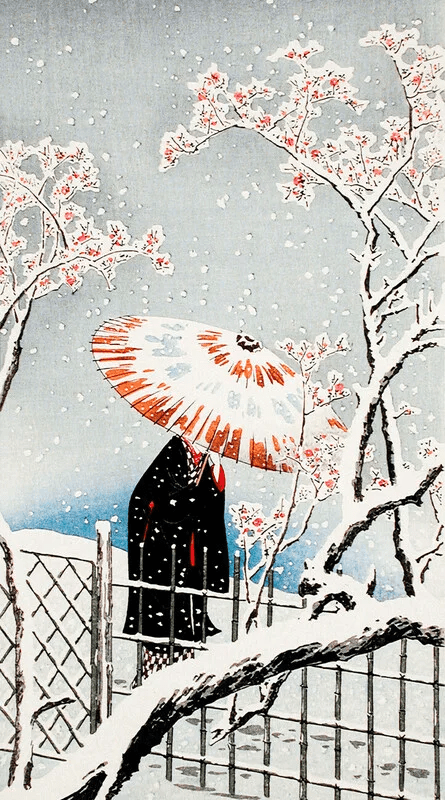
 Painting by Hiroaki Takahashi

Several one-line haiku by Alan Summers

We have a special feature this time around. Here are several commentaries on one-line haiku from Alan Summers’ new book, modŏ – new & selected.

the robin and the snow and the robin’s song again underscored


Commentary by Hifsa Ashraf:

When I read this poem in one go, I feel as if an old vinyl record is playing on a loop, with slight pauses between the music that are almost imperceptible. It is a profound monoku in which the poet sketches a winter scene for us—a season of deep silence, where snow and cold weather often keep people indoors. Yet, winter is also a season of reflection, allowing us to connect more deeply with our inner selves and with nature. Since snow is a familiar part of winter in many regions of the world, connecting one’s emotions with it feels both natural and profound.

The opening word, ‘the’, makes me think of a particular robin. It may be a bird enjoying itself in the snow, or perhaps its song carries a note of sadness or loneliness. Symbolically, I also see the robin as a person seeking solace in nature in whatever way they can. Is the robin connected to deeply personal feelings that resurface each winter? Is it an old longing or desire that has quietly endured over the years and now emerges again in this season? The snow in the background plays an important role in highlighting these thoughts, emotions, moods, and desires. It also evokes a sense of nostalgia—something that keeps returning with the arrival of winter.

‘The snow’, likewise, may represent the familiar qualities associated with winter: silence, loneliness, emptiness, and stillness. Yet, I also see it as a kind of white noise, something vast and difficult to fully grasp. In this sense, the robin and the snow create a yin-yang relationship, complementing and defining one another.

The repetition of and in italics, though less emphasized, together with the recurring presence of the robin and the snow, creates an interesting rhythmic effect in the background. It emphasizes both elements and encourages readers to view them not as separate images but as parts of a unified experience.

The real cut, for me, occurs at ‘again’. The word suggests continuity—something returning time and again, whether through the cycle of the seasons or through recurring personal memories. It is as though the robin’s song repeatedly resurfaces within the snowy landscape. Perhaps it is something a solitary person longs for in winter: a sound that breaks the silence and resonates with their feelings. The song inspires one to join nature’s chorus and find comfort within it. It becomes something impossible to ignore amid the quiet fall of snow.

The haiku concludes with the word ‘underscored’, which shifts our attention from the surface imagery to the deeper music beneath it. Besides the robin’s song and the silence of the snow, there is a hidden harmony created by their interaction. The robin gives voice to the snow, while the snow, in turn, amplifies the robin’s song. The ending carries a subtle melancholy that invites us to reflect on our relationship with nature regardless of the season. At the same time, it offers hope, showing us how silence itself can become a symphony, even when no one else is there to hear it.

The repeated sounds of r, s, o, and n further enhance the musical quality of the monoku, creating a melody that readers can almost hear as they move through the poem.


wintergreen that time spent as Christmas alone


Commentary by Jacob D. Salzer:

It is remarkable how certain scents can transport us back in time to a specific memory (or a collection of memories), in a specific place and circumstance.  In this monoku, the word “alone” could have at least two different interpretations: 1) it could mean that the wintergreen scent is only smelled on Christmas Day with family and/or friends, or 2) Christmas Day was spent alone without the company of family and/or friends. This monoku makes me think of elderly people who live in assisted living homes, memory care facilities, or hospice facilities who may not have family nearby. Although the person referenced in this monoku could also be young and alone for many different reasons. Did the person get stranded in a snowstorm?  Did they experience a tragedy or a flight delay? Did they want to spend Christmas with family but their family members passed away? Does this scent bring back memories when the person celebrated Christmas with family but can no longer do this anymore?  

I also think of a beautiful forest. Perhaps the person spent Christmas in the woods for the first time.

I also appreciate how this monoku shows a disruption in our day-to-day lives, where the Christmas holiday is celebrated (hopefully beyond the capitalist mindset of gifts and money exchange), and where actual relationships are made and nourished beyond the idea of money.

Regardless of our interpretations, it is the wintergreen scent that is remembered, viscerally felt, and re-experienced in this monoku. Perhaps this scent brings a mix of emotions all at once (melancholy, joy, nostalgia, etc.). The wintergreen scent is also strong and powerful (and therefore hard to forget), which (in my mind) translates to strong emotional correlations. What other scents do we recognize, and where do they take us? What mental impressions (samskaras) remain in the subconscious mind from this lifetime (and even past lives) that are associated with various scents? This is a powerful monoku to experience and contemplate.


a single gate faces the forest snow-hinting sky


Commentary by Ron Scully:

Why “a single gate” rather than a double, or another, open or closed? Alan Summers shows deftly the doors, read gate, are one way, one off, and we are stopped by the stand of thick forest, rather than forest bathing, we are on the brink of snow bathing. Quite the piquant piece by a master. Several readings would yield richer reactions.


self-penned obituary again the snow


Commentary by Nicholas Klacsanzky:

Though this monoku is extremely concise, there are at least three ways of reading it. My first interpretation was that the poet, or another person in the poet’s life, is writing an obituary for themselves again, and this act is represented in, or connected to, the snow falling outside. The second look made me think that snow itself might be the obituary that is penned, and that the poet feels (or felt) one with snow; the snow could be falling after the obituary has been read, signifying that nature continues without indifference or reverence. Finally, on the third reading, I saw that a self-penned obituary is perhaps being compared to snowflakes, where variety is present at a focused level, but from far away, it might appear the same.

In any way you read this one-line haiku, the kigo, or seasonal reference, of snow is important. It expresses the mood, the cold, and sometimes the beauty of impending death. Snow can also be a metaphor for the blank page, or erasure. It also adds a layer of sound with “s” that matches the beginning with “self.” Perhaps it is representative of the cycle of life and death. In addition, the “o” sounds in “obituary” and “snow” provide an open feeling as if the person in the poem is welcoming death and ready for it.

The cut to form the two parts of the haiku is felt naturally after either “obituary” or “again.” The word “again” acts as a pivot that can give meaning to both the first and second parts of the haiku.

There is a lot of feeling behind the words and phrasing in this monoku. Not a word or image is out of place. An impactful haiku that calls us to pause and introspect about our relationship with nature, death, and identity.

Publications:

“the robin” previously published in whiptail: journal of the single-line poem, ed. Kat Lehmann & Robin Smith (November 2025)

“a single gate” previously published in haikuKATHA 52 (January 2026) Founder/Managing Editor: Kala Ramesh

“self-penned obituary” previously published in whiptail: journal of the single-line poem, ed. Kat Lehmann & Robin Smith (November 2025)

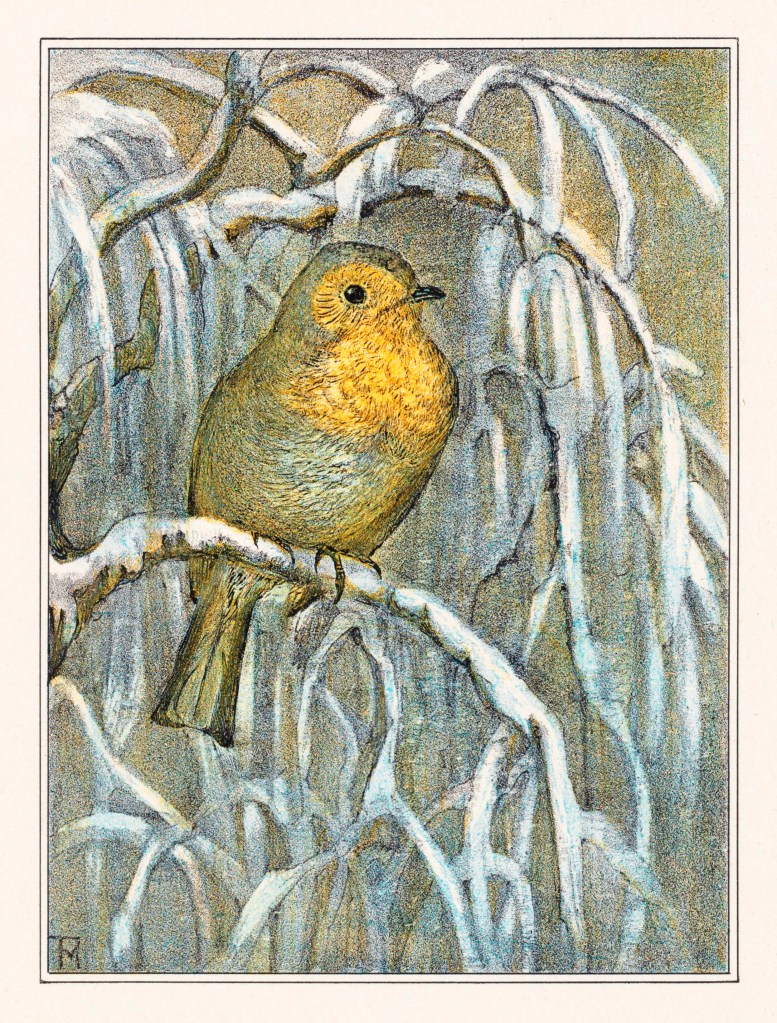
Roodborstje op besneeuwde boomtak (1878–1910) print in high resolution by Theo van Hoytema. Original from The Rijksmuseum. Digitally enhanced by rawpixel.